Devprayag - Sacred Confluence in Uttarakhand

Devprayag is the town in Uttarakhand where the Alaknanda and Bhagirathi rivers meet — and where the combined stream is called the Ganga for the very first time. Sitting in the Tehri Garhwal hills, it's the last of the five sacred Panch Prayag confluences and a stop almost every road-based Char Dham traveller passes through on the way to Badrinath. People come here to bathe at the sangam, pray at the centuries-old Raghunathji Temple, or simply sit by the water and watch two very different rivers become one. If you're driving the Rishikesh–Badrinath highway, you'll pass through Devprayag whether you plan to stop or not — so it helps to know what's worth seeing, how long to stay, and what to be careful about.
Devprayag sits in Tehri Garhwal district at roughly 830 m altitude (town level), about 74 km from Rishikesh and 90–116 km from Dehradun's Jolly Grant Airport (sources vary on the exact route measured). It's the point where the Alaknanda and Bhagirathi rivers merge to form the Ganga. Most travellers need half a day here — enough for the sangam, Raghunathji Temple, and a walk through the old town.
Why Devprayag Is a Special Place for Pilgrims
- Devprayag holds deep spiritual importance for Hindu pilgrims and is a main halt on the Panch Prayag circuit.
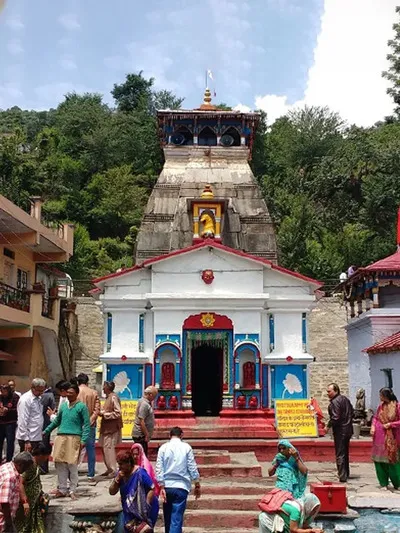
- Its central temple, Raghunathji Mandir, has stood here for centuries and remains the town's spiritual anchor.
- The pandas (hereditary priests) of Badrinath Dham live in Devprayag, adding to its religious weight.
- This is the exact spot where the Alaknanda and Bhagirathi rivers merge and take the name Ganga.
- The Bhagirathi itself originates far upstream at Gaumukh, at the snout of the Gangotri Glacier.
- Local tradition holds that Lord Ram and King Dashrath meditated in Devprayag.
- Many pilgrims take a ritual dip at the sangam — the current here is genuinely strong, so always bathe at the designated, chain-secured spot and never alone.
Devprayag at a Glance
| Detail | Information |
|---|---|
| District | Tehri Garhwal, Uttarakhand |
| Town elevation | 472 m per Tehri Garhwal district administration (see note below) |
| Rivers | Alaknanda + Bhagirathi → Ganga |
| Highway | NH 7, formerly numbered NH 58 before India's 2010 highway renumbering |
| Distance from Rishikesh | ~74 km (~2 hours) |
| Distance from Jolly Grant Airport | 90–116 km depending on source/route (verify current route before travel) |
| Nearest functioning railhead | Rishikesh Railway Station (~74 km); Haridwar has better long-distance connections |
| Best time to visit | March–June and September–November |
A note on elevation: the Tehri Garhwal district administration's own tourism page lists Devprayag at 472 m. Wikipedia lists 830 m for the same town, and a couple of temple-specific pages cite 618 m. That's a real spread, not a typo on anyone's part — it most likely comes from different sources measuring different points (town centre versus the riverbed at the confluence) rather than one figure being correct and the rest wrong. This page uses 472 m as the primary figure because it comes from the district government directly, and flags the 830 m figure since it's what most other sites, including Wikipedia, report.
Devprayag — A Holy Place Full of History
For centuries, Devprayag has been a resting point for saints, sadhus, and pilgrims travelling the Char Dham route toward Badrinath.
Local tradition holds that in the 7th century, Devprayag existed as three separate settlements — Brahmapuri, Brahma Teerth, and Srikhand Nagar — which later merged into one town. This detail is repeated widely across regional tourism accounts, but it isn't backed by a verifiable historical source, so it's worth treating as local lore rather than settled fact — though it's genuinely part of what locals will tell you if you ask.
What's well documented is the earthquake of September 1, 1803 — a major Himalayan quake estimated at magnitude 7.8 — which badly damaged Devprayag along with several other Garhwal towns. The Raghunathji Temple and much of the town were shattered; repairs were later carried out with support from Daulat Rao Sindhia. Local belief credits the sage Dev Sharma — after whom the town is named — with a vision of Lord Vishnu here and a central role in the town's spiritual revival following the disaster. Because of this blend of natural beauty and rebuilt sacred history, Devprayag is often called the "Gem of Uttarakhand."
The Story of the Bhagirathi and Alaknanda Rivers
At Devprayag, the Bhagirathi and Alaknanda physically merge to form the Ganga.
Bhagirathi
Originates at Gaumukh, the snout of the Gangotri Glacier, at nearly 3,900 m elevation, and drops about 205 km through Gangotri and Uttarkashi before reaching Devprayag. Named after King Bhagirath, who in Hindu tradition performed severe penance to bring the goddess Ganga to earth. At the sangam you can usually pick out its greenish-blue water, especially once monsoon silt settles.
Alaknanda
Rises from the Satopanth and Bhagirath Kharak glaciers near Badrinath and picks up the Saraswati river close to Mana village. From there it flows past Vishnuprayag, Nandprayag, Karnaprayag, and Rudraprayag — collecting three other sacred confluences — before reaching Devprayag over a course of roughly 195 km. It usually carries more silt, giving it a muddier tone that contrasts with the Bhagirathi. This stretch is also a well-known base for white-water rafting.
| Feature | Bhagirathi | Alaknanda |
|---|---|---|
| Origin | Gaumukh, Gangotri Glacier | Satopanth & Bhagirath Kharak glaciers |
| Approx. length to Devprayag | 205 km | 195 km |
| Water colour | Greenish-blue | Muddy/brownish |
| Passes through | Gangotri, Uttarkashi | Badrinath, Vishnuprayag, Nandprayag, Karnaprayag, Rudraprayag |
| Known for | The scriptural "source stream" of the Ganga | River rafting and adventure sports |
Best Time to Visit Devprayag
- March–June: Warm days, cool evenings, clear mountain views. Peak Char Dham season, so expect heavy through-traffic — book ahead if staying overnight.
- July–early September: Monsoon brings landslide risk along NH 7 and a much stronger river current. Sangam bathing gets riskier and road delays are common.
- September–November: Generally the best window — air clears after the rains, river flow stabilises, hills look their greenest. Good for photography and calmer temple visits.
- December–February: Cold but usually dry and clear at Devprayag's relatively lower altitude (unlike Badrinath or Kedarnath, it doesn't get snowed in). Quiet, budget-friendly, but pack warm layers.
How to Reach Devprayag
By Flight
Jolly Grant Airport near Dehradun is the nearest airport, with regular flights to and from Delhi. Sources give different distances (roughly 90–116 km), so check your specific route on the day rather than relying on one fixed number. Expect a 3–4 hour drive.
By Rail
Rishikesh Railway Station (~74 km away) is currently the nearest functioning railhead, though it has limited long-distance trains. Haridwar Junction, about 24 km further, has far better connections to major Indian cities and is a more practical railhead for most travellers.
Worth knowing: the under-construction Rishikesh–Karnaprayag rail line is planned to include a station at Devprayag as part of a 125-km route designed to bring trains close to the Char Dham circuit for the first time. As of late 2025, the Devprayag station package was still in the tendering phase, and the project's revised completion target has moved to around December 2028. A genuine upgrade to watch for — but don't plan a near-term trip around it.
By Road
Devprayag sits directly on NH 7 (still commonly called NH 58 locally, its pre-2010 number), so it's easy to reach by road. Regular buses run from Delhi's ISBT Kashmiri Gate toward Rishikesh and onward to Devprayag; taxis are available from Dehradun, Haridwar, Rishikesh, and Srinagar (Garhwal). During peak Yatra season (April–June), expect single-lane sections and slow convoy traffic near river crossings.
| Route | Approx. Distance |
|---|---|
| Rishikesh → Devprayag | ~74 km |
| Haridwar → Devprayag | ~95 km |
| Devprayag → Srinagar (Garhwal) | ~34 km |
| Devprayag → Rudraprayag | ~69 km |
Devprayag on the Char Dham Yatra Route
Devprayag isn't one of the four main Char Dham shrines, but it sits directly on NH 7 between Rishikesh and Srinagar, so nearly every road-based Yatra passes through it. Many pilgrims treat it as a natural first stop before the climb toward Badrinath.
- Registration for the Char Dham Yatra is mandatory and free, done online via the official Uttarakhand Tourism portal (registrationandtouristcare.uk.gov.in).
- In the 2026 season, registration opened on March 6. Yamunotri and Gangotri opened together on Akshaya Tritiya (April 19), Kedarnath opened April 22, and Badrinath opened April 23.
- Shrines typically close for winter around Bhai Dooj (Yamunotri, Gangotri, Kedarnath) and Vijaya Dashami (Badrinath), usually late October–November.
- Exact dates shift each year based on the Hindu calendar — always confirm the current year's schedule before booking.
- If stopping at Devprayag during peak season (May–June), build in extra time for slower hill-road traffic.
Things to Do in Devprayag
- Pilgrimage and temple visits — the sangam, Raghunathji Temple, and Dashrath Shila can be covered in a few unhurried hours.
- Trekking and river rafting — short treks in the surrounding hills, and the Alaknanda stretch near Devprayag is popular for rafting. Use certified, registered operators only.
- Meditation and quiet time — the setting (hills on both sides, two rivers meeting below) makes for a genuinely calm stop.
- River bath at the sangam — spiritually significant and worth doing, but only at the designated, chain-secured ghat.
Places to Visit In and Around Devprayag
Raghunathji Temple
Sits on a terrace above the town, where Lord Vishnu is worshipped as Lord Ram and Goddess Lakshmi as Sita. It's one of the 108 Divya Desams associated with Vishnu worship, and local tradition credits Adi Shankaracharya with its founding or sanctification. From the temple courtyard you get a clear view down to the confluence.
Dashrath Shila
A rock formation where King Dashrath is believed to have prayed during the Ramayana period. A nearby hill, Dashrath Panchal Peak, is named after him.
Teen Dhara
About 10 km along the Rishikesh–Devprayag road, named after three small streams flowing from nearby lakes. A popular roadside halt with dhabas — a nice place to break the journey.
Kyunkaleshwar Mahadev Temple
This 8th-century Shiva temple near Pauri, said to have been established by Adi Shankaracharya, is sometimes listed alongside Devprayag sightseeing — but it's genuinely ~44 km / about 1.5 hours away near Pauri town, not a walkable Devprayag attraction. Worth the drive if you have a spare half-day and want sweeping Alaknanda Valley views, but plan for it as a separate excursion, not a quick add-on.
Accommodation in Devprayag
Devprayag is a small pilgrim town — options are simple rather than luxurious:
- GMVN Tourist Rest House — a government-run guest house, in operation since 1919, offering basic economy rooms (some with common bath), located a couple of kilometres from the bus stand, with an on-site restaurant.
- Ashrams and dharamshalas — very basic, low-cost stays with a spiritual atmosphere, common for pilgrims.
- A handful of small budget hotels and lodges in and around the town.
On pricing: I couldn't find a consistently published, reliable tariff for GMVN Devprayag or local lodges — online listings show inconsistent "starting from" rates that look like OTA markups rather than official prices. Rather than quote a number that might be wrong, the honest guidance is: book through GMVN's official channel or a registered operator, and confirm current rates directly, especially if travelling during the April–June Yatra rush when demand (and prices) rise.
Safety at the Sangam
The meeting point of the Alaknanda and Bhagirathi is beautiful, but it's a real river confluence, not a controlled pool. The current strengthens noticeably during and right after monsoon season. Bathe only at the marked, chain-secured ghat, keep children within arm's reach, and skip the dip entirely if the water looks unusually high or fast. The ghat steps can be slippery — sturdy footwear helps, especially for elderly travellers.
Common Mistakes to Avoid
- Bathing outside the designated ghat — the current away from the chain-secured spot is genuinely risky.
- Assuming Kyunkaleshwar Temple is "in" Devprayag — it's a separate ~44 km excursion near Pauri.
- Treating Devprayag as a 15-minute photo stop — a proper visit (sangam, temple, a short walk) takes at least 2–3 hours.
- Not checking monsoon road conditions — landslide-related closures on NH 7 are common between July and early September.
- Assuming card/UPI works everywhere — small dhabas and ashrams in Devprayag are often cash-only.
Frequently Asked Questions
Q1. Where is Devprayag located?
Devprayag is a town in Uttarakhand's Tehri Garhwal district, where the Alaknanda and Bhagirathi rivers meet to form the Ganga.
Q2. Which two rivers meet at Devprayag?
The Alaknanda and the Bhagirathi. Once they merge, the combined river is called the Ganga.
Q3. How far is Devprayag from Rishikesh?
About 74 km by road, roughly a 2-hour drive along NH 7.
Q4. Is there a railway station at Devprayag?
Not currently — the nearest functioning stations are Rishikesh (~74 km) and Haridwar (better long-distance connectivity). A station at Devprayag is planned as part of the under-construction Rishikesh–Karnaprayag rail line, though full project completion isn't expected before around 2028.
Q5. Is it safe to bathe at the Devprayag sangam?
Yes, but only at the designated, chain-secured ghat. The current elsewhere at the confluence is strong, especially during and after monsoon.
Q6. What is the best time to visit Devprayag?
September to November for clear views and stable river flow; March to June is pleasant but coincides with peak Char Dham crowds. Avoid the July–early September monsoon window if possible.
Q7. How many days are needed to explore Devprayag?
Half a day to a full day for the sangam, Raghunathji Temple, and a walk through town. Add a second day if including a Kyunkaleshwar Temple excursion.
Q8. Can tourists try adventure activities in Devprayag?
Yes — the Alaknanda stretch nearby is used for white-water rafting, and short treks are available in the surrounding hills. Book through certified, registered operators.
Q9. Is Devprayag part of the Char Dham Yatra?
It isn't one of the four main shrines, but it sits directly on the road route to Badrinath, so most pilgrims pass through and many stop for the sangam and temple visit.
Q10. Where can I stay in Devprayag?
GMVN's Tourist Rest House, a few ashrams/dharamshalas, and a small number of budget hotels. Confirm current rates directly, especially during the April–June season.
Q11. Is Kyunkaleshwar Mahadev Temple inside Devprayag town?
No — it's near Pauri, roughly 44 km / 1.5 hours from Devprayag. Worth the detour, but plan it as a separate trip.
Conclusion
Devprayag is a small town that carries an outsized amount of history, faith, and natural drama — two rivers with completely different characters becoming one right in front of you. Whether you stop for twenty minutes on the way to Badrinath or spend a full day exploring the temples and old lanes above the ghat, it rewards anyone who slows down for it. With NH 7 running straight through and a rail project on the horizon, getting here is only going to get easier. Plan around the September–November window if you can, respect the river's current at the sangam, and Devprayag will likely end up one of the more memorable stops on your Char Dham journey — not just a highway pause.
Chardham Travel Guide
Chardham Travel Packages
Hotels in Chardham
Beware of Fake Char Dham & Kedarnath Helicopter Booking Websites
Fake websites, WhatsApp accounts and advertisements may impersonate genuine travel companies or helicopter operators. Always verify before paying.