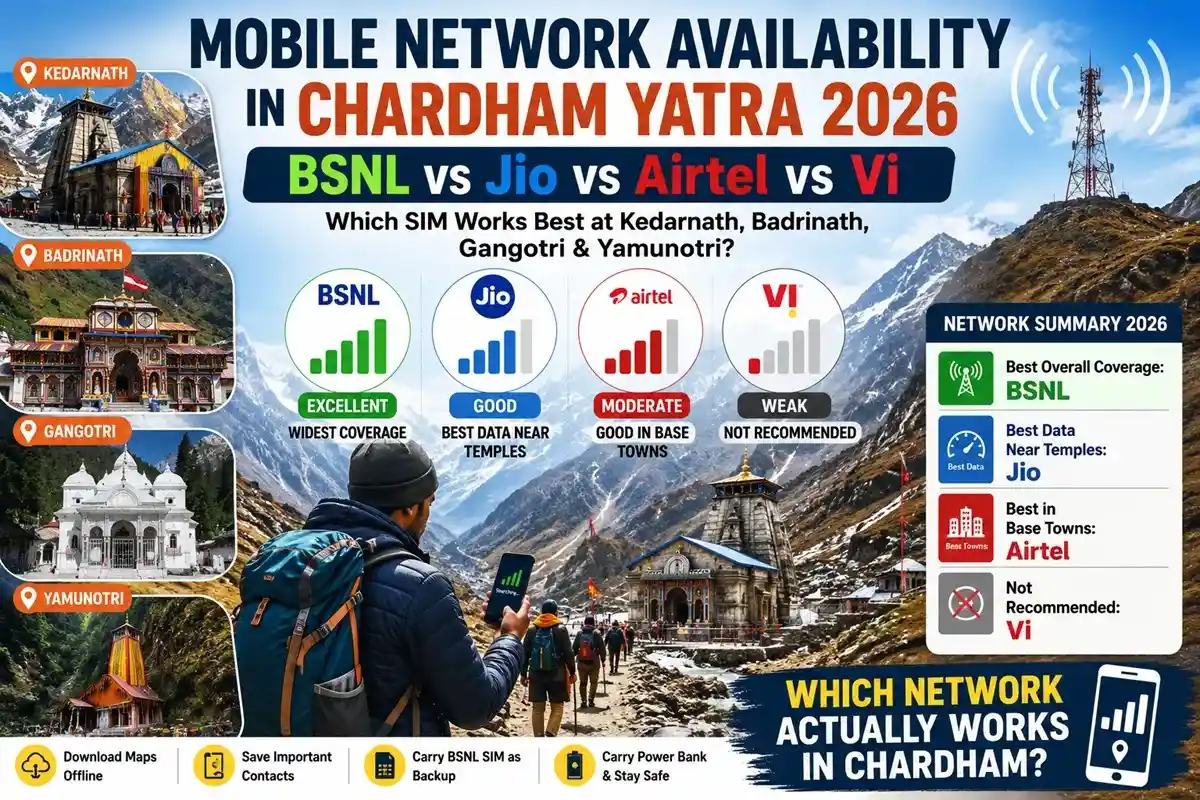
Mobile Network Availability in Chardham Yatra 2026: BSNL vs Jio vs Airtel vs Vi
You are 10 km into the Kedarnath trek, somewhere between Jungle Chatti and Bheembali, when the bars on your phone quietly disappear. You try to send a location pin to your family. Nothing. You try to call. Nothing. For pilgrims from cities where mobile connectivity is taken for granted, this is the moment they wish they had read the mobile network guide before leaving home.
Mobile connectivity in the Chardham circuit — Kedarnath, Badrinath, Gangotri, and Yamunotri — is one of the most searched and least clearly answered questions in Chardham Yatra planning. The confusion is understandable: the network situation is genuinely complex, differs dramatically from dham to dham and from one kilometre to the next, and changes every season as telecom infrastructure is upgraded.
This guide gives you the honest, verified 2026 picture: which operator works where, what type of signal to expect at each dham, what has changed with BSNL’s 4G rollout and Jio’s new small-cell deployments, and what every pilgrim must do before leaving home to stay connected and safe.
Quick OverviewBSNL is the most reliable network across all four dhams — especially for voice calls in remote areas like Kedarnath and Yamunotri. Jio offers the best data speeds near the Kedarnath and Badrinath temple areas, but drops on trek routes. Airtel works well in base towns (Joshimath, Uttarkashi, Rudraprayag) but is inconsistent at the main shrine sites. Vi (Vodafone-Idea) is not recommended for the Chardham route. Practical recommendation: Carry a BSNL SIM as your primary or backup SIM if your regular network is Airtel, Jio, or Vi. BSNL SIM available at Haridwar Railway Station counter at approximately Rs. 200 with instant activation. |
Key Takeaways — Chardham Mobile Network 2026
|
Why Mobile Connectivity Is Genuinely Difficult in Chardham
The four Chardham dhams are among the highest permanently inhabited or seasonally accessible religious sites in the world. Kedarnath is at 3,583 metres. Badrinath is at 3,133 metres. Gangotri is at 3,048 metres. Yamunotri is at 3,291 metres. All four sit in deep Himalayan valleys surrounded by ridges that block line-of-sight signal propagation.
Telecom towers in these locations face extreme operational challenges: temperatures below -20°C in winter require heated equipment cabinets; power supply is unreliable and often depends on diesel generators that must be refuelled by mule in some locations; the towers themselves were destroyed in the 2013 Kedarnath floods and rebuilt; and the six-month seasonal operation window (April–November) limits the time available for upgrades and maintenance.
During peak season, the problem compounds. On days when 32,000 pilgrims simultaneously attempt voice calls and WhatsApp messages, even a tower with four times the usual capacity becomes congested. Signal bars on your phone show coverage — they do not show whether the tower has the capacity to handle your call or data request at that moment.
What ‘Coverage’ Actually Means in Chardham
|
Operator-by-Operator Analysis for Chardham 2026
BSNL — The Most Reliable Choice
BSNL (Bharat Sanchar Nigam Limited) has the widest and most consistent coverage across the entire Chardham circuit. This is not a legacy or outdated recommendation — BSNL’s mountain coverage advantage is structural. Its towers were built to serve remote Himalayan areas as part of India’s universal service obligation, while private operators focused on urban and semi-urban markets.
At Kedarnath and Yamunotri — the two most remote dhams — BSNL is often the only functional network. At Gangotri, BSNL works reliably at Gangotri town and up to Gangotri temple. On the Gangotri route, private operators work up to Uttarkashi; beyond Bhatwari, BSNL is the only reliable option. At Badrinath, BSNL provides stable voice connectivity, with 3G data in the temple area.
BSNL 4G rollout context for 2026: As of September 2025, PM Modi launched 97,500 indigenous 4G towers nationally under the Atmanirbhar Bharat programme. BSNL had 97,068 towers installed and 93,511 on-air by October 31, 2025. The government confirmed BSNL’s 4G network has been stabilised (Communications Ministry statement, May 23, 2026). However, rural and high-altitude Uttarakhand conversions to 4G are ongoing. Voice and 2G/3G data remain the practical reality at most Chardham sites for the 2026 season; 4G data availability at Kedarnath from BSNL is improving but not universally consistent.
Where to buy BSNL SIM: BSNL counter outside Haridwar Railway Station (approximately Rs. 200, instant activation). Also available in Rishikesh market and at Uttarkashi town.
Reliance Jio — Best Data Near Temple Areas
Jio has made the most significant infrastructure investment in Chardham connectivity among private operators over 2025–26. Jio deployed additional small cells and satellite backhaul specifically near Kedarnath Base Camp to handle the surge in pilgrim footfall. Near the Kedarnath temple area, Jio provides limited 4G — and in some spots, 5G — data connectivity.
In 2023, the government launched the 2,00,000th 5G site at Gangotri, with Union Communications Minister Ashwini Vaishnaw and CM Pushkar Singh Dhami present — the ceremony included 5G coverage being announced for all four Chardham sites. Jio and Airtel both participated in this rollout. In practice, 5G functionality at the high-altitude sites has been limited; 4G is more realistic and consistent.
Jio works well and provides decent 4G in base towns including Badrinath town, Uttarkashi, Joshimath, Rudraprayag, and Guptkashi. On the Kedarnath trek route (Gaurikund to Kedarnath), however, Jio signal drops frequently and unreliably — you may have signal at one point and none 200 metres later. The Gangotri-Yamunotri route sees Jio working up to Uttarkashi and intermittently at Harsil (Gangotri route), but not reliably beyond.
Verdict on Jio for Chardham: Good for base towns and data near temple areas. Unreliable on trek routes and at Yamunotri. Carry BSNL as backup for voice reliability on the trail.
Bharti Airtel — Strong at Base Towns, Inconsistent at Shrines
Airtel provides good 4G coverage in the major base towns and transit hubs on the Chardham route — Haridwar, Rishikesh, Dehradun, Rudraprayag, Uttarkashi, and Joshimath. Airtel was the first private operator to restore connectivity at Kedarnath after the 2013 floods and has consistently maintained some presence at all four dhams.
However, Airtel’s performance at the actual shrine sites — particularly Kedarnath and Yamunotri — is inconsistent. Airtel may work at Sonprayag and Gaurikund, but signal is unreliable near the Kedarnath temple. At Yamunotri, Airtel is described as virtually non-existent on the trail and at the temple. At Badrinath and Gangotri — lower-altitude sites with better line-of-sight — Airtel performs more reliably.
Verdict on Airtel for Chardham: Use Airtel for the transit journey (Haridwar → Rishikesh → base towns). Do not rely on Airtel as your only network above Gaurikund on the Kedarnath route or on the Yamunotri trail.
Vi (Vodafone-Idea) — Not Recommended
Vi has very limited coverage on the Chardham route and is consistently not recommended by multiple verified sources for pilgrims. Vi’s network infrastructure in Uttarakhand’s remote mountain areas is minimal. The operator has faced financial and operational challenges that have affected rural and mountain network investment. At the Chardham dham sites themselves, Vi has effectively no reliable presence.
If Vi is your primary SIM, carry a BSNL or Jio SIM specifically for the Chardham journey. Do not attempt the pilgrimage relying solely on Vi for emergency calls.
Master Network Comparison Table — All Four Dhams 2026
| Location / Route Point | BSNL | Jio | Airtel | Vi | Best Choice |
| Haridwar / Rishikesh (base) | 4G Good | 4G Excellent | 4G Excellent | 4G Limited | Any; Airtel/Jio best here |
| Dehradun / Jolly Grant Airport | 4G Good | 4G/5G Excellent | 4G/5G Excellent | 3G Limited | Airtel or Jio |
| Rudraprayag (Kedarnath route) | 4G Good | 4G Good | 4G Good | 2G/Weak | Any; all work here |
| Guptkashi / Sitapur | 3G/4G Reliable | 4G Good | 4G Good | Weak/None | BSNL or Jio |
| Sonprayag | 2G/3G Reliable | 3G/4G Intermittent | Intermittent | None | BSNL |
| Gaurikund (trek start) | 2G Reliable | 3G Intermittent | Weak | None | BSNL |
| Kedarnath Trek Route (mid) | 2G Intermittent | Drops frequently | None/Very Weak | None | BSNL (best available) |
| Kedarnath Temple Area | 2G/3G Voice Reliable | 4G/5G limited (near temple) | Weak/Unreliable | None | BSNL for voice; Jio for data |
| Uttarkashi (Gangotri route) | 4G Good | 4G Good | 4G Good | Weak | Any; Jio/Airtel best here |
| Bhatwari (Gangotri route) | 2G/3G Reliable | Intermittent | Weak | None | BSNL |
| Harsil (Gangotri route) | 2G/3G Reliable | Intermittent (reported 2026) | None | None | BSNL |
| Gangotri Temple | 2G/3G Reliable | Weak/Intermittent | None | None | BSNL |
| Joshimath (Badrinath route) | 4G Good | 4G Good | 4G Good | Weak | Any; Airtel/Jio best |
| Badrinath Temple Area | 3G/4G Reliable | 4G Good | Moderate/Intermittent | None | BSNL or Jio |
| Mana Village (“First Indian Village”, near Badrinath) | 2G/Voice Only | None/Weak | None | None | BSNL only |
| Barkot (Yamunotri route) | 3G/4G Reliable | 3G/4G Good | 3G Good | None | BSNL or Jio |
| Janki Chatti (Yamunotri trek start) | 2G Reliable | Weak/None | None | None | BSNL |
| Yamunotri Trek Route | BSNL only — voice | None | None | None | BSNL — only option |
| Yamunotri Temple | 2G/Voice Only (BSNL) | None | None | None | BSNL — only option |
Dham-by-Dham Network Guide
Kedarnath — Most Challenging Connectivity
Kedarnath presents the most difficult connectivity environment of the four dhams. The temple sits at 3,583 metres in a bowl-shaped valley flanked by ridges on multiple sides. The 16 km trek route from Gaurikund passes through terrain where signal propagation is blocked by the mountain walls for large sections.
BSNL is the only operator that provides consistent voice call capability throughout the Kedarnath trek route and at the temple campus. Even BSNL voice calls can require multiple attempts in poor weather or during peak-congestion hours. Data from BSNL on the trek is 2G at best, and intermittent.
Jio has specifically upgraded its infrastructure near the Kedarnath Base Camp area for the 2025–26 season — small cells and satellite backhaul deployment means 4G data is available near the temple campus with some reliability. However, this improvement does not extend down the 16 km trek route. Jio signal will drop as you ascend above Gaurikund and may not reappear until near Linchauli or the Base Camp.
Airtel and Vi have very limited to no reliable coverage above Gaurikund.
Kedarnath Connectivity Reality — What Pilgrims Report in 2026
|
Badrinath — Best Connectivity Among the Four Dhams
Badrinath, at 3,133 metres and situated in the Alaknanda valley with fewer extreme terrain obstructions, has the best mobile connectivity of the four Chardham sites. The town of Badrinath itself (not just the temple) has seen consistent network investment because of its strategic location near the Mana Pass area and the nearby ITBP (Indo-Tibetan Border Police) presence.
Jio provides good 4G connectivity in Badrinath town and near the temple area. BSNL provides reliable voice and 3G data. Airtel works moderately in Badrinath town but can be inconsistent at the temple itself. Beyond Badrinath — at Mana village (3,200 m), now officially the “First Indian Village” of India (renamed from “Last Indian Village” by the government in 2022, BRO signboard installed April 2023) — only BSNL voice is available.
The Joshimath–Badrinath corridor (approximately 43 km) has good multi-operator coverage for most of its length. Joshimath town (1,875 m) has excellent multi-operator 4G and is a good final charging and download point before ascending to Badrinath.
Gangotri — BSNL Beyond Uttarkashi, Mixed Below
The Gangotri route runs from Rishikesh through Tehri, Chamba, and Uttarkashi to Gangotri (3,048 m). Mobile connectivity follows a clear geography: excellent and multi-operator up to Uttarkashi; decreasing beyond Uttarkashi; BSNL-dominant from Bhatwari onwards; BSNL-only at Gangotri itself.
Jio and Airtel provide good 4G in Uttarkashi town. Between Uttarkashi and Bhatwari, Jio has been reported intermittently in 2026. At Harsil (2,620 m, approximately 25 km before Gangotri), Jio works intermittently — some pilgrims report connectivity, others do not. Beyond Harsil at Dharali and Bhairon Ghati, BSNL is the practical choice. At Gangotri itself, BSNL provides voice and 2G/3G data.
An important fact for planning: the government dedicated optical fibre connectivity for all Chardham sites including Gangotri in a 2023 ceremony. This backhaul improvement helps all operators, but the last-mile connectivity at high altitude still depends on tower placement and terrain.
Gangotri route practical rule: Download offline maps before leaving Uttarkashi. Beyond Bhatwari, do not rely on anything other than BSNL for voice calls.
Yamunotri — BSNL Only Above Barkot
Yamunotri is the most network-isolated of the four dhams. Janki Chatti, the trek starting point at 2,650 metres, has only BSNL voice connectivity — 2G only according to verified pilgrim reports (PlanYourPackage.com, March 2026). Private operators Jio and Airtel are described as ‘virtually non-existent on the trail’.
The 6 km trek from Janki Chatti to Yamunotri temple (3,291 m) has no reliable private network coverage at any point. At the temple itself, only BSNL provides intermittent voice. Data connectivity at Yamunotri is not practically available from any operator.
Barkot (approximately 50 km from Janki Chatti) is the last town with good multi-operator coverage — Jio and BSNL both provide 3G/4G at Barkot. Carry a printed copy of your Yatra e-pass specifically because of weak signal at Janki Chatti — ‘mobile signal is weak on the trail’ per the official Yamunotri Trek Guide 2026 (udanaviation.in, March 2026).
BSNL 4G Rollout 2026: What It Means for Chardham Pilgrims
BSNL’s 4G rollout is one of the biggest telecom stories in India for 2025–26. Here is the verified status and what it means practically for Chardham connectivity:
| Milestone | Date | Source |
| BSNL 4G supply begins, first sites in Punjab/Haryana/HP/Uttarakhand | September 2023 | Business Standard, July 2024 |
| BSNL reaches 62,000+ 4G towers installed | Early 2025 | RCR Wireless, January 2025 |
| PM Modi launches 97,500 indigenous 4G towers nationally | September 27, 2025 | NewsonAir.gov.in |
| 97,068 towers installed, 93,511 on-air as of October 31, 2025 | October 2025 | RCR Wireless, December 2025 |
| BSNL 4G network stabilised — Communications Ministry announcement | May 23, 2026 | ChannelIAM.com (ANI source) |
| BSNL plan for 5G: upgrade existing 4G sites (no new hardware needed) | December 2025 onwards | RCR Wireless, December 2025 |
What this means for Chardham pilgrims: BSNL’s 4G rollout is specifically targeting Uttarakhand hill stations under the Atmanirbhar Bharat programme. Existing BTS towers are being converted to 4G-capable equipment. For the 2026 season, 4G data from BSNL is available at many base towns and improving gradually at higher altitudes. However, the practical reality at Kedarnath and Yamunotri temple sites during peak 2026 season remains voice and 2G/3G — not consistent 4G data.
The network improvement trajectory is positive. By 2027, BSNL 4G at Kedarnath and Badrinath may be consistently available. For 2026, plan around voice reliability rather than data capability for BSNL at the remote dham sites.
2026 Infrastructure Highlights Verified from Official Sources
|
Practical Connectivity Tips for Chardham Pilgrims 2026
Before Leaving Home
- Download offline Google Maps for the entire route — from your home city to each dham. Maps app → search area → download offline. Do this when on good WiFi.
- Save all critical numbers offline: SDRF helpline (1070), District Control Room Rudraprayag (0135-2722002), your hotel numbers at each stop, family emergency contacts.
- Download your Yatra e-pass as a local photo on your phone — do not rely on loading it from an app or browser at Janki Chatti or Gaurikund.
- If your SIM is Jio, Airtel, or Vi: buy a BSNL prepaid SIM before departure. Available at Haridwar Railway Station BSNL counter, approximately Rs. 200, with instant activation.
- Inform family of your day-wise itinerary before leaving — so they know when to expect silence from you (trek days) and when to expect contact (base town nights).
On the Route
- Last reliable multi-operator download point on Kedarnath route: Guptkashi or Sitapur. Download everything here.
- Last reliable multi-operator point on Gangotri route: Uttarkashi. Download everything here.
- Last reliable point on Yamunotri route: Barkot. Download everything here. Beyond Barkot, BSNL only.
- For Badrinath: Joshimath is the last strong multi-operator coverage point before Badrinath. Use it for downloads and family updates.
- Peak-season congestion hack: make important calls in the early morning (before 6 AM) or after 8 PM when tower load is lowest.
- If BSNL voice call fails: try SMS instead — SMS delivery often succeeds even when voice calls cannot connect. WhatsApp text messages (not voice/video) also often go through on low-data connections.
At the Temple Sites
- Kedarnath: BSNL for emergency voice calls; Jio for data near the temple campus. Accept that the trek route is a digital black hole.
- Badrinath: Both BSNL and Jio work reliably. Use either for family updates. Last data point before Mana village is Badrinath town.
- Gangotri: BSNL for voice at the temple. Guest houses near Gangotri sometimes offer WiFi — ask on arrival.
- Yamunotri: BSNL voice only, intermittent. Plan family communication around your Barkot or Janki Chatti check-in, not from the temple.
- Mobile phone ban at Kedarnath temple: phones must be deposited at the cloakroom before entering the temple premises. This applies inside the temple boundary only.
Power and Device Management
- Carry a power bank with at least 2 full phone charges. Electricity at Kedarnath and Yamunotri is unreliable and limited hours.
- Airplane mode saves battery: switch to airplane mode on sections where you know there is no signal (trek routes) — constant signal searching drains battery extremely fast.
- At high altitude, cold reduces battery performance significantly. Keep your phone in an inner pocket close to your body during the trek.
- Charge all devices fully at Guptkashi (Kedarnath), Joshimath (Badrinath), Uttarkashi (Gangotri), and Barkot (Yamunotri) before the final push to the dham.
WiFi Options at Chardham Sites
WiFi is available at select locations along the Chardham route — primarily in hotels, guesthouses, and some government rest houses. Connectivity quality varies but WiFi can supplement poor mobile data when available.
| Location | WiFi Availability | Quality | Best Use |
| Haridwar / Rishikesh | Widespread in hotels | Good to excellent | Heavy downloading; video calls before yatra |
| Guptkashi (Kedarnath route) | Most mid-range hotels | Moderate | Final download point; family video call |
| Badrinath town | Select hotels / lodges | Moderate | Family updates; data backup |
| Gangotri (near temple) | Select guesthouses | Weak / variable | Useful if mobile data fails; WhatsApp messages |
| Kedarnath temple campus | GMVN camps (very limited) | Very weak / unreliable | Emergency use only; do not count on it |
| Yamunotri area | Extremely limited | Very weak if available | Not reliable — plan without WiFi here |
Operator Scorecard — Chardham Yatra 2026
| Operator | Voice Reliability | Data Availability | Trek Route Coverage | Base Town Coverage | Recommendation |
| BSNL | ★★★★★ Best | ★★★ (2G/3G; improving 4G) | ★★★★★ Only reliable option on trails | ★★★★ Good | Carry as primary or backup SIM — essential |
| Jio | ★★★ Near temples | ★★★★ Near temples/towns | ★★ Drops on trek routes | ★★★★★ Excellent | Good for data near temples; unreliable on trails |
| Airtel | ★★★ Base towns | ★★★★ Base towns | ★ Weak above Gaurikund/Janki Chatti | ★★★★★ Excellent | Good transit SIM; not for remote shrine sites |
| Vi | ★ Very limited | ★ Very limited | ✗ Not reliable anywhere on route | ★★ Limited | Not recommended — carry BSNL or Jio instead |
Frequently Asked Questions
Q1. Which is the best SIM for Kedarnath Yatra 2026?
BSNL is the best SIM for voice calls on the Kedarnath trek and at the temple. BSNL is the only operator that provides consistent voice connectivity on the 16 km Gaurikund-to-Kedarnath trail and at the temple campus. Jio is a good secondary option for data near the temple area itself. If you already have Jio or Airtel, carry a BSNL prepaid SIM as backup — available at Haridwar Railway Station for approximately Rs. 200.
Q2. Does Jio work at Kedarnath in 2026?
Jio works near the Kedarnath temple area and Base Camp with limited 4G/5G data — a genuine improvement from Jio’s 2025–26 small cell and satellite backhaul deployment. However, Jio signal drops frequently on the 16 km trek route between Gaurikund and Kedarnath. Expect unreliable or no Jio connectivity between Gaurikund and Linchauli. Near the temple itself, Jio is functional for WhatsApp and data in good weather.
Q3. Does Airtel work at Kedarnath?
Airtel works in base towns — Sonprayag and Gaurikund may have Airtel signal — but becomes unreliable above Gaurikund on the trek route and is weak or non-functional near the Kedarnath temple. Airtel performs well on the full route up to these base towns. Do not rely on Airtel as your only network for the trek or at the temple. BSNL is significantly more reliable for this specific route.
Q4. Which network works at Yamunotri?
Only BSNL works reliably at Yamunotri — and even BSNL provides only voice (2G) at Janki Chatti and intermittent voice at the temple. Private operators Jio and Airtel are virtually non-existent on the 6 km Janki Chatti-to-Yamunotri trail. Download offline maps at Barkot before proceeding. Always carry a printed Yatra e-pass for Yamunotri specifically because of weak signal at checkpoints.
Q5. Which network is best for Badrinath?
Badrinath has the best connectivity of the four dhams. Both BSNL and Jio work reliably in Badrinath town and near the temple. Airtel works in Joshimath and parts of Badrinath town. Jio provides 4G data in Badrinath town. Beyond Badrinath at Mana village (officially the “First Indian Village” of India since 2022), only BSNL voice is available. Joshimath (43 km from Badrinath) is an excellent last-download and charging point.
Q6. Does any network work on the Kedarnath trek route?
BSNL is the only operator that provides voice connectivity along significant stretches of the trek. Even BSNL coverage is intermittent and weather-dependent on the higher sections above 3,000 metres. Data connectivity on the trek route from any operator is not practically reliable. Download offline maps, save emergency contacts offline, and inform family of your trek schedule before departing Gaurikund.
Q7. What is the network situation at Gangotri?
BSNL provides voice and 2G/3G data at Gangotri temple. Jio and Airtel work up to Uttarkashi on the Gangotri route. Between Uttarkashi and Gangotri, Jio works intermittently — reported at Harsil in 2026 but not consistently. Beyond Bhatwari, BSNL is the recommended primary network. One traveller account noted making 60–70 attempts to connect a BSNL call from this area — acceptable for emergencies but do not count on it for casual use.
Q8. Will BSNL 4G work at Kedarnath in 2026?
BSNL 4G is improving nationally — 93,511 towers were on-air as of October 2025, and the government confirmed the network has been stabilised as of May 2026. Hill state Uttarakhand tower conversions are ongoing. In practice for the 2026 season, expect BSNL to provide reliable voice and 2G/3G data at most Chardham sites; 4G data from BSNL at high-altitude sites like Kedarnath and Yamunotri is improving but not yet universally consistent. Plan around voice reliability, not 4G data, for the 2026 Kedarnath trek.
Q9. When is the best time to make calls from Kedarnath?
Early morning (4–6 AM) and late evening (8–9 PM) offer the best connectivity windows at Kedarnath. During the day, especially between 7 AM and 4 PM, 30,000+ pilgrims simultaneously use the same towers — causing significant congestion even on BSNL. If you need to make an important call to family, time it for early morning before the day’s crowd activity begins, or after most pilgrims have settled for the night.
Q10. Is there WiFi at Kedarnath?
GMVN tented camps and guesthouses at Kedarnath have very limited WiFi — unreliable and not suitable for video calls. Treat WiFi at Kedarnath as an emergency backup rather than a usable service. The practical approach: make all important family calls and WhatsApp updates from Guptkashi or Sonprayag the night before trekking, when hotel WiFi and mobile data are both reliable.
Q11. Is mobile phone allowed inside Kedarnath temple?
No. From 2026, carrying a mobile phone inside Kedarnath temple premises is completely prohibited. This includes photography, video, and simply carrying the device. Cloakrooms with a token system are provided at the temple entrance gate. Deposit your phone before entering the temple boundary. BKTC and SDRF staff enforce this rule. The ban applies inside the temple boundary only — the accommodation compound outside is unaffected.
Q12. What should I download offline before the Chardham trek?
Download before leaving base town: (1) Google Maps offline for your entire route; (2) Your Yatra e-pass as a local photo/screenshot; (3) Hotel booking confirmations as PDFs or screenshots; (4) Bus/train tickets offline; (5) Key contacts saved in offline-accessible format (phone contacts, not only app-based). For Kedarnath: download at Guptkashi. For Gangotri: at Uttarkashi. For Yamunotri: at Barkot. For Badrinath: at Joshimath.
Final Advice
The most practical mindset for Chardham mobile connectivity is simple: plan as if there will be no signal above the last base town, and be pleasantly surprised when there is. Pilgrims who plan around connectivity — needing to receive a call at a certain point, or counting on WhatsApp to navigate — are the ones who face anxiety when the signal bars drop.
Pilgrims who complete their digital responsibilities at the last base town — family update made, offline maps downloaded, e-pass saved, emergency numbers stored — and then enter the trek with that done, find the digital silence above Gaurikund or Janki Chatti to be part of the experience rather than a source of stress.
BSNL SIM is your safety net. It costs Rs. 200 at Haridwar station. There is no practical reason not to carry one.
The Himalayan mountains did not receive signal for millennia before any of us arrived, and they managed to become sacred anyway. Your pilgrimage will too.

Related Posts

Narad Kund, Badrinath
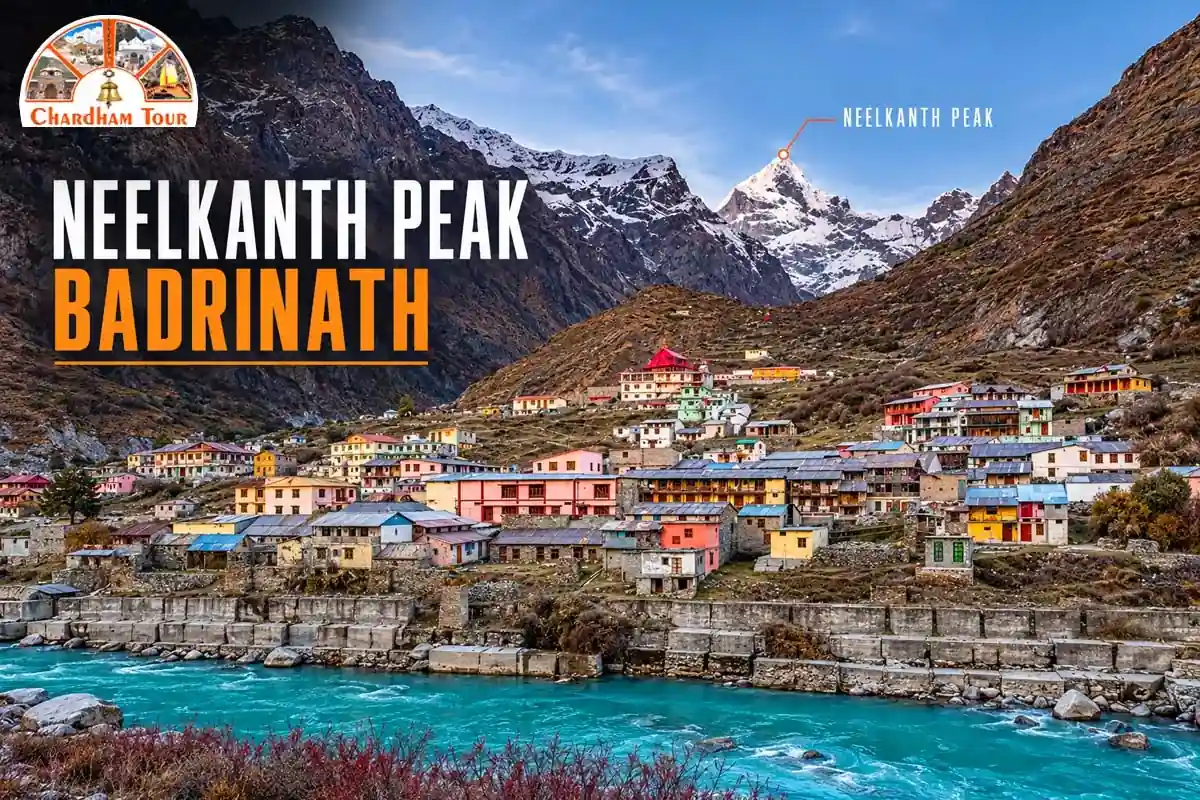
Neelkanth Peak, Badrinath