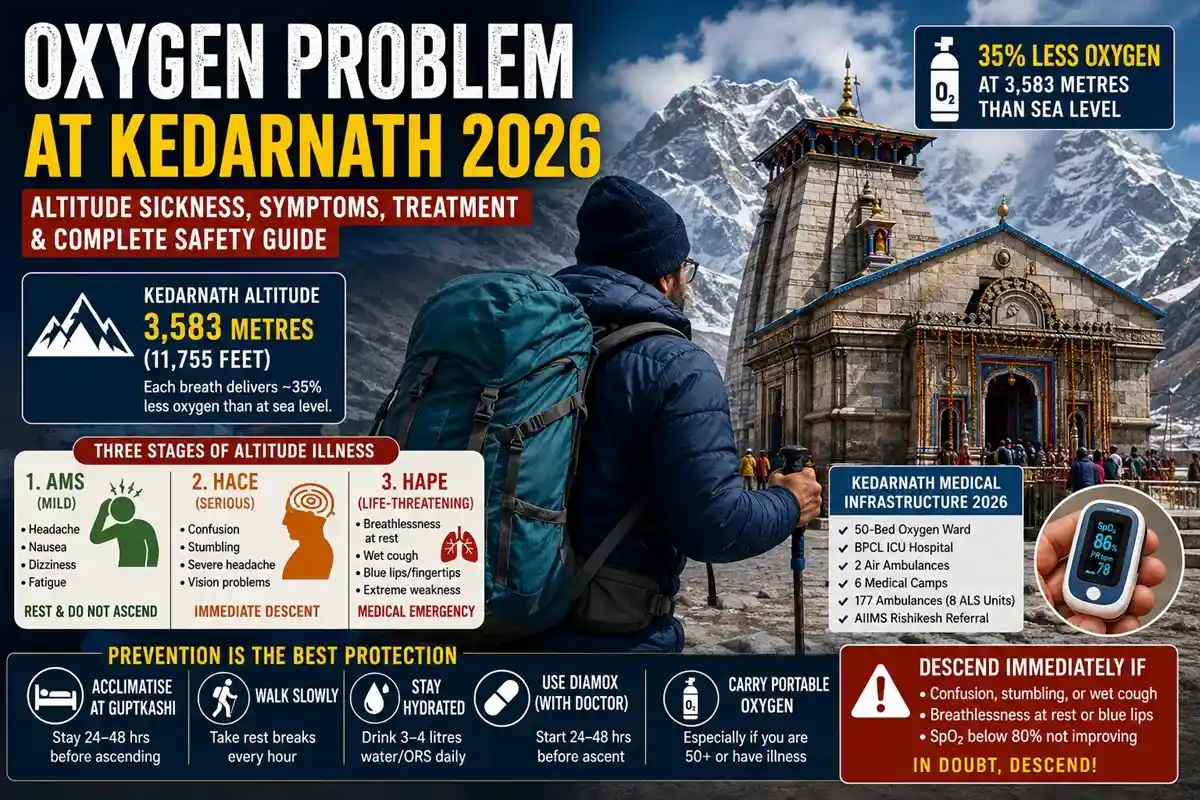
Every year, thousands of pilgrims set out for Kedarnath filled with devotion — and many are completely unprepared for the one invisible challenge that no amount of faith can override: the oxygen problem at Kedarnath. Situated at 3,583 metres (11,755 feet) above sea level in the Garhwal Himalayas, Kedarnath temple sits in an environment where each breath delivers approximately 35% less oxygen to your lungs than it does at sea level. Your heart pumps harder. Your breathing quickens. Your brain, deprived of its usual oxygen supply, begins to protest.
The numbers are sobering. On the very first day of Kedarnath Yatra 2026 — 22 April 2026 — two pilgrims died of cardiac arrest. In 2025, over 80 pilgrims across Char Dham died due to heart attacks and high-altitude illness. In 2022, 120 deaths were recorded at Kedarnath in just 27 days. Most of these deaths were directly or indirectly caused by oxygen deprivation at altitude — compounded by poor acclimatisation, pre-existing health conditions, and in many cases, the rapid altitude gain of helicopter travel.
This guide explains the Kedarnath oxygen problem completely: the science behind it, who is most at risk, how to recognise the three stages of altitude illness (AMS, HACE, HAPE), exactly what to do if symptoms appear, and the full medical infrastructure now in place for 2026. All information is verified against current sources.
🔬 Quick Overview: |
Kedarnath Oxygen Problem 2026
- Kedarnath altitude: 3,583 m (11,755 ft). Oxygen partial pressure is approximately 65% of sea-level — meaning 35% less available oxygen per breath
- Opening day 22 April 2026: 2 pilgrims died of cardiac arrest on Day 1 itself — oxygen deprivation is the primary cause of most yatra deaths
- AMS (Acute Mountain Sickness) can affect 30–90% of unacclimatised people making rapid ascents to 3,000–4,000 m
- Three stages: AMS (mild, manageable) → HACE (brain swelling, serious) → HAPE (lung fluid, most rapidly fatal)
- Highest risk groups: age 50+, heart patients, hypertension, diabetes, asthma sufferers, helicopter arrivals (rapid ascent = highest AMS risk)
- Best prevention: mandatory overnight at Guptkashi (1,319 m) before ascending to Kedarnath — government-recommended
- Carry a portable pulse oximeter — SpO2 below 80% at rest = medical emergency requiring immediate descent
- New 2026: 50-bed oxygen ward at Kedarnath, BPCL permanent ICU hospital, 2 air ambulances on standby
- 177 ambulances including 8 Advanced Life Support units across Char Dham circuit; AIIMS Rishikesh referral for critical cases
- Medical fitness certificate mandatory for pilgrims aged 50+ or those with heart disease, hypertension, diabetes, or asthma
- Diamox (acetazolamide): most evidence-backed AMS prevention medicine — doctor’s prescription mandatory, do not self-medicate
- Tentative closing date 2026: 11 November 2026 (Bhai Dooj, two days after Diwali on 8 November 2026)
Why Is Oxygen Lower at Kedarnath? The Science in Plain Language
A common misconception needs to be cleared first: the percentage of oxygen in air does not change with altitude. At sea level, at Kedarnath, and even at the summit of Everest — the air contains approximately 21% oxygen. What changes dramatically with altitude is atmospheric (barometric) pressure.
As you climb higher, the weight of air above you decreases, so barometric pressure drops. Since the amount of oxygen your lungs can extract per breath depends on the partial pressure of oxygen — not its percentage — lower pressure means your lungs absorb significantly less oxygen per breath, even though the air around you is still 21% oxygen. At 3,000 metres, oxygen partial pressure is approximately 70% of sea-level values. At Kedarnath’s 3,583 metres, it is approximately 65% — meaning each breath delivers roughly 35% less oxygen than it would at sea level.
To compensate, your body forces your heart to beat faster and your lungs to breathe more rapidly. For a healthy, acclimatised adult, this compensation works adequately after 1–2 days of gradual adjustment. For someone with a pre-existing heart or lung condition, or someone who arrived by helicopter and gained 2,000+ metres of altitude in 12 minutes, the body cannot compensate fast enough — and the consequences range from severe headache and nausea to cardiac arrest.
| Location / Altitude | Oxygen Partial Pressure (vs sea level) | What a First-Timer Typically Feels |
| Sea Level (0 m) | 100% (baseline) | Normal — no altitude effects |
| Delhi (216 m) | ~99% | No noticeable change |
| Haridwar / Rishikesh (~300 m) | ~98% | No effect |
| Guptkashi (1,319 m) | ~86% | Mild breathlessness on steep exertion for some; no concern for most |
| Gaurikund (1,982 m) | ~79% | Breathing noticeably harder during fast walking; manageable with rest |
| Kedarnath (3,583 m) | ~65% | Significant reduction; 35% less oxygen per breath; AMS risk real and common |
| 📌 Clarification: You may read online that ‘oxygen at Kedarnath is only 40% of the required level.’ This is a widely circulated but imprecise statement found on several Indian travel websites. Scientifically, at 3,583 m, oxygen partial pressure is approximately 65% of sea-level, not 40%. The body at 3,583 m still receives oxygen — it receives about 35% less per breath than at sea level. At 40% reduction, Kedarnath would be at roughly 5,000 m altitude, which it is not. Always refer to verified altitude physiology sources. |
Who Is Most at Risk from the Oxygen Problem at Kedarnath?
Altitude sickness does not discriminate purely by age or fitness. Young athletes have died at altitude; elderly yoga practitioners have trekked Kedarnath comfortably in their 70s. However, certain groups carry significantly elevated risk and must plan accordingly.
| Risk Group | Why Oxygen Deficiency Is Especially Dangerous for Them |
| Heart disease patients | Reduced oxygen forces the heart to work much harder; any existing weakness can trigger cardiac arrest; highest death risk group at Kedarnath |
| Hypertension patients | Altitude raises blood pressure further; stroke and cardiac events risk significantly elevated above 3,000 m |
| Diabetics | Glucose metabolism at altitude is altered; dehydration worsens blood sugar control; risk of hypoglycaemia during the trek |
| Asthma / COPD sufferers | Already reduced lung function cannot compensate adequately for thin mountain air; bronchospasm risk increases in cold, dry air |
| Pilgrims aged 50+ | Cardiac and pulmonary reserve decreases with age; recovery from oxygen deficit is slower; government mandates medical fitness certificate for this group |
| Helicopter arrivals | Gain 2,000+ m altitude in 12 minutes — no time to acclimatise; AMS incidence 30–40% higher than for trekkers |
| Post-COVID recoveries | COVID causes lasting pulmonary changes; increased risk of HAPE even months after apparent recovery |
| Obese / overweight pilgrims | Higher metabolic oxygen demand; lungs work harder; fatigue sets in faster on the trek |
| Dehydrated pilgrims | Dehydration thickens blood and reduces oxygen-carrying capacity; amplifies all AMS symptoms dramatically |
| Rapid trekkers | Rushing the trek burns oxygen faster; body produces lactic acid; AMS can develop within hours of arrival |
Even apparently healthy, fit pilgrims who live at low altitude can experience AMS. The 2022 Kedarnath season saw 120 deaths in 27 days — a sharp spike that experts attributed partly to undetected post-COVID pulmonary damage. Anyone who had COVID in the 12 months before their Kedarnath trip should get a pulmonary function test (PFT) and a cardiac stress test before travelling.
Three Stages of Altitude Illness at Kedarnath: Know the Difference
Altitude illness exists on a spectrum from uncomfortable-but-manageable to life-threatening. Knowing exactly where you or a fellow pilgrim is on this spectrum is critical — because the correct response depends entirely on the stage.
Stage 1: Acute Mountain Sickness (AMS) — Most Common
AMS is the body’s initial response to reduced oxygen. Symptoms typically begin within 4–12 hours of reaching altitude and peak at 18–24 hours. At Kedarnath, most pilgrims who experience any altitude sickness will be at this stage. AMS is uncomfortable but manageable if you stop, rest, and absolutely do not ascend further.
| AMS Symptom | What You Experience | Correct Response |
| Persistent headache | Dull to throbbing; present for hours; not fully relieved by rest | Stop; hydrate; ibuprofen 600 mg or paracetamol 500 mg every 8 hrs; rest; do NOT ascend |
| Nausea / vomiting | Upset stomach; loss of appetite; vomiting possible | Rest; eat light foods; stay hydrated; ondansetron 4 mg if prescribed; rest |
| Dizziness | Unsteadiness; lightheadedness; world seems tilted | Sit or lie down immediately; hydrate; do not stand suddenly |
| Unusual fatigue | Exhaustion far beyond what physical effort warrants | Mandatory rest; give body time to adjust; do not push forward |
| Poor sleep | Cannot sleep despite exhaustion; waking repeatedly | Normal at altitude; rest even without sleeping; Diamox helps with sleep-related AMS |
| Breathlessness on exertion | Short of breath climbing stairs or walking on flat ground | Slow down significantly; take 15-minute rests every hour; check SpO2 |
Stage 2: High-Altitude Cerebral Edema (HACE) — Serious, Requires Immediate Descent
HACE is AMS that has progressed to the brain. Reduced oxygen causes the brain to swell inside the skull — a life-threatening condition. HACE is the reason no amount of devotion should keep you at altitude if the following signs appear:
- Severe headache that does not respond to rest or painkillers
- Confusion, disorientation, inability to think or speak clearly
- Stumbling, loss of coordination (ataxia) — ask the person to walk a straight line; inability to do so is a strong HACE indicator
- Extreme lethargy — difficulty staying awake; abnormal drowsiness
- Vision disturbances — blurred vision; double vision
Action: IMMEDIATE DESCENT — do not wait for morning, do not wait to see if it improves at the same altitude. Every 300 metres of descent provides measurable relief. Administer supplemental oxygen at the nearest medical camp while evacuation is arranged. HACE can progress to unconsciousness within hours.
Stage 3: High-Altitude Pulmonary Edema (HAPE) — Most Rapidly Fatal
HAPE is fluid accumulation in the lungs caused by altitude-induced pulmonary hypertension. It is the most rapidly fatal form of altitude illness and is responsible for many pilgrimage deaths. Crucially, HAPE can develop independently of AMS — meaning a person can appear fine one evening and develop life-threatening symptoms overnight.
- Persistent dry cough progressing to a wet, gurgling cough
- Breathlessness at complete rest — struggling to breathe while simply sitting
- Crackling or gurgling sounds in the chest (rales) — fluid in lungs
- Extreme weakness — cannot walk even a few steps without stopping
- Blue lips or fingertips (cyanosis) — critically low blood oxygen
- Rapid heart rate at rest; increasing confusion as oxygen drops
Action: MEDICAL EMERGENCY. Contact the Kedarnath medical camp immediately. Administer supplemental oxygen. Request helicopter evacuation — two air ambulances are on standby at Kedarnath in 2026. Do not give water to drink if wet cough is present (lungs are filling with fluid). Begin descent immediately while awaiting evacuation. Nifedipine (if prescribed by your doctor and in your kit) reduces pulmonary artery pressure and can buy critical time.
| 🚨 HAPE Warning: HAPE can be more rapidly fatal than HACE. Early warning signs — a persistent dry cough and slightly greater breathlessness than expected — are easily dismissed as ‘just tired from the trek.’ Do not dismiss them. A cough that appears at altitude and does not stop with rest is a warning sign. Act early. |
SpO2 Readings at Kedarnath: What the Numbers Mean and When to Act
A portable pulse oximeter (₹800–₹1,500) measures the percentage of haemoglobin in your blood carrying oxygen. At sea level, normal SpO2 is 95–100%. At altitude, it drops. Understanding your readings helps you make real-time safety decisions on the trek.
| SpO2 Reading | What It Means at Kedarnath | Action Required |
| 95–100% | Excellent acclimatisation; no concern | Continue normally; monitor regularly |
| 90–94% | Mild hypoxia; common at altitude | Rest; hydrate; do not exert heavily; monitor every 2 hours |
| 85–89% | Expected range for partially acclimatised pilgrims at 3,583 m | Rest if symptomatic; watch for AMS signs; avoid exertion |
| 80–84% | Body is struggling — significant hypoxia | Stop trekking; complete rest; seek nearest medical camp; do not ascend |
| Below 80% | Dangerous hypoxia — medical situation | Supplemental oxygen immediately; contact medical camp; begin descent NOW |
| Below 75% | Critical — risk of organ damage, unconsciousness | Emergency — helicopter evacuation; oxygen therapy; do not delay |
Important: SpO2 alone does not give the full picture. Some pilgrims with SpO2 at 83% feel fine; others with 90% are severely symptomatic. Altitude sickness is diagnosed primarily on symptoms, not numbers alone. A sudden, rapid drop in SpO2 over a few hours is more concerning than a stable low reading. Use the oximeter as one tool alongside how the person actually looks, feels, and behaves.
How to Prevent Altitude Sickness at Kedarnath: Proven Steps
Prevention at altitude is vastly more effective than treatment. Following the steps below can reduce AMS risk from 30–90% to well under 10% for most healthy pilgrims.
Step 1: Acclimatise at Guptkashi — The Single Most Important Step
This one step prevents more altitude illness deaths than any medicine or equipment. The Uttarakhand government specifically recommends spending at least one night at Guptkashi (1,319 m) before ascending to Kedarnath. Ideally, two nights. For helicopter pilgrims — who gain 2,000+ metres of altitude in 12 minutes — spending the night before the flight at Guptkashi or Phata is not optional; it is their primary protection against AMS.
| Day | Location | Altitude | Purpose |
| Day 1 | Haridwar / Rishikesh | ~300 m | Arrive; rest; start hydrating well; begin Diamox if prescribed |
| Day 2 | Drive to Guptkashi | ~1,319 m | Altitude gain begins; light evening walk; SpO2 check before bed |
| Day 3 | Rest at Guptkashi | 1,319 m | Full rest day — mandatory; body starts producing extra red blood cells |
| Day 4 | Guptkashi to Gaurikund | ~1,982 m | Short drive; overnight at Gaurikund; SpO2 check before sleep |
| Day 5 | Trek to Kedarnath (start 4–5 AM) | 3,583 m | Slow pace; rest at Bhimbali and Lincholi; reach by 10–11 AM |
| Day 6 | Rest day at Kedarnath | 3,583 m | Do not rush darshan on arrival day; let body adjust; SpO2 morning + evening |
| Day 7 | Darshan + begin descent by 2–3 PM | 3,583 m → 1,982 m | Descent by 5 PM mandatory; most altitude symptoms resolve on descent |
Step 2: Walk at the Right Pace — Slower Than Feels Natural
The Kedarnath trek gains approximately 1,600 metres over 16–18 km. Most pilgrims start too fast. The rule for altitude trekking: if you cannot hold a comfortable conversation while walking, you are going too fast. Take 10–15 minute rest breaks every hour. The slowest, most careful trekkers almost always complete the trek safely. Fast, determined trekkers who ignore breathlessness are the ones who end up at the medical camp.
Step 3: Hydrate Aggressively — Before You Feel Thirsty
Dry mountain air at altitude causes respiratory fluid loss far faster than you realise. Dehydration amplifies every AMS symptom and reduces your blood’s oxygen-carrying capacity. Drink 3–4 litres of water or ORS daily during the trek. Urine should be pale yellow — dark yellow means you are already dehydrated. Avoid alcohol completely; it accelerates dehydration and suppresses the normal breathing response to reduced oxygen.
- Drink water every 20–30 minutes on the trek — set a timer if needed
- ORS (Oral Rehydration Salts) packets replace electrolytes lost through sweat and rapid mountain breathing
- Avoid alcohol, caffeinated drinks in excess, and carbonated beverages at altitude
- Eat light, carbohydrate-rich meals — heavy protein meals demand more oxygen to digest
Step 4: Diamox — Only With a Doctor’s Prescription
Diamox (acetazolamide) is a prescription medicine that stimulates faster breathing at altitude, helping the body absorb more oxygen. It is the most evidence-backed pharmaceutical prevention for AMS. However, it must be prescribed and is not suitable for everyone.
How it works: Diamox makes the blood slightly more acidic, triggering the brain’s respiratory centre to increase breathing rate — more breaths per minute means more oxygen absorbed despite thinner air.
Typical dosage: 125 mg to 250 mg twice daily. Start 24–48 hours before ascending to altitude. Consult your doctor at least 7–10 days before departure. Do NOT purchase from a mountain pharmacy and self-administer.
- Common side effects: tingling in fingers and toes, increased urination, mild fatigue — these are expected and not dangerous
- Not suitable for: sulpha drug allergy sufferers, those with kidney conditions, pregnant women — confirm with your doctor
- Diamox prevents and reduces AMS — it does not treat HACE or HAPE
Step 5: Carry a Pulse Oximeter — Use It Regularly
A fingertip pulse oximeter costs ₹800–₹1,500 and is the most useful item in your daypack for altitude safety. Take a reading every 2–3 hours on the trek and every morning when you wake at Kedarnath. If you are with elderly family members, check theirs every hour. Refer to the SpO2 table above for action thresholds.
Step 6: Portable Oxygen Cylinder — For High-Risk Pilgrims
Compact portable oxygen cans (typically 8–16 litres) are available in Rishikesh, Haridwar, and along the route. They provide temporary relief — enough to stabilise a person during the trek while reaching the nearest medical camp. They are not a substitute for descent in serious cases.
- Who should carry one: pilgrims aged 65+, heart patients, those with asthma or COPD, and anyone who has previously experienced AMS
- Buy in Rishikesh or Haridwar for best availability — stock is limited at Guptkashi and Gaurikund
- Government medical camps at all 6 points on the trek carry full cylinder-based oxygen — use these for sustained treatment
Kedarnath Medical Infrastructure 2026: What Is in Place
The 2026 season has seen the most significant upgrade to Kedarnath medical infrastructure in recent history — a direct government response to the pilgrimage death toll of recent seasons.
New 50-Bed Oxygen Support Ward at Kedarnath
A dedicated 50-bed oxygen support ward is now operational at Kedarnath specifically for altitude-related oxygen problems. It is staffed with trained medical personnel and equipped with oxygen cylinders, monitoring equipment, and basic treatment facilities. Critical cases are stabilised here before helicopter evacuation.
BPCL Permanent High-Altitude Hospital (New for 2026)
BPCL (Bharat Petroleum Corporation Limited) funded and built a permanent hospital at Kedarnath in 2026, replacing the earlier temporary 8-bed facility. The hospital includes: ICU beds with ventilator support; diagnostic laboratories; 24×7 medical staff trained specifically in high-altitude medicine; and a referral link to AIIMS Rishikesh and Doon Medical College for cases requiring specialist care.
Two Air Ambulances on Permanent Standby
For 2026, two air ambulances are on permanent standby at Kedarnath. Any pilgrim with a critical condition — HAPE, HACE, cardiac arrest, or severe AMS — can be airlifted directly to AIIMS Rishikesh or Doon Medical College without the delays seen in previous seasons. This infrastructure was specifically strengthened after the opening-day deaths on 22 April 2026.
Medical Camps Across the Entire Trek Route
| Location | Medical Facilities | Altitude |
| Sonprayag | First-aid, health screening, ambulance standby | ~1,830 m |
| Gaurikund | Medical camp, oxygen cylinders, fitness screening | ~1,982 m |
| Jungle Chatti | First-aid post; rest area | ~2,200 m |
| Bhimbali / Bheembali | Medical camp with oxygen; SDRF team stationed | ~2,835 m |
| Lincholi | Medical camp; oxygen; treatment facility | ~3,150 m |
| Kedarnath (Base) | 50-bed oxygen ward + BPCL ICU hospital + air ambulance area | 3,583 m |
Ambulance Deployment — 2026
- 177 ambulances including 8 Advanced Life Support (ALS) units deployed across the Char Dham circuit
- Every government medical facility on the entire yatra route carries oxygen cylinders — available to any pilgrim in distress at no immediate charge
- AIIMS Rishikesh helicopter ambulance operational for Kedarnath emergencies
| ✅ 2026 Medical Summary at Kedarnath: 50-bed oxygen support ward | BPCL permanent ICU hospital with ventilators | 2 air ambulances on standby | Medical camps at 6 points on the trek route | 177 ambulances across Char Dham (incl. 8 ALS units) | AIIMS Rishikesh referral network | Oxygen cylinders at all government medical points |
Special Guidance for High-Risk Groups
Helicopter Pilgrims — Highest AMS Risk of Any Group
Flying from Phata (1,524 m) to Kedarnath (3,583 m) in roughly 12 minutes means a gain of over 2,000 metres with zero time to acclimatise. Studies confirm that rapid passive ascent to 3,000–4,600 m significantly increases AMS incidence, with rates as high as 30–40% among helicopter arrivals compared to much lower rates for trekkers who gain altitude gradually over hours.
The opening-day 2026 deaths illustrate this precisely. The mandatory medical screening now deployed at all helipads in 2026 is specifically designed to catch high-risk individuals before boarding.
- Night before helicopter flight: stay at Guptkashi (1,319 m) — not Haridwar, not Delhi
- Do not travel Delhi → Rishikesh → helicopter to Kedarnath in a single day
- After landing: walk very slowly; do not rush to the darshan queue; rest 30–45 minutes at the helipad area first
- Request supplemental oxygen at the Kedarnath helipad medical post if any discomfort appears after landing
Pilgrims Aged 50+ — Mandatory Medical Protocols
The Uttarakhand government mandates a medical fitness certificate for all pilgrims aged 50 and above. This is not a formality — it exists because the cardiac and pulmonary reserve that younger people take for granted decreases significantly with age, and the body’s ability to compensate for reduced oxygen becomes slower and less reliable.
- Full cardiac checkup including ECG and stress test before travel
- Pulmonary function test (PFT) if any previous breathing issues or COVID history
- Discuss Diamox prophylaxis with your cardiologist — it is generally safe but must be cleared against your specific medications
- Check SpO2 every hour on the trek; rest if it drops below 85%
- Plan an extra acclimatisation day at Kedarnath before attempting any early-morning puja slots
Heart Patients — When Not to Go and When You Can
The Kedarnath trek is 16–18 km with 1,600 metres of altitude gain and 35% reduced oxygen. For heart patients, this combination is genuinely dangerous. Reduced oxygen forces the heart to pump harder at exactly the time it is under maximum physical exertion in cold mountain air. Doctors typically advise against Kedarnath for patients with: active angina; severe heart failure (ejection fraction below 40%); recent heart attack or cardiac surgery (within 6 months); and uncontrolled hypertension.
If your cardiologist has cleared you for Kedarnath: take the helicopter (avoid the trek); carry a complete list of current medications; keep a recent ECG copy; inform your group about your condition; and never push through chest pain or severe breathlessness.
The Most Important Rule: When to Descend Immediately
In high-altitude medicine, one rule overrides all others: when in doubt, descend. Not tomorrow. Not after one more rest. Immediately. Every 300 metres of descent delivers measurable relief. The 1,600-metre descent from Kedarnath to Gaurikund resolves most altitude illness symptoms significantly or completely.
| 🔴 DESCEND IMMEDIATELY if you or anyone in your group shows:• Confusion, stumbling, or inability to walk a straight line (HACE sign)• Breathlessness at complete rest — struggling to breathe while sitting (HAPE sign)• Wet or gurgling cough — especially with pink or bloody sputum (HAPE sign)• Blue lips or fingertips (cyanosis)• SpO2 below 80% not recovering after 20 minutes of rest• Loss of consciousness for any duration• Severe chest pain• Persistent vomiting preventing hydrationThese are medical emergencies. Alert the nearest medical camp. Call SDRF: 9557444486. Request helicopter evacuation if at Kedarnath base. |
No version of darshan is worth risking permanent health damage or death. Kedarnath will be open next season. Come back prepared. The mountain has patience that outlasts any pilgrimage calendar.
Medicines to Carry for Kedarnath: Doctor-Recommended List
Always consult your personal physician before taking any of the below. This table is for awareness — not a prescription. All Rx items require a doctor’s prescription.
| Medicine | Type | Used For | Key Notes |
| Diamox (Acetazolamide) | Rx only | AMS prevention | 125–250 mg twice daily; start 24–48 hrs before ascent; not for sulpha allergy |
| Ibuprofen 600 mg | OTC | AMS headache | Every 8 hours; evidence-backed for AMS headache; avoid with gastric issues |
| Paracetamol 500 mg | OTC | Mild pain / headache | Milder alternative; safe for most; symptom relief only, not AMS treatment |
| Ondansetron 4 mg | Rx | Nausea / vomiting | Dissolving tablet ideal at altitude; prevents dehydration from vomiting |
| Nifedipine | Rx — Emergency | HAPE treatment only | Reduces pulmonary artery pressure; for HAPE only; doctor must prescribe |
| Dexamethasone | Rx — Emergency | HACE treatment only | Emergency drug for HACE; not for prevention; requires doctor’s prescription |
| ORS packets | OTC | Dehydration prevention | Carry 15–20 packets; dissolve in water throughout trek; maintain electrolytes |
| Personal prescriptions | Rx | Existing conditions | Carry double the quantity needed — no pharmacy above Gaurikund |
| ⚠️ Self-Medication Warning: Do not buy Diamox, Nifedipine, or Dexamethasone from mountain pharmacies without a prescription. These are prescription medicines with specific dosing requirements and contraindications. Consult your doctor 7–10 days before departure and get a personalised altitude health plan based on your own medical history. |
Complete Packing Checklist: Kedarnath Oxygen Safety Kit
Health and Medical
- Portable pulse oximeter (₹800–₹1,500) — most important item; check SpO2 every 2–3 hours on trek
- Portable oxygen can — especially for pilgrims 65+, heart patients, asthma/COPD sufferers
- Diamox (doctor-prescribed) — start 24–48 hrs before reaching high altitude
- Ibuprofen 600 mg or paracetamol — for AMS headache
- ORS packets (15–20) — for hydration throughout the trek
- All personal prescription medicines — double supply
- Medical fitness certificate (mandatory for 50+)
- Recent ECG copy — for heart patients; can be critical in an emergency
Clothing and Gear
- Heavy woollen layers — Kedarnath is near 0°C in mornings even in May
- Waterproof rain jacket — sudden showers possible in any month
- Non-slip trekking shoes with ankle support — 16–18 km of uneven terrain
- Woollen cap, gloves, thermal innerwear — non-optional above Gaurikund
- Walking stick — essential especially for the descent
Documents and Practical
- Aadhaar card — original + photocopy
- Yatra registration QR pass — both digital and printed copy
- Cash — no ATMs at Kedarnath or Gaurikund; withdraw from Haridwar/Rishikesh
- High-capacity power bank — no charging at temple area
- Offline Google Maps for Kedarnath trek route — mobile signal unreliable after Gaurikund
Best and Worst Times to Visit Kedarnath for Oxygen-Sensitive Pilgrims
| Month | Temperature at Kedarnath | Crowd | AMS Risk | Verdict |
| Late April | 0°C to 8°C | High (opening) | Moderate | ✅ Spiritual; cold adds cardiac stress; well-prepared pilgrims only |
| May | 5°C to 15°C | Very High (peak) | Higher (crowds) | ✅ Best roads; most crowded; book accommodation far in advance |
| Early June | 8°C to 18°C | Moderate | Moderate | ✅ Good window; less pressure than May |
| July–August | 10°C to 20°C (rainy) | Low | Lower (thin crowd) | ⚠️ Monsoon landslide risk high; wet cold adds to respiratory stress |
| September | 8°C to 16°C | Low–Moderate | Low | ✅✅ Recommended by doctors — best month for altitude-sensitive pilgrims |
| October | 0°C to 10°C | Moderate | Moderate | ✅ Last good window; cold nights; close before 11 Nov |
September is the consistently recommended month by high-altitude medical professionals for pilgrims with any health concern. Thin crowds mean lower physical stress, post-monsoon air is the clearest of the season, and moderate temperatures minimise cold-induced cardiovascular strain. Morning darshan in September is frequently described by pilgrims as the most peaceful and personal experience of all the yatra months.
Practical Tips That Experienced Pilgrims and Local Guides Share
- ‘Do not eat a heavy meal before starting the trek’ — heavy digestion at altitude diverts blood flow from muscles and brain, worsening breathlessness
- ‘Stop and take slow, deliberate deep breaths when you feel breathless — do not just push through’ — 2–3 minutes of conscious deep breathing measurably improves SpO2
- ‘Jaggery (gur) and dry fruits are better than packaged snacks on the trek’ — natural sugars provide sustained energy release; high-salt snacks worsen dehydration
- ‘Sleep slightly elevated — head higher than feet’ — this reduces fluid accumulation tendency in lungs during sleep at altitude
- ‘Check SpO2 first thing in the morning before getting up’ — SpO2 drops during sleep at altitude; morning readings help detect developing HAPE early
- ‘Warm water is better than cold water at altitude’ — cold water can trigger throat irritation and coughing in cold mountain air
- ‘The descent feels harder on knees but dramatically better for lungs’ — most pilgrims feel measurably better within 1–2 hours of beginning descent from Kedarnath
- ‘Tell your fellow pilgrims your medical conditions before starting’ — group awareness has saved lives on the trek
Frequently Asked Questions
1. How much less oxygen is available at Kedarnath compared to sea level?
At Kedarnath’s altitude of 3,583 metres, the oxygen partial pressure is approximately 65% of sea-level values — meaning each breath delivers about 35% less oxygen to your lungs than it would at sea level. The percentage of oxygen in air (21%) does not change with altitude; what drops is atmospheric pressure, reducing how much oxygen your lungs can extract per breath. This is why your heart and lungs must work significantly harder at altitude.
2. What is the tentative closing date of Kedarnath in 2026?
The tentative closing date of Kedarnath Temple for 2026 is 11 November 2026. The temple traditionally closes on Bhai Dooj — which in 2026 falls on 10–11 November (two days after Diwali on 8 November 2026). The official closing date is confirmed every year on Vijayadashami (Dussehra). Always check the BKTC official website at badrinath-kedarnath.gov.in for the final confirmed date before planning your October–November visit.
3. What happened on the opening day of Kedarnath Yatra 2026?
On 22 April 2026 — the very first day of the 2026 yatra season — two pilgrims died of cardiac arrest: Dilip Bhai Manu Mali from Gujarat and Rahul Chaudhary from Uttar Pradesh. The family of Dilip Bhai reported waiting over an hour for medical response. Officials attributed helicopter evacuation delays to DGCA safety inspection protocols. The incident triggered an immediate review of emergency response times and led to the deployment of two air ambulances on permanent standby at Kedarnath for 2026.
4. What is Acute Mountain Sickness (AMS) and how common is it at Kedarnath?
AMS is the body’s initial response to receiving less oxygen at high altitude. Symptoms appear within 4–12 hours of reaching altitude and include persistent headache, nausea, dizziness, unusual fatigue, and poor sleep. At 3,000–4,000 metres, AMS can affect 30–90% of unacclimatised people making rapid ascents. Most cases at Kedarnath are mild and resolve with rest and acclimatisation. It becomes dangerous only when the person continues ascending rather than resting, allowing it to progress to HACE or HAPE.
5. What is the difference between AMS, HACE, and HAPE?
AMS is the mild initial stage — headache, nausea, fatigue. It is manageable with rest and does not require descent in most cases. HACE (High-Altitude Cerebral Edema) is AMS that has progressed to cause brain swelling — confusion, stumbling, disorientation are key signs — and requires immediate descent. HAPE (High-Altitude Pulmonary Edema) is fluid in the lungs — wet cough, breathlessness at rest, blue lips — and is the most rapidly fatal; it can cause death within hours if the person remains at altitude.
6. Should I carry a pulse oximeter to Kedarnath?
Yes — strongly recommended for all pilgrims, essential for those above 50 or with any health condition. A portable fingertip pulse oximeter costs ₹800–₹1,500 and measures your blood oxygen saturation (SpO2). At Kedarnath, readings of 85–92% are normal for acclimatised pilgrims. Below 80% at rest is a medical situation requiring you to stop and seek the medical camp. Below 75% is a medical emergency. Take readings every 2–3 hours on the trek and every morning when you wake.
7. Is Diamox necessary for everyone going to Kedarnath?
Not for everyone, but strongly recommended for: pilgrims above 50, helicopter arrivals, anyone with a history of previous altitude sickness, and those with heart or lung conditions (only if their cardiologist approves). For healthy adults who plan to acclimatise properly at Guptkashi and trek slowly, Diamox provides an extra safety margin but is not mandatory. It must be prescribed by a doctor — do not buy it at a mountain pharmacy and self-administer. Consult your physician 7–10 days before departure.
8. What new medical facilities are in place at Kedarnath for 2026?
2026 has the strongest medical infrastructure in Kedarnath’s modern pilgrimage history. Highlights: a new 50-bed oxygen support ward specifically for altitude illness; a BPCL-funded permanent hospital with ICU beds, ventilators, and diagnostic labs; two air ambulances on permanent standby for helicopter evacuation; medical camps with oxygen support at 6 points on the trek route (Sonprayag, Gaurikund, Jungle Chatti, Bhimbali, Lincholi, Kedarnath base); 177 ambulances including 8 ALS units across the Char Dham circuit; and AIIMS Rishikesh on call for critical referrals.
9. Why are helicopter pilgrims at higher AMS risk than trekkers?
The Kedarnath trek gains approximately 1,600 metres over 6–8 hours — giving the body time to begin adjusting. A helicopter from Phata gains the same altitude in 12 minutes. This rapid altitude gain means the body has no time to increase red blood cell production, adjust breathing rate, or expand pulmonary blood vessels before being placed at 3,583 metres. Studies confirm this increases AMS risk significantly. The best protection for helicopter pilgrims is spending the night before the flight at Guptkashi (1,319 m) — not at Haridwar or Delhi.
10. What should I do if my fellow pilgrim shows signs of HACE or HAPE?
Act immediately — do not wait to see if it gets better. Lay the person down; loosen all tight clothing; administer supplemental oxygen from the nearest medical camp or personal cylinder; alert any Yatramitra, SDRF ranger, or other pilgrims around you for assistance. Call SDRF Uttarakhand: 9557444486. If HAPE is suspected (wet cough, breathlessness at rest), do not give water to drink — begin gentle descent while awaiting helicopter evacuation. The two air ambulances at Kedarnath are available for exactly such emergencies in 2026.
11. Can heart patients visit Kedarnath?
It entirely depends on the individual’s current cardiac health. Patients with controlled, stable conditions who are cleared by their cardiologist after a thorough checkup (ECG, stress test, echocardiogram) can visit — but must take the helicopter, not trek; carry all medications; keep a recent ECG copy; and inform their group of their condition. Patients with active angina, severe heart failure, recent cardiac procedures, or uncontrolled hypertension should not attempt Kedarnath. The altitude-exertion-cold combination creates extreme cardiac stress.
12. What is the SpO2 reading at which I should immediately descend from Kedarnath?
If your SpO2 drops below 80% at rest — after taking a reading twice to confirm — and does not recover after 20 minutes of complete rest, you should begin descent and seek the nearest medical camp. This is the threshold at which supplemental oxygen alone is insufficient and the body needs the help of lower altitude. Below 75% is a medical emergency requiring helicopter evacuation if available. Do not rely on SpO2 alone — if symptoms are severe (confusion, wet cough, blue lips) at any reading, descend immediately.
13. Is it safe to visit Kedarnath in May if I have high blood pressure?
With medical clearance and proper preparation, it may be possible — but requires careful management. Altitude raises blood pressure further in hypertensive patients. Before going: get your cardiologist’s explicit clearance; ensure BP is well-controlled on medication; carry sufficient blood pressure medicine for the full trip; check BP morning and evening on the trek; take the helicopter rather than trekking; plan for an extra acclimatisation day. September is the medically preferred month for BP patients — thinner crowds, no rush, more stable conditions.
14. What is the medical age threshold for mandatory health checkup at Kedarnath?
The Uttarakhand government mandates a medical fitness certificate for pilgrims aged 50 years and above, or those with pre-existing conditions including heart disease, hypertension, diabetes, and asthma — regardless of age. Note: some older sources mention 55 as the threshold; the current government requirement for Char Dham Yatra is 50 and above. Carry your fitness certificate from a registered MBBS doctor throughout the yatra — you may be asked for it at health screening checkpoints.
15. What emergency contacts should I save before leaving for Kedarnath?
Save all contacts before leaving Rishikesh — mobile signal is unreliable beyond Gaurikund. Key numbers: SDRF Uttarakhand (State Disaster Response Force): 9557444486 | AIIMS Rishikesh referral: 0135-2462927 | Rudraprayag District Control Room: contact at Sonprayag checkpoint | Yatramitra helpdesks: stationed at Sonprayag, Gaurikund, Bhimbali, Lincholi, and Kedarnath base. Also note the locations of all medical camps on the route — refer to the table in this guide.
Final Words: The Oxygen Problem Is Real — But Kedarnath Is Safe When You Prepare
The oxygen problem at Kedarnath is not a reason to not go. It is a reason to go prepared. Millions of pilgrims complete this journey safely every year — of all ages, fitness levels, and health backgrounds. The difference between those who have a spiritually transformative experience and those who are evacuated is almost always preparation, pacing, and the willingness to listen to their own bodies.
Acclimatise at Guptkashi — do not skip this step. Start the trek before dawn at a moderate pace. Drink water before you feel thirsty. Carry a pulse oximeter and check it regularly. Know the warning signs of HACE and HAPE — not to be frightened, but so you can act in time. And if you are above 60, have a heart condition, or are recovering from any illness — take the helicopter, plan an extra acclimatisation day, and let your body set the pace, not the pilgrimage calendar.
The new medical infrastructure at Kedarnath for 2026 — the 50-bed oxygen ward, the BPCL ICU hospital, the two air ambulances on standby — reflects a genuine commitment to pilgrim safety. Use it if you need it. There is no virtue in suffering silently at altitude.
Baba Kedar has been welcoming pilgrims for over 1,200 years. He will be there next season too. Come prepared. Come healthy. Come humble.
Har Har Mahadev.
| 📌 Essential Contacts and References:• Emergency (SDRF Uttarakhand): 9557444486• AIIMS Rishikesh: 0135-2462927• Kedarnath Registration (free): registrationandtouristcare.uk.gov.in• BKTC (puja booking, live darshan): badrinath-kedarnath.gov.in• Kedarnath closing date 2026 (tentative): 11 November 2026 — confirm at badrinath-kedarnath.gov.in in October• If SpO2 below 80% at rest: seek nearest medical camp immediately• Wet cough + breathlessness at rest = HAPE = descend and evacuate NOW |

Related Posts

Adi Shankaracharya Samadhi, Kedarnath

Adi Kailash vs Kedarnath: Complete Comparison Guide