Mobile connectivity in Adi Kailash is one of the most important things pilgrims underestimate before the yatra. This is a restricted border region in Pithoragarh district, and once you cross Dharchula, mobile signal in Gunji and beyond drops fast. Knowing where signal is realistically available, and where it isn’t, changes how you plan communication with family back home.
Network Coverage Route-Wise
| Location | Network Status |
| Pithoragarh | Good multi-network coverage — all major networks work |
| Dharchula | Reliable BSNL and Jio, patchy Airtel/Vi |
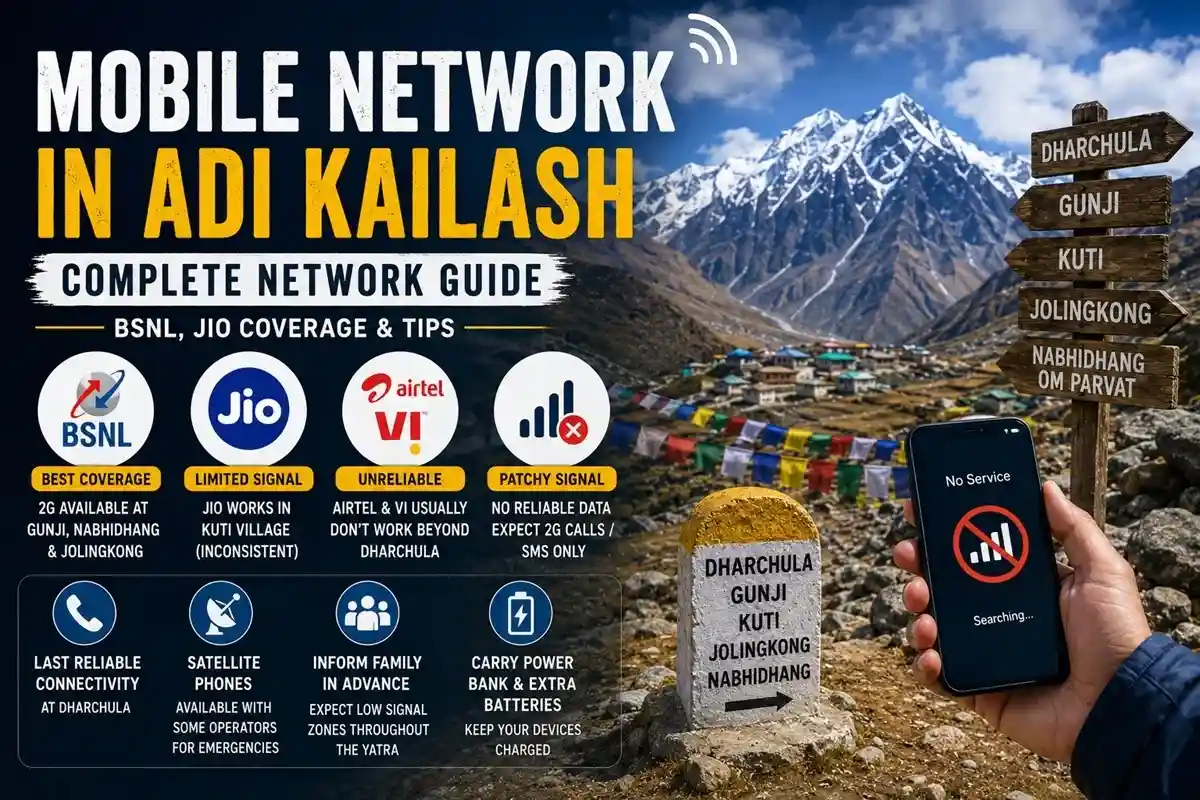
| Gunji | BSNL 2G reported (calls/SMS), no reliable data |
| Kuti village | Limited Jio connectivity reported, inconsistent by season |
| Jolingkong | BSNL 2G reported here; basic calls/SMS only, weather-dependent |
| Nabhidhang/Om Parvat viewpoint | BSNL 2G reported; coverage thin and weather-dependent |
Most pilgrims prefer to make their last proper call home from Dharchula, since that’s genuinely the last place with dependable connectivity before the restricted zone begins.
BSNL 2G Coverage and Internet in Adi Kailash
This is the single biggest update to know before the yatra: according to recent government and BSNL connectivity updates, basic 2G coverage has been introduced at Gunji, Nabhidhang, and Jolingkong, specifically to serve pilgrims and border villages. The push followed a well-publicised connectivity gap during a high-profile visit to Jolingkong in October 2023, when even basic calls needed a temporary setup.
This is a reported 2G-level upgrade, not 4G. Expect basic voice calls and SMS in favourable weather, not data, video calls, or UPI. Internet in Adi Kailash beyond Dharchula remains effectively unavailable on any network. Coverage isn’t uniform either — pilgrims report drop-offs depending on cloud cover, tower load in peak season, and exactly where you’re standing. Treat this as “occasional signal,” not guaranteed connectivity.
Why Connectivity Is So Limited Here
This isn’t a case of poor infrastructure alone — Adi Kailash sits inside a sensitive Inner Line Permit zone along the India-Tibet-Nepal border, and telecom rollout here moves slower due to security clearances, terrain, and remote villages like Gunji and Kuti. Towers need power and maintenance access that’s hard to sustain through winter, when the region is snowed in. Road conditions near Kuti already make vehicle access tough; running telecom cabling through the same terrain is even harder.
Which SIM Works in Adi Kailash?
BSNL is generally considered the most dependable option for this route by locals and repeat pilgrims, simply because it’s reported to hold a signal in more pockets than any competitor — even if that’s often just enough for a text rather than a call. Local drivers usually recommend carrying a BSNL SIM as backup even if your primary number is on another network.
- BSNL: Generally the most dependable choice now that 2G coverage is reported at Gunji, Nabhidhang, and Jolingkong — for calls/SMS, not data
- Jio: Limited connectivity reported around Kuti village, inconsistent by season and weather
- Airtel/Vi: Usually unreliable beyond Dharchula
If you’re travelling with a group, it helps to have at least one BSNL number and one Jio number between you, rather than everyone carrying the same carrier.
Satellite Phones and Emergency Communication
During peak season, some organised tour operators and emergency agencies may have satellite communication facilities for emergencies, since normal mobile networks can’t be relied on past Gunji — though not every operator carries one, so it’s worth confirming with yours in advance. If you’re travelling independently, ask your homestay or local guide whether a satellite device is available nearby in case of a medical emergency. ITBP posts along the route also maintain their own communication channels and can assist in genuine emergencies, even where public networks fail.
Practical Tips to Stay in Touch
- Inform family of your rough itinerary and expected low-signal days before you leave Dharchula
- Set a fixed daily check-in window (for example, evening at Gunji, when a BSNL text sometimes goes through)
- Carry a power bank — charging points are limited at Gunji and unavailable at Jolingkong
- Digital payments are unreliable beyond Dharchula — carry sufficient cash, since Gunji, Jolingkong, and the trek sections effectively run on cash
- Download offline maps and any documents you might need before losing steady signal
Local drivers usually recommend switching your phone to battery-saving mode once past Gunji, since a phone constantly searching for signal drains battery far faster than usual.
Booking Through an Operator vs Travelling Independently
During peak season, most established operators build communication planning into their itinerary — a fixed evening check-in call from Gunji using a shared BSNL number, or an update sent to a base coordinator in Dharchula. This is one reason operators discourage travelling this route independently: without a local guide who knows the weak pockets of signal, families back home can go days without word. If travelling independently, ask your homestay host in Gunji about the specific time of day when BSNL signal is most likely to hold — locals usually know this down to the hour.
Latest Updates 2026
Government and BSNL communications from recent seasons indicate the 2G coverage at Gunji, Nabhidhang, and Jolingkong — first set up around a high-profile October 2023 visit — has continued into the 2026 season, giving pilgrims basic call and SMS access at points that had zero signal a few years ago. Jio’s footprint around Kuti village is still reported as inconsistent, depending on weather and tower load in peak months. Internet in Adi Kailash beyond Dharchula remains effectively unavailable, so treat this as current guidance rather than a permanent guarantee.
FAQs
Q-1: Is there mobile network at Adi Kailash?
Basic BSNL 2G coverage is reported at Gunji, Nabhidhang, and Jolingkong for calls/SMS, but not for data.
Q-2: Which network works best for Adi Kailash Yatra?
BSNL is generally the most dependable for calls and SMS; Jio may offer limited data only up to Kuti village.
Q-3: Does Jio work in Adi Kailash?
Limited, inconsistent Jio connectivity has been reported near Kuti village, but it shouldn’t be relied on beyond there.
Q-4: Is there any network at Jolingkong?
BSNL 2G coverage is reported here — basic calls/SMS in good weather, no data.
Q-5: What is the mobile network in Gunji like?
BSNL 2G is generally available for calls/SMS; other networks are unreliable this far into the zone.
Q-6: Is there internet in Adi Kailash?
Reliable internet effectively ends at Dharchula. Beyond that, expect calls/SMS at best, not data.
Q-7: Can I make emergency calls near Adi Kailash?
BSNL calls are possible at several points now; ITBP posts and, where available, operator satellite phones support genuine emergencies.
Q-8: Which SIM works in Adi Kailash — BSNL or Jio?
Carry both if possible: BSNL for basic connectivity along the route, Jio for occasional data near Kuti.
Q-9: Where is the last reliable network point before Adi Kailash?
Dharchula is the last stop with dependable multi-network coverage, including data.
Q-10: Are there charging points at Gunji or Jolingkong?
Gunji has limited charging access; Jolingkong has none. Carry a fully charged power bank.
Q-11: Can I use UPI or digital payments during the yatra?
Digital payments are unreliable beyond Dharchula. Carry sufficient cash for the entire circuit.
Q-12: Will my phone work at Nabhidhang for Om Parvat darshan?
BSNL 2G coverage is reported here, but it stays thin and weather-dependent.
Q-13: Do all yatra operators carry satellite phones?
No — only some organised operators and emergency agencies do. Confirm with yours before relying on this.
Final Word
Mobile connectivity in Adi Kailash has genuinely improved with reported BSNL 2G coverage at Gunji, Nabhidhang, and Jolingkong, but this remains a sensitive border region where fast data and dependable calls stay out of reach. Plan your last proper call from Dharchula, carry a BSNL SIM as backup, keep a power bank charged, and let your family know that basic texts — not conversations — are the realistic best case near Jolingkong. Network conditions here can shift with weather and maintenance, so treat this as current guidance rather than a fixed guarantee. For most pilgrims, once the initial worry passes, that quieter, low-signal stretch ends up being one of the most memorable parts of the entire journey.