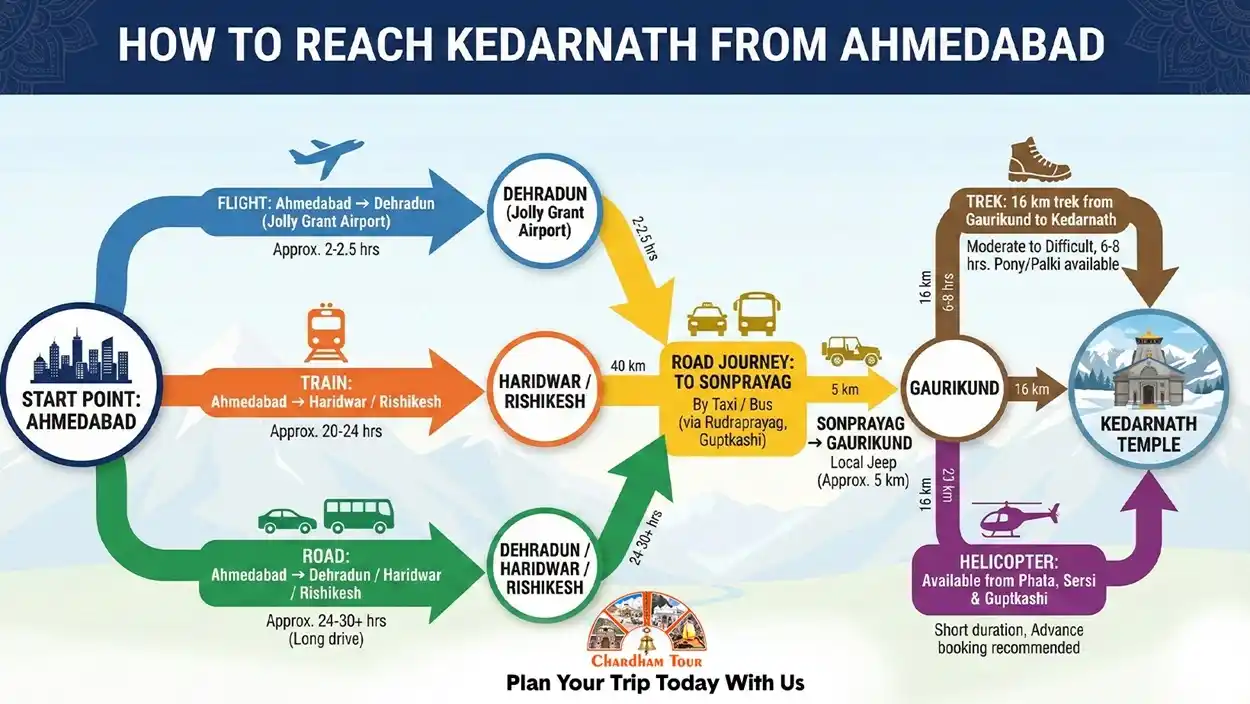
There’s no road to Kedarnath itself. That’s the detail most guides skip, and it’s the one that actually shapes your trip. Whatever you book from Ahmedabad — flight, train, or your own car — it gets you as far as Gaurikund. After that, everyone walks, rides a pony, or flies the last stretch by helicopter. No exceptions, no shortcuts.
The good part is that once you know this, the planning stops being confusing. This guide covers the routes, the registration you can’t skip, current helicopter fares, and the mistakes that trip up first-timers.
Quick Answer
Fly or take the train from Ahmedabad toward Dehradun or Haridwar, drive on to Sonprayag/Gaurikund, then cover the last 14–18 km (sources vary) by foot, pony, or helicopter from Sirsi, Phata, or Guptkashi. Register for the Yatra before you travel — it’s free, mandatory, and required before you can even attempt a helicopter booking. Budget two to three days one-way if you’re combining flight and road travel.
Best Ways to Reach Kedarnath from Ahmedabad
Pick based on time and who’s travelling with you. A family with an elderly parent has different constraints than two friends on a five-day trip.
Ahmedabad to Kedarnath by Flight
Flying gets you there fastest, but check the routing before you assume it’s a straight hop.
- IndiGo’s own Ahmedabad–Dehradun route page lists flights via Delhi, Mumbai, and Bengaluru — these are connecting flights, not non-stop. Some travel aggregators advertise a direct service on this route; treat that as unconfirmed and check the actual flight number before booking, because airline schedules shift seasonally.
- Air India and Air India Express also serve this sector, generally through the same hub cities.
- Total journey time with a connection typically runs 4–6 hours door to door, depending on the layover. Fares move with demand — expect a wider range during the May–June rush than in the shoulder months.
- From Jolly Grant Airport, hire a taxi to Rudraprayag, Guptkashi, or Sonprayag. Most people break this drive with an overnight halt rather than pushing straight through.
This is still the route most families lean toward. Even with a connection, it beats two straight days on the highway.
Ahmedabad to Kedarnath by Road
You can drive the whole way. Just don’t underestimate it.
- Road distance from Ahmedabad to the Sonprayag/Gaurikund area runs close to 1,429 km by the commonly quoted route — treat this as an approximate figure rather than an exact one, since it depends on your exact starting point in the city and the route your map app picks.
- Common route: Ahmedabad → Udaipur/Jaipur → Delhi → Haridwar/Rishikesh → Rudraprayag → Guptkashi → Sonprayag → Gaurikund.
- Two to three days with proper rest is realistic. One exhausted overnight push is how people end up driving hill roads after dark, which is the wrong way to do the Rishikesh–Gaurikund stretch.
- There’s no direct bus service from Ahmedabad to Kedarnath. You’ll connect through Haridwar or Rishikesh first, then a local bus or shared taxi onward to Sonprayag.
- From Gaurikund, the trek to Kedarnath is commonly quoted at 16 km, though official Uttarakhand sources aren’t fully consistent — some list figures as low as 14 km, others closer to 17–18 km depending on the exact route measured. Plan for something in that range rather than banking on one exact number. You can walk it, hire a pony, or book a palanquin (doli/kandi).
Ahmedabad to Kedarnath by Train
The train costs less than flying and beats a two-day drive for comfort, especially for anyone travelling with older family members.
- The Yoga Express (19031) runs daily from Ahmedabad to Haridwar, covering roughly 1,180–1,200 km in about 23–24 hours on current timetables. Fares range from around ₹590 in Sleeper to ₹3,600+ in AC classes — check IRCTC for the current fare before you commit, since these shift with class availability and dynamic pricing on some quotas.
- Haridwar and Rishikesh are the practical points to get off; Dehradun station also works if that suits your onward plan better.
- From Haridwar or Rishikesh, take a taxi to Sonprayag, then a jeep to Gaurikund.
- Book well ahead between April and June. This corridor gets heavy pilgrim traffic and tatkal seats disappear fast.
Helicopter services from Phata, Sirsi, and Guptkashi remain the way to skip most of the trek — covered in detail below.
Kedarnath Registration: What You Need Before You Travel
Skip this step and you risk the trip stalling out somewhere on the route. Char Dham Yatra registration is mandatory for anyone visiting Kedarnath, and it’s free — be wary of any third party charging a “registration fee,” because that’s a known scam during peak season.
- Register at the official portal, registrationandtouristcare.uk.gov.in, or through the Tourist Care Uttarakhand app. The portal typically opens ahead of the season; the exact date is announced closer to the temple’s opening, so check the site directly rather than relying on last year’s timeline.
- You’ll need a government photo ID (Aadhaar, Passport, or Voter ID), a recent photo, and your travel dates.
- Offline counters exist too, at points like Haridwar, Rishikesh, and Guptkashi, if you’d rather register on the way.
- Carry your registration slip both digitally and printed. Signal is patchy on this route, and you don’t want to be stuck with only a phone screen that won’t load.
Complete registration before the pilgrimage itself, and specifically before attempting a helicopter booking — the IRCTC portal won’t process a helicopter ticket without a valid registration number tied to it.
Kedarnath Helicopter Booking: Fares and Process
If the trek isn’t realistic for your group, the helicopter is the real alternative, and it’s in heavy demand every season.
Helicopter tickets are sold only through the official IRCTC HeliYatra portal (heliyatra.irctc.co.in). Three helipads serve Kedarnath:
| Helipad | Distance from Kedarnath | 2026 round-trip fare |
|---|---|---|
| Sirsi/Sersi | Shortest flight | ₹6,390 |
| Phata | Mid-range | ₹10,164 |
| Guptkashi | Longest route, best road access | ₹12,762 |
These are the UCADA-regulated base fares for the 2026 season. A convenience fee plus GST gets added on top at checkout — confirm the final payable amount on the portal rather than assuming the base fare is what you’ll pay.
A few things worth knowing before you try to book:
- Your Char Dham registration number is required before the portal will let you proceed.
- Helicopter seats are limited relative to demand, and popular slots go quickly during peak weeks. If your dates are fixed, log in as soon as the booking window opens rather than waiting.
- Book only through the official IRCTC site. Fake helicopter booking websites and WhatsApp-forwarded “agent” links have cost pilgrims real money in past seasons — this isn’t a hypothetical risk, it’s a documented pattern every Yatra season.
Ahmedabad to Kedarnath Itinerary
Here’s a realistic plan for first-timers, built around flying rather than driving the whole way. Treat it as a starting point — weather, trek pace, and darshan queues will shift the actual timing.
- Day 1 – Ahmedabad to Haridwar: Fly or take the train, check in, and catch the Ganga Aarti at Har Ki Pauri in the evening.
- Day 2 – Haridwar to Guptkashi: Drive via Devprayag and Rudraprayag, where two rivers meet. Overnight in Guptkashi.
- Day 3 – Guptkashi to Gaurikund, then the trek: Start early. Trek up, or take your booked helicopter from Phata, Sirsi, or Guptkashi instead.
- Day 4 – Darshan at Kedarnath, then back down: Attend the morning puja — timings vary by season, so confirm locally rather than assuming a fixed hour — then head back toward Guptkashi.
- Day 5 – Guptkashi to Rishikesh: Ram Jhula, Laxman Jhula, some time by the Ganga.
- Day 6 – Rishikesh to Haridwar: A lighter day, local sightseeing.
- Day 7 – Haridwar to Ahmedabad: Fly or board your return train.
A tighter 4–5 day version is possible if you fly both ways and cut the Rishikesh leg, but it leaves almost no buffer if weather or road conditions cause a delay — which happens often enough on this route that I wouldn’t plan around the tight version unless you genuinely have no flexibility.
Budget: How Much Does It Cost?
These are indicative ranges based on typical transport, stay, and food costs — not a fixed quote, since hotel category, exact dates, and availability move the number around.
- Budget (train + trek): roughly ₹12,000–₹18,000 — train to Haridwar, shared taxis, basic guesthouses, walking the trek.
- Mid-range (flight + trek or pony): roughly ₹20,000–₹28,000 — flight with a connection, private or shared taxi, mid-range stay, pony for the final stretch.
- Comfortable (flight + helicopter): roughly ₹35,000–₹45,000+ — flight, helicopter from Guptkashi or Phata, better hotels near Guptkashi or Sonprayag.
Separately: pony, kandi, and palki rates vary by service and season, and are best confirmed at the official prepaid counters rather than assumed in advance. Same goes for the helicopter convenience fee and GST — check the final total at checkout, not the headline fare.
Weather and Best Time to Visit
The season runs roughly late April to late October or early November, opening around Akshaya Tritiya and closing around Bhai Dooj, after which the deity moves to Ukhimath for winter. Exact dates are announced by the temple trust each year, usually around Mahashivratri — don’t rely on a fixed calendar date from a previous season.
- May–June: Pleasant days, cold nights, the heaviest crowds of the season.
- July to mid-September: Monsoon. Rain, landslides, and road disruption are common on the Rudraprayag–Sonprayag stretch. Check current road advisories before you travel in this window — I wouldn’t plan a trip here without one.
- Late September–October: Clearer skies and thinner crowds, generally the more comfortable trekking window.
Nights get cold even in the warmer months. Pack proper warm layers regardless of which month you’re travelling.
Common Mistakes to Avoid
- Skipping registration until the last minute. Helicopter and other bookings depend on it — do it first.
- Driving Rishikesh–Gaurikund in one exhausted push. These are narrow hill roads. Split the drive.
- Booking helicopter tickets through unofficial agents. Only heliyatra.irctc.co.in is real.
- Assuming a fixed trek distance or temple timing. Both vary by source and season — check current information rather than repeating last year’s numbers.
- Traveling through the monsoon corridor without checking road status. Landslides close this stretch for hours at a time most years.
Pro Tips for a Smooth Journey
- Start the trek early — leaving Gaurikund by 6–7 AM keeps you ahead of the crowd and the afternoon weather shift.
- Carry your own trash bag. The trail stays walkable when pilgrims pack their own waste out.
- Download maps and your registration slip before you lose signal — connectivity gets patchy past Sonprayag, and it varies by carrier and location rather than being reliably strong on any one network.
- Confirm the full helicopter fare, including fees and GST, before you pay — not after.
- Anyone with a heart, lung, or blood pressure condition should talk to a doctor before attempting a high-altitude pilgrimage, and check the latest official health advisory rather than assuming last year’s guidance still applies.
Why Choose Chardham Tour
You can plan every piece of this yourself — registration, transport, helicopter slots, hotel bookings during peak season. It’s doable, but it eats time, and a missed registration window or a sold-out helicopter slot can derail a trip that took months to plan. Chardham Tour packages the registration, transport, and stay together. Compare the inclusions and cancellation terms against what you’d spend booking each piece separately before deciding which makes sense for your trip.
Frequently Asked Questions
Q1: What is the Ahmedabad to Kedarnath distance?
There’s no motorable road to Kedarnath Temple itself. The road journey from Ahmedabad ends around Sonprayag/Gaurikund — commonly quoted near 1,429 km, though this varies by exact route — and the final stretch to Kedarnath is covered on foot, by pony, or by helicopter.
Q2: Is there a direct flight from Ahmedabad to Kedarnath?
No, and there isn’t a confirmed non-stop flight to Dehradun either. IndiGo’s Ahmedabad–Dehradun route currently runs via Delhi, Mumbai, or Bengaluru. Check the specific flight before booking, since airline schedules change by season.
Q3: Is there a direct bus service from Ahmedabad to Kedarnath?
No. You’ll need a bus or train to Haridwar or Rishikesh first, then a local bus or shared taxi to Sonprayag and Gaurikund.
Q4: Do I need to register before travelling to Kedarnath?
Yes. Char Dham registration is mandatory and free, done via registrationandtouristcare.uk.gov.in. Complete it before attempting a helicopter booking — the portal requires a valid registration number.
Q5: How much does a Kedarnath helicopter ticket cost?
For the 2026 season, round-trip fares are ₹6,390 from Sirsi, ₹10,164 from Phata, and ₹12,762 from Guptkashi, plus a convenience fee and GST at checkout. Booked only through heliyatra.irctc.co.in.
Q6: Is trekking safe for children and senior citizens?
Children can manage it with proper shoes, breaks, and supervision. Ponies are widely available. Senior citizens or anyone with health concerns should lean toward a pony, palanquin, or helicopter instead of the full trek.
Q7: How long does the Gaurikund to Kedarnath trek take?
Most people take roughly 6–9 hours on foot, depending on fitness, weather, and trail traffic. It’s not a fixed number — build in buffer rather than planning around the fastest estimate.
Q8: How much budget is needed from Ahmedabad to Kedarnath?
Indicatively between ₹12,000 and ₹45,000 per person, depending on whether you go train-and-trek or flight-and-helicopter. Treat this as a planning range, not a quote.
Q9: Which month is least crowded at Kedarnath?
Late September into October generally sees fewer crowds than the May–June peak, with more settled weather too.
Q10: Is the road from Ahmedabad to Haridwar safe for a self-drive trip?
The highway stretch is manageable. The final Rishikesh–Gaurikund section is a proper hill road, though, and deserves a full day of its own rather than being tacked onto the end of a long drive.
Q11: When does Kedarnath Temple open and close each year?
Roughly late April to late October or early November, with exact dates announced by the temple trust around Mahashivratri. Check the current year’s announcement rather than assuming a repeat of last season’s dates.
Q12: Can I book helicopter tickets through a travel agent?
Only IRCTC’s HeliYatra portal sells genuine tickets. Treat any agent promising guaranteed seats outside that portal as a red flag.
Conclusion
The road ends at Gaurikund — that’s the fact this whole trip is organised around. Everything from Ahmedabad, whether it’s a flight with a layover or a straight highway drive, is really just getting you to that one point. After that, it’s foot, pony, or helicopter, and the choice comes down to time, budget, and who’s travelling with you. Register early. If you want the helicopter, be logged into the portal the moment bookings open, because Guptkashi and Phata slots move fast. Split the hill-road driving across two days instead of one. Handle those and the rest of the trip is mostly waiting rooms and river views.
Suggested Tour:

Related Posts
Narad Kund, Badrinath

Neelkanth Peak, Badrinath