
The Yamuna carries more religious weight than almost any river in India, and more untreated sewage than almost any stretch of water near a national capital. Both things are true at the same time, and neither cancels the other out.
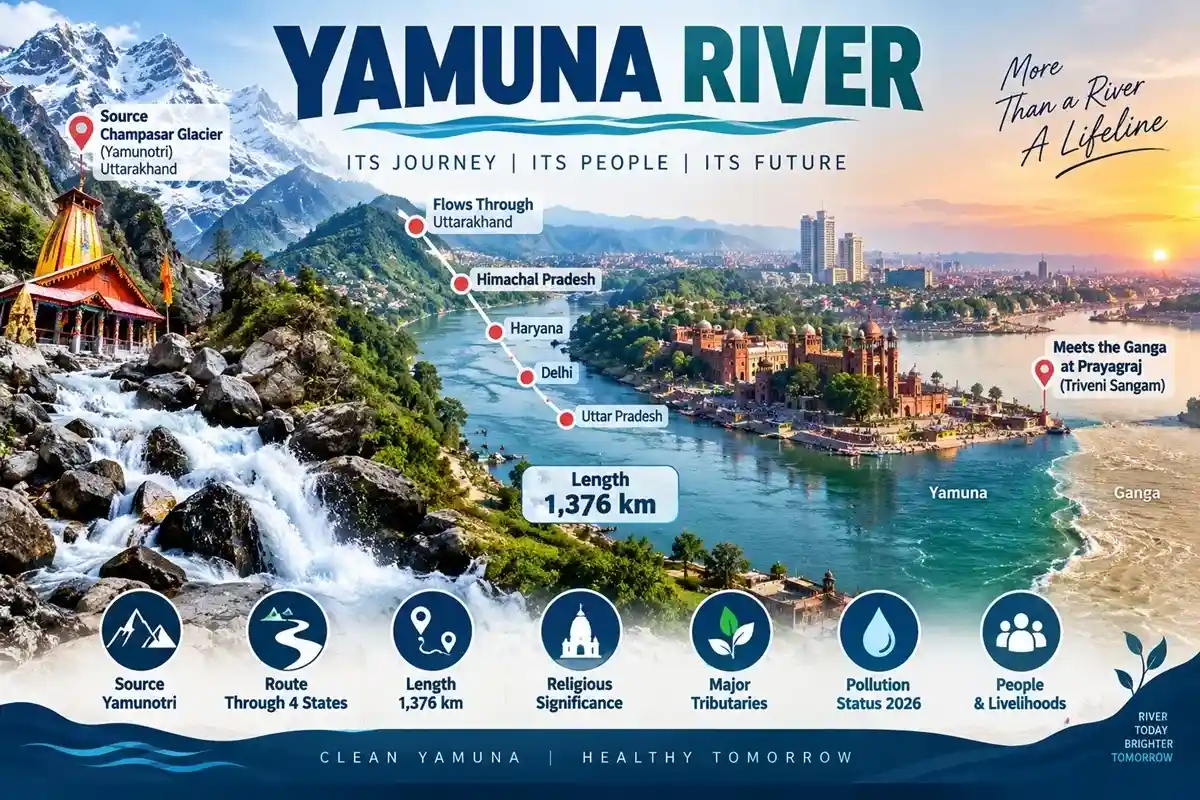
Also known as Jumna or Jamna — not the Jamuna that runs through Bangladesh — the Yamuna rises in the Garhwal Himalaya and flows about 1,376 km before meeting the Ganga at Triveni Sangam in Prayagraj, the site of the Kumbh Mela. For most Hindus, she isn’t simply a river. She’s Yami, sister of Yama, and the river that ran through Krishna’s childhood.
Quick answer: The Yamuna’s glacial source is the Champasar Glacier on Kalind Parvat, near Yamunotri in Uttarakhand, at about 4,421 m. It runs roughly 1,376 km through Uttarakhand, Haryana, Delhi and Uttar Pradesh before joining the Ganga at Prayagraj. She’s sacred and she’s badly polluted — mainly through the 22-km stretch that runs through Delhi.
Yamuna River: Key Facts
| Detail | Information |
|---|---|
| Glacial source | Champasar Glacier, Kalind Parvat, near Yamunotri |
| Source elevation | ~4,421 m (see note below on the higher 6,387 m figure) |
| Total length | ~1,376 km |
| Confluence with Ganga | Triveni Sangam, Prayagraj |
| Main river course | Uttarakhand → Haryana → Delhi → Uttar Pradesh |
| Wider Yamuna basin | Also touches Himachal Pradesh, Rajasthan, Madhya Pradesh |
| Major tributaries | Tons, Hindon, Chambal, Sindh, Betwa, Ken |
| First Char Dham shrine | Yamunotri |
Where the Yamuna Begins
Official sources don’t agree on a single elevation for the Yamuna’s source, and that’s worth explaining instead of just picking a number.
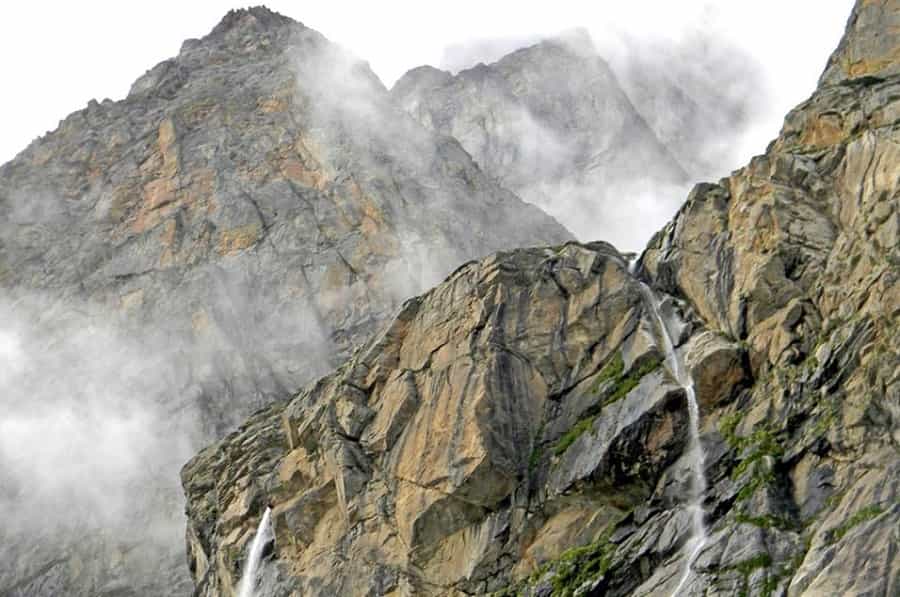
The Shri Badrinath-Kedarnath Temple Committee places the glacial source — the Champasar Glacier on Kalind Parvat — at 4,421 m, about a kilometre above the Yamunotri temple. That’s the figure most pilgrimage and tourism sources use, and it’s the one this page uses too. A Central Water Commission report on Yamuna morphology cites a higher figure, 6,387 m. That’s not a contradiction — it’s the elevation of the surrounding Bandarpunch massif, a different point on the same watershed, not the glacier itself.
The Bandarpunch massif holds three summits: White Peak at 6,102 m above Yamunotri, the main Bandarpunch peak at 6,316 m, and Kalanag at 6,387 m to the northeast. Tenzing Norgay reached the top in 1950 with Roy Greenwood and Sherpa Kin Chok Tshering, on an expedition led by Harold Williams. The massif sits inside Govind Pashu Vihar National Park, on the western edge of the high Himalaya.
The River’s Course
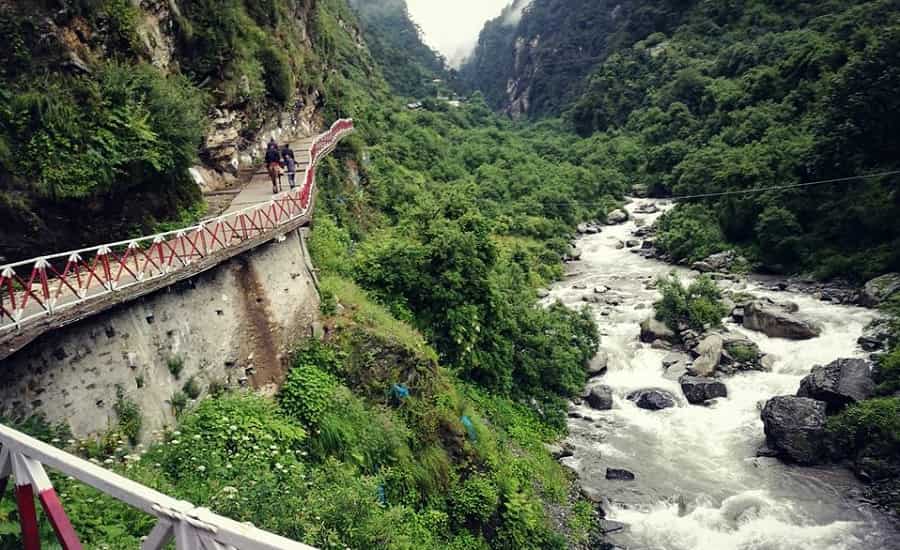
From Champasar Glacier, the Yamuna drops through roughly 200 km of lower Himalaya and Shivalik terrain before it reaches the plains. Near Naugaon, old terrace formations mark centuries of deposits from the river.
Its biggest tributary is the Tons — by some hydrological accounts, it actually carries more water than the Yamuna’s main stream at their confluence near Kalsi, close to Dehradun. From there the river passes Paonta Sahib, a significant Sikh pilgrimage town, and reaches Hathnikund Barrage in Haryana, where much of its flow is diverted for irrigation. During the dry months, what’s left downstream of the barrage thins out considerably before Delhi.
Upstream, the Yamuna forms part of the Uttarakhand–Himachal Pradesh boundary. Further down, it separates Haryana, Uttar Pradesh and Delhi. Once it reaches the plains, it runs roughly parallel to the Ganga, and the land between the two rivers forms the Ganga-Yamuna Doab — fertile ground, and the reason this belt grows so much basmati rice.
Why the River Is Sacred
In Hindu tradition, the Yamuna is Yami, daughter of the sun god Surya and sister of Yama, the god of death. Bathing in her waters is believed to protect against an untimely death, which is part of why the river is tied to Bhai Dooj rituals.
Her connection to Krishna runs deeper in everyday devotion. Puranic tradition holds that the river parted to let Vasudeva carry the infant Krishna safely across on a stormy night. Krishna grew up on her banks in Vrindavan and Mathura, and much of the Krishna Leela — his years as a cowherd, his time with Radha and the gopis — is set along this stretch of water.
Along the River
Yamunotri — the westernmost of the four Chota Char Dham shrines and the traditional starting point of the Char Dham Yatra. The temple sits beside Surya Kund, a hot spring where pilgrims cook rice as prasad, and the deity is represented in black marble.
Vrindavan — Krishna’s childhood home, now home to hundreds of temples, from the centuries-old Banke Bihari to the newer Prem Mandir.
Mathura — revered as Krishna’s birthplace, with ghats along the Yamuna where pilgrims take a ritual dip believed to free them from the fear of death.
Triveni Sangam, Prayagraj — where the Yamuna meets the Ganga and the mythical Saraswati. This confluence hosts the Kumbh and Ardh Kumbh melas, among the largest religious gatherings on earth.
The Trek to Yamunotri
Janki Chatti is the last point a vehicle can reach. From there, it’s about 6 km on foot to the temple — sources vary between 5 and 6 km, but the current Uttarakhand Tourist Care portal lists 6 km, and that’s the figure worth going with. Round trip works out to roughly 12 km.
On the road, Hanuman Chatti comes before Janki Chatti, not after — it’s a junction roughly 7 km short of Janki Chatti, sitting where the Yamuna meets the Hanuman Ganga. The actual foot trail starts at Janki Chatti and passes through Phool Chatti partway up before reaching the temple.
Most pilgrims cover the trek in 2 to 3 hours at a steady pace. Some guides quote 4 to 5 hours, and that’s realistic if you’re elderly, unfit, or walking during a crowded weekend. Pony, palki and doli services run out of Janki Chatti through official rate counters — use those instead of arranging something informally on the trail.
A chartered helicopter service also operates from Dehradun during the yatra season. It lands at Kharsali, not at the temple, so pilgrims still cover the final stretch to Yamunotri by road, pony or on foot. It cuts down road travel considerably, but it depends on weather and operator schedules, so don’t build a tight itinerary around it without confirming availability first.
When to Go, How to Get There
May–June and September–October are the safer windows. July and August bring a real risk of landslides and road closures on this route, and the temple committee itself advises against travel in that period.
Dehradun’s Jolly Grant Airport is the nearest airport; Rishikesh is the nearest major railhead. Both mean a long onward drive to Janki Chatti — the exact distance depends on which route you take, so treat any single number quoted online as approximate rather than fixed.
Registration Is Not Optional
Char Dham Yatra registration is required for every pilgrim heading to Yamunotri, and it should be completed online before travel — not at the checkpoint. For the 2026 season, the temple opened on 19 April, Akshaya Tritiya. A closing date around Bhai Dooj in November is widely reported, but it wasn’t officially confirmed at the time of writing. Check the Uttarakhand Tourism portal directly before you lock in travel dates.
What’s Actually Happening to the River
The Yamuna’s problem has a location. The 22-km stretch through Delhi — barely 2% of the river’s total length — is widely reported to produce more than 80% of its pollution load, according to Centre for Science and Environment assessments. Two drains, Najafgarh and Shahdara, do most of the damage.
Government data reported in July 2025 put Delhi’s sewage treatment capacity at 37 operational STPs, together handling 3,474 MLD against roughly 3,596 MLD generated daily. Only 23 of those plants met discharge norms; the rest didn’t. An estimated 641 MLD went into the river or drainage network untreated. Downstream at Nizamuddin, Okhla and Asgarpur, Biochemical Oxygen Demand readings ran well above the 3 mg/L threshold that defines acceptable water quality for this parameter.
That was the picture in mid-2025. By February 2026, a Delhi Pollution Control Committee inspection ordered by the Centre found a gap between what the Delhi Jal Board reported and what was actually happening on the ground. DJB claimed 238 MGD of sewage had been intercepted and diverted; the inspection found only about 142 MGD had genuinely been stopped. More than 117 MGD of untreated waste was still entering the river from drains the board had marked complete.
Delhi has also announced 12 additional STPs, planned at an estimated cost of ₹7,200 crore. Thousands of crores have already gone into Yamuna cleanup work over the years, and the river still isn’t clean. That gap between spending and results is the real story here — more than any single number in this section.
Where Pilgrims Go Wrong
Skipping registration is the most common mistake. Without it, you won’t be allowed to start the yatra, so handle it weeks ahead, not the night before.
The trek gets underestimated too. Six kilometres sounds manageable until you’re doing it above 3,000 m with a steep final push near the temple. Carry water, pace yourself, and don’t treat it as a casual walk.
Timing the trip around monsoon is another one worth avoiding outright. The landslide risk on this stretch is real, not theoretical, and the temple committee’s own advice reflects that.
Skip the informal pony deals outside the official counters at Janki Chatti as well. Rates are fixed there for a reason.
What Actually Helps
Start the trek early, ideally before the mid-morning crowd builds up. Carry a jacket regardless of season — temperatures near Yamunotri drop fast once the sun drops behind the ridge. If time is tight, the helicopter-to-Kharsali option saves a full day of road travel, though it’s worth confirming the operator’s schedule in advance rather than assuming availability.
FAQs
Q1. Where does the Yamuna River originate?
Its glacial source is the Champasar Glacier on Kalind Parvat, near Yamunotri, at about 4,421 m. A government report on the surrounding Bandarpunch massif cites a higher figure, 6,387 m — that’s a different point on the same watershed, not a contradiction.
Q2. How long is the Yamuna River?
About 1,376 km, from its Himalayan source to its confluence with the Ganga at Prayagraj.
Q3. Is the Yamuna a tributary of the Ganga?
Yes — it’s the Ganga’s only right-bank tributary.
Q4. How far is the Yamunotri trek from Janki Chatti?
About 6 km one way, roughly 12 km round trip. Janki Chatti is the last point a vehicle can reach.
Q5. How long does the Yamunotri trek take?
Most pilgrims manage it in 2 to 3 hours at a steady pace. Allow longer if you’re elderly, unfit, or walking during peak-season crowds.
Q6. Is Char Dham registration compulsory for Yamunotri?
Yes. It’s required for every pilgrim and should be completed online ahead of travel.
Q7. When does Yamunotri Temple open and close in 2026?
It opened on 19 April 2026, Akshaya Tritiya. A closing date around Bhai Dooj in November is widely expected but wasn’t officially confirmed at the time of writing — check the Uttarakhand Tourism portal before travelling.
Q8. What’s the best time to visit Yamunotri?
May–June and September–October. July and August carry landslide risk on this route and are best avoided.
Q9. Why is the Yamuna considered sacred?
She’s worshipped as the goddess Yami, sister of Yama, and closely tied to Krishna’s childhood in Vrindavan and Mathura.
Q10. Is the Yamuna polluted?
Badly, especially through Delhi. The 22-km stretch through the city is reported to account for more than 80% of the river’s total pollution load, despite being a small fraction of its length.
Q11. Can pilgrims hire a pony or palki for the trek?
Yes, through official rate counters at Janki Chatti. A chartered helicopter also runs to Kharsali during the season, with the final stretch to the temple covered by road, pony or on foot.
Q12. Which states does the Yamuna flow through?
The main river runs through Uttarakhand, Haryana, Delhi and Uttar Pradesh. The wider Yamuna basin also touches Himachal Pradesh, Rajasthan and Madhya Pradesh.
2 thoughts on “Yamuna River, Uttarakhand”
Leave a Reply

Related Posts
Sayanachatti to Yamunotri Guide
Dharchula: Gateway to Adi Kailash, Om Parvat & Kailash Mansarovar
There should also be programme like yamuna cleaning act and the river yamuna is a very religious river and people are dumping garbage in it.
क्या इस देश का हर नागरिक यमुना नदी को पवित्र करने का संकल्प करे