
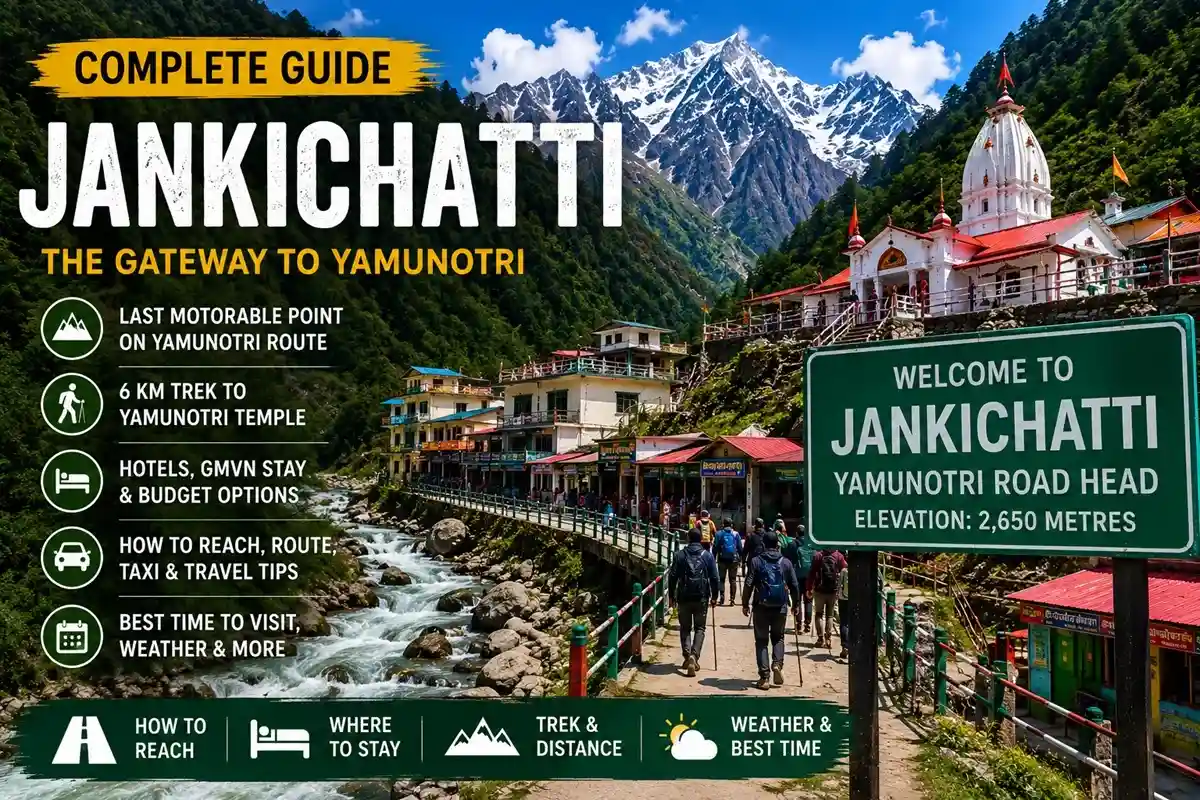
Jankichatti is the last motorable point on the way to Yamunotri — where the real journey begins. Once your cab or bus stops here, the temple, hot springs, and trails ahead are reached only on foot, pony, or palki. It’s a small halt that sets the tone for the entire Yamunotri leg of the yatra.
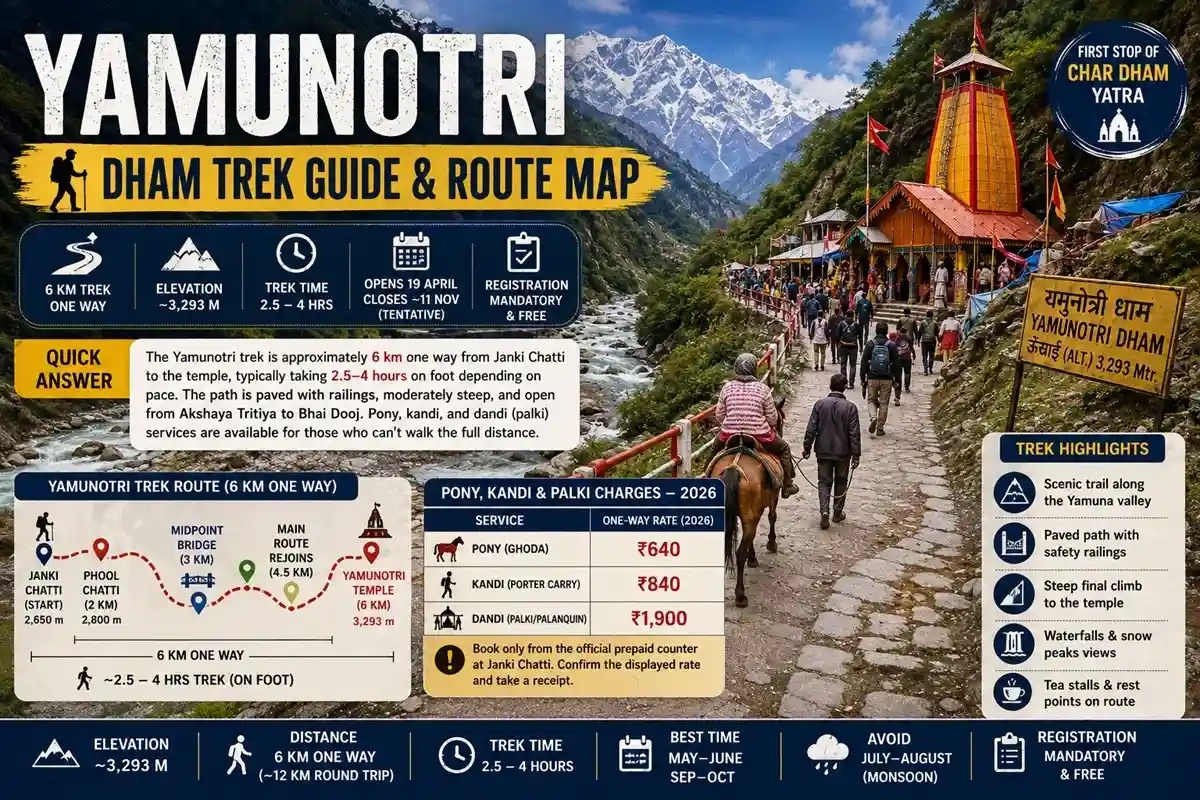
Quick Answer: Jankichatti sits at an elevation widely cited as around 2,650 metres in the Garhwal Himalayas. Yamunotri temple is 6 km away on foot, while Hanuman Chatti — a separate, earlier stopover — is about 13 km from Yamunotri. Late April–June and September–October are generally best, though exact yatra dates change yearly.
Location and How Far Is Yamunotri from Jankichatti
Jankichatti lies close to Kharsali village, at the base of the Garhwal Himalayas, at an elevation commonly quoted around 2,650 metres. The Jankichatti to Yamunotri distance is 6 km on foot (a couple of sources round it to 5 or 7 km). Most travelers cover it in 2–4 hours depending on fitness and pace; pilgrims on pony or palki often do it faster.
Note: Hanuman Chatti, an earlier stopover on the route, is about 13 km from Yamunotri — not 13 km from Jankichatti. Jankichatti, the last motorable point and much closer to the temple, is where most vehicles stop and most pilgrims prefer to stay before the final climb.
How to Reach Jankichatti
By Road to Jankichatti
From Rishikesh, the route runs via Dehradun – Mussoorie – Barkot – Syanachatti – Ranachatti – Jankichatti, taking roughly 7–10 hours depending on traffic and road conditions. Buses and private taxis both run this stretch during the yatra season.
By Train
Rishikesh (~222 km) and Dehradun are the nearest practical railway stations — Dehradun is sometimes closer depending on the route. Taxis are available outside both for the onward journey.
By Air
Dehradun’s Jolly Grant Airport, roughly 200–210 km away, is the closest airport. Taxis and private transfers cover the onward journey, typically 7 hours or more depending on conditions.
Cab and Taxi Costs
Pricing depends on group size — a smaller car works for 2–4 people, larger groups need a 12/14/16-seater tempo traveller. Taxi fares vary by vehicle, season and union rates — confirm current fares with a local operator before booking.
Char Dham registration: Uttarakhand requires pilgrims to register online (or at designated counters) before starting the Yamunotri leg. Carry your registration letter/e-pass and ID — verification may be required at designated checkpoints.
Where to Stay in Jankichatti
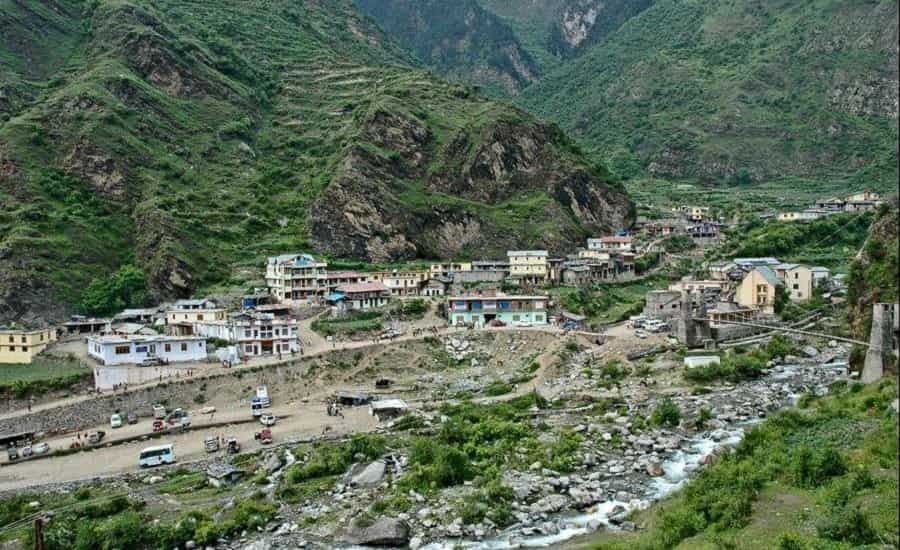
- Hotels: Standard, deluxe, and super-deluxe options are available. Prices vary significantly by season and room category — peak yatra dates (May–June) can be considerably more expensive than shoulder months, so check current rates directly with the hotel or GMVN before booking.
- GMVN Guest Houses: A reliable, budget-friendly option available in the Jankichatti area, subject to seasonal operation and availability.
- Ashrams and Dharamshalas: Several are located in and around Jankichatti, offering low-cost stays with simple meals for pilgrims on a tight budget.
Since Jankichatti has limited rooms, especially during peak season, Barkot (roughly 1.5–2 hours away by car) is a solid backup if everything here is booked out.
Jankichatti’s Role in the Chardham Yatra
Jankichatti is the last motorable point on the Yamunotri route — vehicles cannot go beyond it, making it the main parking and staging point for the pilgrimage. Many pilgrims stay overnight here to start the trek early and catch the morning darshan before crowds build up. The town is lively through the yatra season and turns quiet once the temple closes for winter.
Weather and Best Time to Visit
Yamunotri Dham opens and closes each year on Hindu calendar dates — around Akshaya Tritiya (typically late April) and Bhaiya Dooj (typically late October). Always confirm current-year dates before planning.
| Season | Approx. Months | Conditions |
| Peak | Late April – June | Main pilgrimage season, generally favorable, crowds build up |
| Monsoon | July – August | Rain, slippery trails, landslide risk |
| Post-monsoon | September – late October | Generally favorable, weather can still change quickly |
| Winter (closed) | Late October – April | Temple closed; Jankichatti turns quiet |
Late April–June and September–mid-October are generally preferred for the trek, but check road and weather conditions before travelling — hill roads can be affected by landslides even outside monsoon.
Hot Water Springs
Jankichatti itself has natural hot water springs. The most famous, Surya Kund, is actually located at Yamunotri temple, not Jankichatti — pilgrims traditionally cook potatoes and rice as prasad there by dipping cloth-wrapped bundles into the naturally boiling water, a ritual first-time visitors rarely expect. The springs hold deep religious significance for pilgrims.
Nearby Places and Advanced Treks
- Saptarishi Kund – A remote, high-altitude glacial lake around 10 km from Yamunotri, linked to the legend of seven sages performing penance here. This is an arduous trek, not a casual sightseeing excursion — experienced trekkers should use local guidance.
- Kharsali – The winter seat of Yamuna Maa’s idol, known for scenic views and close proximity to Jankichatti.
- Hanuman Chatti – Home to an ancient Hanuman temple, believed (per local tradition) to mark where Bheem met Hanuman.
- Barkot – A quiet hill town with Bandarpoonch range views, useful as a stopover or overflow accommodation.
What to Pack for Jankichatti
Since Jankichatti sits at roughly 2,650 metres and the trail climbs higher still, temperature swings between day and night are sharp even in peak season. Carry:
- A warm jacket or fleece
- Sturdy trekking or walking shoes with good grip
- A rain cover or poncho, especially during monsoon
- A refillable water bottle and dry snacks
- Any prescribed medicines and a basic first-aid kit
Senior citizens and those trekking with elderly family members should plan for pony or palki assistance in advance, since availability drops quickly once the peak season crowd arrives.
Mobile connectivity can be intermittent around Jankichatti and is unreliable on the trek itself — share your rough schedule with family before you start walking, and don’t rely on it for emergencies.
Common Mistakes to Avoid
- Assuming rooms will be available without booking during peak season.
- Starting the trek late instead of early morning, missing cooler weather.
- Skipping layered clothing — temperatures drop sharply after sunset.
- Ignoring local advice on trail conditions after monsoon rain.
Pro Tips
- Book Jankichatti or Barkot accommodation in advance during peak season.
- Start the 6 km trek early morning for cooler weather and lighter crowds.
- Carry cash — digital payments can be unreliable this close to the mountains.
- Pony and palki options are available if you’d rather not trek the full stretch.
FAQs
Q1. How far is Jankichatti from Yamunotri temple?
It’s about 6 km, usually covered on foot in 2–4 hours depending on fitness and pace, or faster by pony or palki.
Q2. How do I reach Jankichatti from Rishikesh?
By road via Dehradun–Mussoorie–Barkot, roughly 7–10 hours depending on conditions; taxis and buses both run this route.
Q3. What is the best time to visit Jankichatti?
Late April–June and September–mid-October are generally preferred, but exact Yamunotri opening/closing dates change every year — confirm before you travel.
Q4. Where should I stay near Jankichatti?
Hotels, GMVN guest houses, or ashrams in Jankichatti itself, or Barkot as a backup if rooms are full.
Q5. Is Yamunotri open in winter?
No — the temple closes for winter (roughly late October to late April, dates vary yearly); Jankichatti stays much quieter with reduced services.
Q6. What is Surya Kund known for?
A hot-water spring at Yamunotri temple where pilgrims cook rice and potatoes as prasad — it holds religious significance for the yatra.
Q7. Do I need to register for the Yamunotri trek from Jankichatti?
Yes — Char Dham Yatra registration is mandatory; carry proof at checkpoints along the route and at Jankichatti itself.
Q8. Is Jankichatti suitable for senior citizens?
Yes, with planning — book pony or palki assistance in advance, since demand is high in peak season and options run out fast.
Q9. Is mobile network available in Jankichatti?
Connectivity can be intermittent in town and is unreliable on the trek — don’t depend on it for emergencies.
Q10. Can I do the Jankichatti to Yamunotri trek in a day?
Yes, if you start early morning — though an overnight stay makes it far more comfortable.
Conclusion
Jankichatti works best as a well-planned overnight halt: arrive early, book your stay ahead of time, and start the trek to Yamunotri at first light. Late April–June or September–mid-October are generally the smoothest windows to visit — but confirm current-year opening/closing dates and road conditions before you travel, and keep Barkot as a backup if Jankichatti’s limited rooms are full.
2 thoughts on “Jankichatti: Starting Point to Yamunotri Trek”

Related Posts
Planning a Gangotri Yamunotri Yatra Package
Yamunotri Temple Opening Date 2026
अति सुन्दर प्रस्तुति और वातावरण
i a m not getting any shared jeep or bus from janaki chatti to barkot on 16-6-2023-waiting from 7am- please help