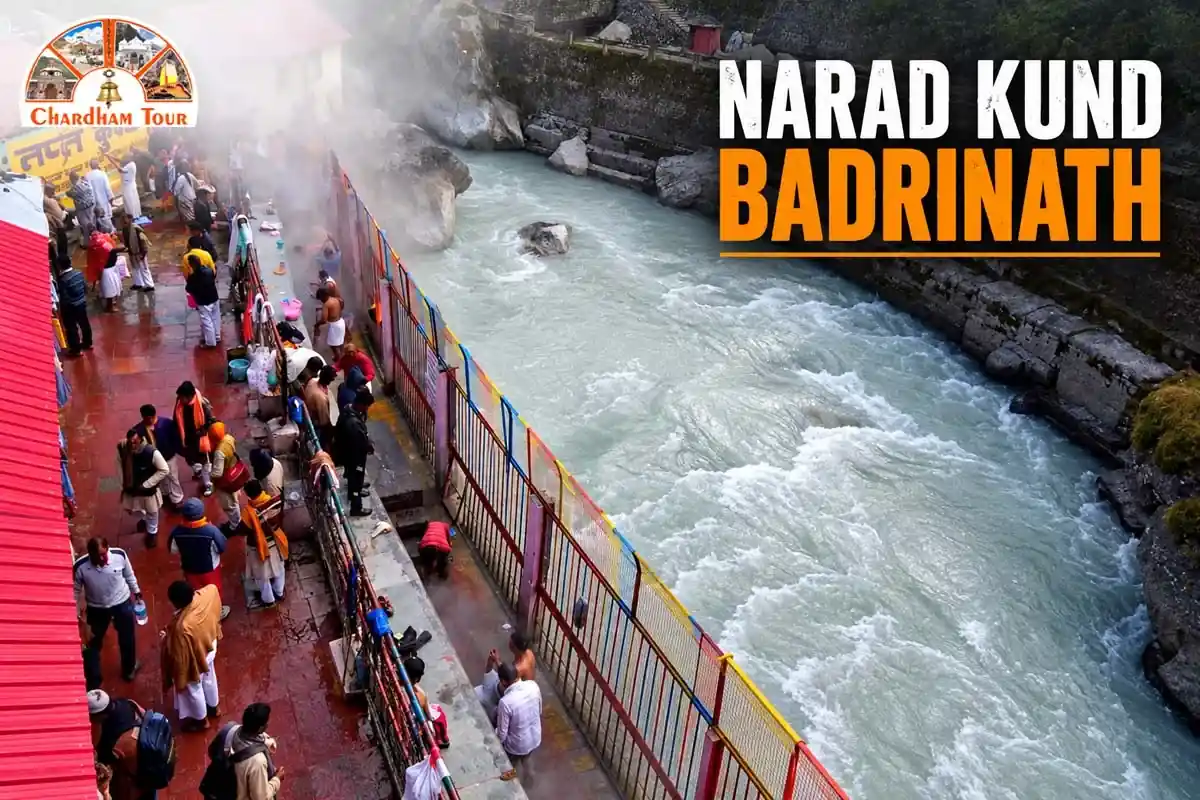
Half a kilometre from Badrinath Temple, right next to Tapt Kund, sits a small pool most visitors walk past without stopping. That’s Narad Kund. Temple tradition says this is where the Badrinath idol was recovered. It doesn’t get the footfall Tapt Kund does, but it’s arguably closer to the actual founding story of the shrine.
Quick answer: Narad Kund is a natural pool in the Alaknanda, about 0.5 km from Badrinath Temple, right beside Tapt Kund. Tradition holds that Adi Shankaracharya recovered the Badrinath idol from here in the 8th century. It takes its name from the sage Narad Muni, associated with the site through a separate rock nearby called Narad Shila.
| Detail | Information |
| Distance from Badrinath Temple | About 0.5 km / 4 minutes |
| Location | Beside Tapt Kund, on the left side of the temple complex |
| Nature | A bay in the Alaknanda, naturally enclosed by rock |
| Named after | Sage Narad Muni |
| Significance | Traditionally where Adi Shankaracharya recovered the Badrinath idol |
| Century | 8th century AD |
| Idol | Black Shaligram stone, one metre high, holding a conch and chakra |
| Temple bank | Badrinath Temple sits on the right bank of the Alaknanda |
| Bathing | Many pilgrims take a dip here before darshan |
| 2026 Kapat opening | 23 April 2026 |
What Tradition Says Happened Here
Adi Shankaracharya’s Himalayan travels in the 8th century are the starting point for most of Badrinath’s founding story. Temple tradition holds that he recovered a black Shaligram idol of Vishnu from the Alaknanda at Narad Kund and first enshrined it in a cave near Tapt Kund. The current temple structure came later — Garhwal’s king moved the murti to its present location in the 16th century. The idol itself is one metre tall, carved in black stone, and shown holding a conch and chakra with two other hands resting in yoga mudra. That’s the idol worshipped in the sanctum today.
I’ll flag one thing plainly: this is temple tradition, not an archaeological record. Treat it that way, and it doesn’t need constant hedging — it’s simply the account the Badrinath-Kedarnath Temple Committee itself gives, and it’s the version worth repeating.
Named After Narad Muni — But Not Quite the Way Most Sites Describe It
Here’s where a lot of travel content gets sloppy. Sites routinely lump Narad Shila into a list of “five sacred rocks” collectively called the Panch Shila. The temple committee’s own listing says otherwise: the Panch Shila are Garud, Nar, Narsingh, Varah, and Markandeya Shila, sitting around Tapt Kund. Narad Shila is described separately — a distinct, cone-shaped rock standing between Tapt Kund and Narad Kund, not one of the five.
Other tourism sources — including some fairly widely repeated lists — swap Nar Shila out and put Narad Shila into the group of five instead. Both versions are in circulation. I’m going with the temple committee’s own account as the primary one here, since it’s the more authoritative source for a fact specifically about temple geography, but you’ll see the other version elsewhere and it’s not fabricated — it’s just a different official-sounding source saying something different.
Narad Muni’s connection to the spot comes through this Narad Shila, where he’s said to have meditated for a long stretch of time. Some accounts tie the composition of the Narada Bhakti Sutra to this same spot.
What the Panch Shila Actually Represent
Each of the five stones carries its own story. Garud Shila marks where Garuda meditated for thirty thousand years hoping to become Vishnu’s vahana. Narsingh Shila is tied to the Narasimha avatar. Varah Shila takes its shape and name from the boar incarnation. Markandeya Shila is where the sage Markandeya is said to have settled after Narad advised him to leave Mathura. Nar Shila completes the set. All five sit within the same stretch of ground near Tapt Kund — not scattered across Badrinath, and not, contrary to how some pages describe it, ringing Narad Kund itself.
Why the Water Is Warm
The temple committee’s own account attributes the warm water at Narad Kund to Garuda Shila — the spring flows out from beneath that rock and into the pool. Incredible India’s page, by contrast, names a different rock, Gauri Shila, as the source. That’s a real conflict between two official-sounding sources, not something I can resolve by picking whichever sounds more authoritative. I’d treat the Garuda Shila account as the stronger of the two, since it comes directly from the temple committee, but I’m not going to pretend the other version doesn’t exist.
Geologically, warm springs at this altitude are generally explained by geothermal activity, though I haven’t found a source that gets specific about Narad Kund’s mechanism rather than the region’s springs generally.
Do Pilgrims Actually Bathe Here?
Yes. This is worth correcting plainly: some travel content draws a hard line between Tapt Kund as “the bathing spot” and Narad Kund as “the historical one, not for bathing.” That’s not accurate. The temple committee describes many pilgrims taking a bath in Narad Kund before heading to the shrine. Tapt Kund remains the better-known and more customary bathing point before darshan, but Narad Kund isn’t excluded from that practice.
The Vasuki Legend
One more piece of local belief, worth knowing because it explains a rule at the temple: local tradition holds that the serpent king Vasuki’s realm lies beneath Narad Kund, and that blowing a conch could disturb him — which is offered as the reason conch-blowing is avoided during Badrinath rituals. I haven’t found this specific claim in the temple committee’s own material, so treat it as local legend rather than an official account. It’s widely repeated, but repetition isn’t the same as a primary source.
Visiting Narad Kund
It’s close enough to the main temple and Tapt Kund that seeing it doesn’t require a separate trip — about 0.5 km, four minutes, according to the temple committee’s own distance listing. Since Narad Kund sits within the Badrinath shrine area, access follows the same seasonal pattern as the temple. The 2026 Kapat opened on 23 April. Closing dates get confirmed by the temple committee closer to the date each year — if you’re planning a late-season visit, check their current announcement rather than relying on last year’s schedule.
Frequently Asked Questions
What is Narad Kund known for?
Temple tradition holds it’s where Adi Shankaracharya recovered the Badrinath idol in the 8th century.
Is Narad Kund the same as Tapt Kund?
No. They’re separate pools next to each other. Tapt Kund is the more customary bathing spot; Narad Kund carries the idol-recovery story.
Can you bathe in Narad Kund?
Yes. The temple committee describes pilgrims bathing here before heading to the shrine, alongside the more common practice at Tapt Kund.
How far is Narad Kund from Badrinath Temple?
About 0.5 km, roughly a four-minute walk, per the temple committee’s own distance listing.
What are the Panch Shila?
Five sacred rocks near Tapt Kund. The temple committee lists them as Garud, Nar, Narsingh, Varah, and Markandeya Shila. Some other tourism sources give a different fifth name and include Narad Shila instead — the sources genuinely disagree here.
Is Narad Shila part of the Panch Shila?
According to the temple committee, no — it’s a separate rock standing between Tapt Kund and Narad Kund. Other sources group it with the five.
How big is the Badrinath idol?
One metre tall, carved from black Shaligram stone, shown holding a conch and chakra.
Which side of the Alaknanda does Badrinath sit on?
The right bank.
Why is the water at Narad Kund warm?
The temple committee attributes it to Garuda Shila; a separate source names Gauri Shila instead. The two accounts don’t agree.
Why is conch-blowing avoided at Badrinath?
Local legend ties it to Vasuki’s realm beneath Narad Kund. It’s a widely told explanation, though not one I found in the temple committee’s own material.
When does Narad Kund become accessible each year?
Whenever Badrinath Temple opens for the season. The 2026 Kapat opened 23 April; closing is confirmed by the temple committee closer to the date.
Bottom Line
Narad Kund’s core story checks out against the temple’s own account: Shankaracharya, the idol, the cave, the 16th-century move to the present temple. Where things get messy is the surrounding detail — the exact five names of the Panch Shila, which rock actually warms the water, whether Narad Shila belongs in that list at all. Different official-sounding sources say different things on those points, and the honest move is to say so rather than pick one and present it as settled. If you’re at Badrinath, it’s a two-minute stop next to Tapt Kund, and it’s worth making before you go in for darshan.
Suggested Tour