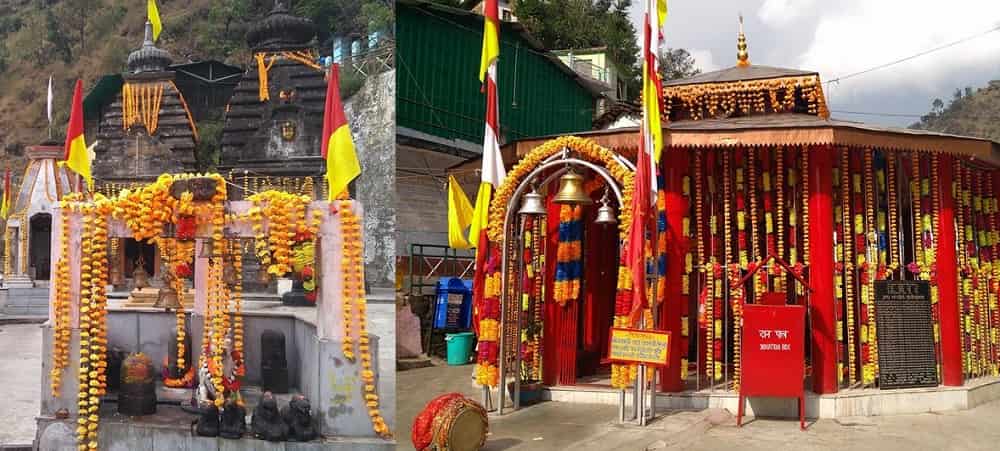
Kalimath sits on the banks of the Kaliganga (locally known as Saraswati river) in Rudraprayag district, close to Guptkashi and Ukhimath. The Badrinath-Kedarnath Temple Committee, which administers the shrine, classifies it as a Siddha Peeth. A number of pilgrimage and tourism sources go further and list it among the 108 Shakti Peethas described in the Srimad Devi Bhagwat Mahapuran. Both descriptions circulate. The temple committee’s own classification is the one worth trusting first.
At a glance:
| Detail | Info |
| Location | Kalimath village, Rudraprayag district, Uttarakhand |
| River | Saraswati (locally also called Kali Ganga) |
| Official status | Siddha Peeth (Badrinath-Kedarnath Temple Committee) |
| Guptkashi | ~10 km by road |
| Ukhimath | ~20 km by road |
| Rudraprayag town | ~49 km by road |
| Jolly Grant Airport | ~204 km |
| Rishikesh Railway Station | ~186–187 km |
| Best time | Navratri for atmosphere; March–June or late autumn for weather |
How Old Is the Tradition Here, and What Do People Believe About It
Local tradition holds that Goddess Kali slayed the demon Raktabeej at this spot and then went into the ground. A tradition connects Kalimath to nearby Dhari Devi Temple: Kalimath is said to hold the lower half of the Goddess, Dhari Devi the upper half. Neither of these is something you can verify against a government record. Treat them as what they are: religious tradition, repeated across pilgrimage accounts for generations, not documented history.
What the temple committee does confirm: the shrine is visited year-round, and it draws its biggest crowds during Navratra.
What’s Actually Inside the Temple
This is where a lot of write-ups get sloppy. Several call Kalimath an idol-less temple and stop there. It’s not that simple.
The central worship at the Kali shrine is tied to a sacred spot associated with the Sri Yantra — several pilgrimage sources describe a silver-covered plate marking this spot, said to be uncovered only once a year, at midnight on Ashtami during Navratri, for a ritual performed by the chief priest alone. That detail comes from tourism sources, not from the temple committee’s own page, so hold it as tradition rather than confirmed procedure.
What the temple committee does confirm: the complex has a Har Gauri idol over a metre tall, plus shrines to Mahalaxmi, Mahasaraswati, Gauri Shankar Mahadev, and Bhairav. So “no idol at all” is wrong. The main Kali worship centres on the Yantra tradition; the wider complex is full of idols.
Kalimath Temple Timings
There’s no published timing chart on the temple committee’s site. None of the fixed hours you’ll see quoted elsewhere — 5 AM to 9 PM, 6 AM to 8 PM, whatever the number — come from an official source. Don’t plan around them as fact.
What’s reliable: the temple is open through the day, closes briefly for a midday break, and stays open later during Navratri. Confirm the day’s actual schedule once you reach Ukhimath or Guptkashi. That single phone call or local check saves more hassle than any timing chart you’ll find online.
Getting There
There’s no airport or railhead at Kalimath. Every route ends with a stretch of hill road.
By air: Jolly Grant Airport, Dehradun, is roughly 204 km away, per the temple committee. Taxis and buses run between Dehradun and Rudraprayag; you’ll switch to a local taxi for the final leg to Kalimath.
By rail: Rishikesh railway station is around 186–187 km away and is the railhead most travellers use. Dehradun’s station is farther, around 228 km. Haridwar also works as a starting point for onward road travel, though it isn’t the nearest station — don’t trust any write-up that claims it is.
By road: Rishikesh → Devprayag → Srinagar (Garhwal) → Rudraprayag → Ukhimath → Kalimath is the standard route. From Rudraprayag town it’s about 49 km; from Ukhimath, a shorter 20 km. Shared jeeps run this stretch regularly.
| From | Distance to Kalimath |
| Ukhimath | ~20 km |
| Guptkashi | ~10 km |
| Rudraprayag | ~49 km |
| Rishikesh Railway Station | ~186–187 km |
| Jolly Grant Airport | ~204 km |
| Dehradun Railway Station | ~228 km |
Places to Visit Near Kalimath
Guptkashi — About 10 km away. Legend places Lord Shiva here, hiding from the Pandavas. It’s also where most pilgrims stage before or after visiting Kalimath, since it has the most reliable stay options in the area.
Ukhimath — Around 20 km. This is the winter seat of Kedarnath and Madhyamaheshwar, with the Omkareshwar Temple as its main draw.
Kalishila — A rock shrine connected to the same Raktabeej legend, reached by trek from Kalimath. Sources disagree on the exact distance, with figures ranging from 6 to 8 km depending on the route counted. Budget half a day if you’re adding this on.
Gaurikund — The starting point for the Kedarnath trek, at around 1,982 metres, with a tank where pilgrims bathe before the climb.
Kedarnath Temple — One of the twelve Jyotirlingas. Getting there from Kalimath means driving via Guptkashi and Sonprayag, then walking the final stretch from Gaurikund on foot — there’s no road all the way.
Rudraprayag — The confluence of the Alaknanda and Mandakini rivers, considered a sacred bathing point.
Chopta — A high-altitude spot popular for trekking, with views toward the Kedarnath range.
Weather
March to June brings mild-to-warm days and cooler evenings, and this is generally the best stretch for road conditions and visibility. Monsoon, July through September, brings heavy rain and a real risk of landslides on the Rudraprayag–Ukhimath stretch — check road conditions before you set out in this window. December to February turns cold, especially mornings and evenings, though the temple stays accessible; road conditions can still slow you down after snowfall.
I’m not going to hand you exact temperature ranges here. Every write-up online quotes a different set of numbers for Kalimath specifically, and none of them point to an actual weather station. If you need precise figures for trip planning, check a current forecast closer to your travel date rather than trusting a blog’s seasonal averages.
Best Time to Visit
Navratri is when the temple is most alive — both the spring and autumn observances draw the biggest crowds and the most visible rituals. If crowds aren’t your thing, April–May or late September into October gives you good road conditions without the festival rush. Monsoon months are worth skipping outright.
Where to Stay
Kalimath village has only basic guesthouses and dharamshalas. Most travellers stay in Guptkashi, Ukhimath, or Rudraprayag instead.
- Guptkashi (~10 km): Closest real option, with a mix of budget and mid-range hotels. Popular with Kedarnath pilgrims too, so book ahead in peak season.
- Ukhimath (~20 km): Slightly better rooms, including ones with attached bathrooms and hot water. Good base if Madhyamaheshwar is also on your list.
- Rudraprayag (~49 km): The widest range of stays in the district. Rates shift a lot by season and demand — check current pricing before you book rather than going by any number quoted online, including this one.
Common Mistakes
Skipping the timing check is the big one. Since there’s no official schedule published anywhere, calling ahead is the only way to know you won’t arrive during the midday break.
Assuming Kalimath village itself has real hotel options is the second. It doesn’t — base yourself in Guptkashi or Ukhimath.
Traveling through in peak monsoon without checking road conditions first causes more cancelled plans than anything else on this route.
And treating this as a five-minute stop undersells it. The complex has more in it than most visitors realise — the Har Gauri idol, the Mahalaxmi and Mahasaraswati shrines, Gauri Shankar Mahadev, Bhairav — worth the extra half hour.
Planning a Kedarnath or Panch Kedar Trip That Includes Kalimath
Kalimath sits close enough to the Ukhimath–Guptkashi stretch that it fits naturally into a Kedarnath or Panch Kedar itinerary without a major detour. If you’re routing through Chardham Tour, mention Kalimath when discussing your itinerary and it can be built into the stops without disrupting your main plan.
FAQs
Is Kalimath Temple a Shakti Peeth or a Siddha Peeth?
The Badrinath-Kedarnath Temple Committee classifies it as a Siddha Peeth. Several pilgrimage and tourism sources separately describe it as one of the 108 Shakti Peethas. Both descriptions are in circulation; the temple committee’s classification is the more authoritative one.
Is there an idol inside Kalimath Temple?
The main Kali worship is centred on a sacred spot tied to the Sri Yantra tradition, not a conventional idol. But the wider complex has a Har Gauri idol over a metre tall, plus shrines to Mahalaxmi, Mahasaraswati, Gauri Shankar Mahadev, and Bhairav.
How far is Kalimath from Guptkashi?
About 10 km by road, per the temple committee. A few other sources quote figures between 5 and 13 km, so treat 10 km as the reliable middle figure.
How far is Kalimath from Ukhimath?
About 20 km by road.
How far is Kalimath from Rudraprayag?
About 49 km by road.
What’s the nearest airport to Kalimath?
Jolly Grant Airport, Dehradun, about 204 km away.
What’s the nearest railway station?
Rishikesh, at roughly 186–187 km. Dehradun’s station is farther out, at about 228 km.
Are the exact temple timings published anywhere?
No. There’s no official timing chart. Confirm the day’s schedule locally once you reach Ukhimath or Guptkashi.
What’s the best time to visit?
Navratri for the fullest experience of the rituals; April–May or late September–October if you want good weather without the crowd.
Can Kalimath be combined with a Kedarnath trip?
Yes — it sits close to the Ukhimath–Guptkashi stretch on the standard Kedarnath route.
Is there an entry fee?
Darshan itself is free. Donations toward upkeep and prasad are typically voluntary, though this isn’t something the temple committee’s page spells out in detail.
What is Kalishila and how far is it from Kalimath?
Kalishila is a rock shrine connected to the same Kali legend, reached by trek. Sources put the distance anywhere from 6 to 8 km, depending on the route.
Conclusion
Kalimath doesn’t get the footfall of Kedarnath or Badrinath, and that’s most of its appeal — a Siddha Peeth with a real ritual tradition, minutes off a route most Kedarnath pilgrims already travel. Stick to what’s actually confirmed — the temple committee’s distances, the deities in the complex, the lack of a fixed timing schedule — and skip the invented precision that shows up on half the pages about this place. If you’re building a Kedarnath or Panch Kedar route and want Kalimath worked into it, that’s a conversation Chardham Tour can help with directly.

Related Posts
Narad Kund, Badrinath
Neelkanth Peak, Badrinath