Kedarnath Dham’s doors opened on 22 April 2026. On the very first day, 38,000 devotees turned up — the highest single-day opening count in the history of the pilgrimage. In the first 20 days, more than 4.5 lakh pilgrims had already completed darshan. By 18 May, that number reached 6.5 lakh, with roughly 32,000 people arriving daily. For comparison, the daily average in 2025 was around 18,000.
These aren’t just impressive statistics. They translate directly into what you’ll experience on the road: queues at Sonprayag that form before 9 AM, shuttle buses running at capacity for hours, and a 16 km mountain trek that starts feeling crowded before sunrise. On 12 May 2026, the traffic situation at Sonprayag didn’t just slow down — it collapsed. Thousands of pilgrims were stranded on roadsides for hours, including elderly devotees and young children.
This guide uses verified data from ANI, the Rudraprayag District Administration, UCADA’s official 2026 fare card, and News9Live ground reporting to give you the actual picture. No estimates, no outdated fares, no optimistic summaries that ignore the real conditions on the road.
Route Status Right Now: Is the Kedarnath Highway Open?
As of May 2026, the Kedarnath Yatra route is open. Pilgrims are reaching Kedarnath daily. But ‘open’ only means the road isn’t physically blocked right now — it says nothing about travel time, shuttle availability, or what you’ll encounter at the checkpoints.
- NH-107 Rishikesh to Sonprayag: Open, operational
- Sonprayag to Gaurikund shuttle: Running, but under heavy demand — long queues reported daily
- Gaurikund to Kedarnath trek: Open, well-marked, busy
- Season total visitors as of 18 May 2026: 6.5 lakh (Source: DM Vishal Mishra, ANI, 18 May 2026)
- Char Dham combined: Over 15.12 lakh pilgrims in 30 days — an all-time record
- Daily footfall at Kedarnath: Averaging 32,000 per day; single-day peak was 38,000 (opening day, 22 April)
- IMD Orange Alert issued: 12-13 May for Rudraprayag, Uttarkashi, Chamoli — heavy rain, 40-50 kmph winds, snowfall above 4,500 metres
- Admin deployment: Dedicated CO-rank officer, sector officers and SDMs at Sonprayag for crowd and traffic control
NH-107 Road Condition 2026: Segment by Segment
The Kedarnath pilgrimage route runs on National Highway 107 from Rishikesh to Sonprayag — roughly 200 km of road that passes through some of the most geologically sensitive terrain in the Garhwal Himalayas. Each stretch has its own character and its own risks.
| Segment | Approx. Distance | Road Condition (2026) | What to Watch For |
| Rishikesh to Devprayag | ~70 km | Good — widened under Char Dham All-Weather Road Project | Slow stretches near the Ganga ghats; tourist traffic |
| Devprayag to Rudraprayag | ~70 km | Fair — ongoing construction at certain patches | Single-lane sections near river confluences; construction delays |
| Rudraprayag to Guptkashi | ~70 km | Moderate — narrow mountain road with hairpin bends | Sirobgad zone just before Guptkashi — notorious perennial landslide stretch; approach with caution |
| Guptkashi to Sonprayag | ~25 km | Narrow; heavy congestion during peak hours | Worst jam zone of the 2026 season; avoid reaching after 9 AM in May |
| Sonprayag to Gaurikund | ~5 km | Shuttle-only route — no private vehicles permitted | Long queue for government shuttle buses; plan for 1-3 hour wait in peak hours |
| Gaurikund to Kedarnath (Trek) | 16 km (new route) | Paved stone path, well-maintained, multiple check-posts | Altitude gain of ~1,600 m; last departure from Gaurikund is 1:30 PM |
A word on Sirobgad specifically — most travel guides skip it. This stretch just before Guptkashi has loose, fragile geological composition that makes it highly vulnerable even in light rain. Local JCBs are permanently stationed there. On a clear day you’ll see small stones rolling off the slope. During rain, that trickle becomes a road-blocking torrent within minutes. Slow down here, keep moving, and don’t stop.
Past Sonprayag, the rules change entirely. Private vehicles — cars, SUVs, bikes — are not allowed. The designated parking facility at Sonprayag is where you leave your vehicle. Government shuttle buses cover the 5 km to Gaurikund. In peak season, the wait for a shuttle has been stretching to 2-3 hours for late arrivals.
The Sonprayag Collapse: What Happened on 12 May 2026
It’s worth understanding 12 May in detail, because it’s not an extreme outlier — it’s a preview of what any busy day looks like when arrivals aren’t managed well.
That Tuesday, the combined weight of motorcycles, private cars, shared jeeps and thousands of pedestrians converged on Sonprayag at roughly the same time. The shuttle buses were already full. The road through Sonprayag is effectively one functional lane during heavy traffic. Once the flow stalled, it locked. Pilgrims who had driven through the night from Rajasthan, Uttar Pradesh and Madhya Pradesh found themselves sitting on a roadside kerb in the morning heat, hours from Gaurikund, with no clarity on when they’d move.
Elderly pilgrims, people in their 70s and 80s who’d planned this trip for years, were among those waiting without shade or adequate water. Small children were crying. The videos from 10 May had already gone viral before this happened, and locals who live along the route say the jams are not exceptions — they’re daily reality throughout the May holiday period.
The administration’s response after 12 May: DM Vishal Mishra told ANI on 18 May that in situations of extreme crowd pressure, the administration channels pilgrims on foot from Sonprayag to Gaurikund — the 5 km road walk — rather than let them wait indefinitely for shuttles. RTO, CO and SDM officials now patrol this stretch every morning. Whether that’s enough is something residents and pilgrim welfare groups continue to debate publicly.
Kedarnath Temple Timings and Darshan Rules 2026
Many pilgrims trek to Kedarnath without checking this and end up at the temple outside permitted hours. The Kedarnath temple opens at 5:00 AM and closes at 2:00 PM for darshan in 2026. Evening prayers (aarti) follow a separate schedule. Factoring temple timings into your trek start time is non-negotiable — if you reach late, you wait until the following morning.
For pilgrims arriving by helicopter, a Priority Darshan slip is available near the helipad — Rs 1,100 for a single person, Rs 2,100 for a group of four. This gives you queue priority during your 2-hour window at the dham before the return flight.
The Panchmukhi idol of Lord Kedarnath, which spends the winter at Ukhimath, was ceremonially returned to the shrine before the 22 April opening, following rituals that have been observed without interruption for centuries. The Shri Bhairavnath Temple opening, which traditionally precedes the full season, has also been completed. Both mark the season as fully active.
New Rules for Kedarnath Yatra 2026: What’s Changed
Before you pack a bag, make sure you know what’s different this year. Several rules have changed since 2025.
Mobile Phone and Camera Ban Inside the Temple
The Badrinath-Kedarnath Temple Committee (BKTC) has imposed a complete ban on mobile phones, cameras and video recording inside the Kedarnath temple complex. This was brought in after extended darshan queues were being caused by pilgrims taking photographs and recording reels at the shrine. Devices must be deposited at designated cloakrooms before entry. Violations are penalised. At Badrinath, cameras are not permitted beyond Singhdwar, roughly 100 metres from the sanctum sanctorum.
Non-Hindu Entry Restriction and Affidavit Requirement
Following a BKTC directive, non-Hindu pilgrims are required to submit an affidavit affirming faith in Sanatan Dharma to enter Kedarnath, Badrinath and Gangotri. This is a new rule introduced specifically for 2026.
Registration is Mandatory — and It’s Free
Online registration is mandatory for all pilgrims. It’s free and done through the official Uttarakhand government portal. Over 19 lakh pilgrims had pre-registered before the temple even opened on 22 April. The QR-coded pass is checked at Sonprayag — no pass means no entry. Offline counters are available at Haridwar, Rishikesh, Sonprayag, Guptkashi and Dehradun airport for those who can’t register online.
Registration steps: visit the official Char Dham Yatra portal, enter Aadhaar and personal details, upload a passport photo and valid ID, and download the QR-coded e-pass. Your unique registration number is also required if you plan to book helicopter tickets.
Pakistani Citizen Registrations Revoked
77 Pakistani citizens who had enrolled for the 2026 yatra had their registrations revoked following a government directive. This is a policy decision specific to 2026.
25 EV Charging Stations Now Live on the Route
The Uttarakhand government has installed 25 electric vehicle charging stations along the Char Dham route on GMVN properties, with CM Dhami announcing plans to expand to 38 stations. If you’re driving an EV to Kedarnath in 2026, the route infrastructure has improved significantly.
Kedarnath Helicopter Service 2026: Official UCADA Fares, Helipads and Booking
Three helipads serve Kedarnath: Sirsi (also written as Sersi), Phata and Guptkashi. Each has different flight duration, fare and infrastructure. Agastmuni does not have active Kedarnath helicopter operations — this is a common misinformation that appears in several travel blogs.
For 2026, UCADA finalised a fresh tender process and selected 8 operators across the three helipads: 2 from Guptkashi, 4 from Phata, and 2 from Sirsi. The operators include Chipsan Aviation, Trans Bharat, Thumby Aviation, Pilgrimage Aviation, United Helicharters, Rajas Aerosports, Himalayan Heli Services, Heritage Aviation and Arrow Aircraft. You don’t choose the operator when booking — IRCTC allocates by rotation.
| Helipad | One-Way Fare (UCADA 2026) | Round-Trip (IRCTC portal) | + GST & Fee | Flight Time | Notes |
| Sirsi (Sersi) | Rs 3,043 | Rs 6,390 | + 18% GST + Rs 300 | ~7-11 min | Cheapest; fare reduced from 2025; sells out fastest |
| Phata | Rs 4,840 | Rs 10,164 | + 18% GST + Rs 300 | ~9-10 min | Most popular; fare INCREASED by Rs 838 from 2025 |
| Guptkashi | Rs 6,077 | Rs 12,762 | + 18% GST + Rs 300 | ~10-15 min | Highest fare; best for elderly — widest accommodation, medical access |
Source: UCADA official fare notification, heliyatra.irctc.co.in, April 2026. The round-trip fares above are the base amount before GST and the Rs 300 IRCTC convenience charge. All-in cost for Sirsi round-trip works out to approximately Rs 7,840; Phata approximately Rs 12,324; Guptkashi approximately Rs 15,350.
Phata’s fare increased this year because demand consistently outpaces supply there. Sirsi’s fare was deliberately reduced — likely to distribute pilgrim load more evenly across helipads. Guptkashi remains the most expensive but has the most to offer around it: 30+ accommodation options within 5 km, proper medical facilities and a gradual altitude buffer at 1,319 m versus Haridwar at approximately 300 m.
Booking opens only at heliyatra.irctc.co.in. The 2025 Guptkashi window sold out in under 90 minutes on opening day. No travel agent is authorised. No third-party site is authorised. The Uttarakhand DIPR and DGP’s office have flagged multiple fraudulent booking sites in previous seasons — don’t risk it.
How to Reach Kedarnath from Delhi and Rishikesh: Step-by-Step for 2026
- Register first. Get your QR-coded Yatra pass from the official portal. Your registration number is also needed for helicopter booking. Arriving at Sonprayag without this means being turned back — no exceptions.
- Reach Haridwar or Rishikesh. Overnight buses from Delhi take 6-8 hours. Haridwar is the closest major railway junction. UTC (Uttarakhand Transport Corporation) also runs direct bus services from Delhi to the Char Dham route.
- First overnight halt at Rudraprayag or Srinagar Garhwal. Rishikesh to Rudraprayag is 3-4 hours. Breaking the journey here makes the next day’s drive manageable and gives your body a first altitude step.
- Second day — Guptkashi or Sonprayag, departing your halt by 5:00 AM. Target Sonprayag before 8:00 AM. After 9:00 AM in peak May, queue times for the shuttle rise sharply. The Guptkashi to Sonprayag stretch is where the road narrows most.
- Park at Sonprayag. The parking facility is designated and managed. Private vehicles stop here — no exceptions.
- Government shuttle to Gaurikund. 5 km. Arrive early and the queue is short. Arrive after 10 AM in May and you may wait 2+ hours. If the shuttle queue is completely overwhelmed, the administration may channel you to walk — be physically prepared for this.
- Start the Gaurikund to Kedarnath trek. 16 km on the new route (the old route is approximately 18 km). Best start time is between 4:00 AM and 7:00 AM. The last permitted departure from Gaurikund is 1:30 PM. Ponies, palkis and pitthu carriers are all available at Gaurikund. Medical posts are positioned at Jungle Chatti (6 km) and Bheem Bali (approximately 10 km).
What the Trek from Gaurikund to Kedarnath Actually Looks Like
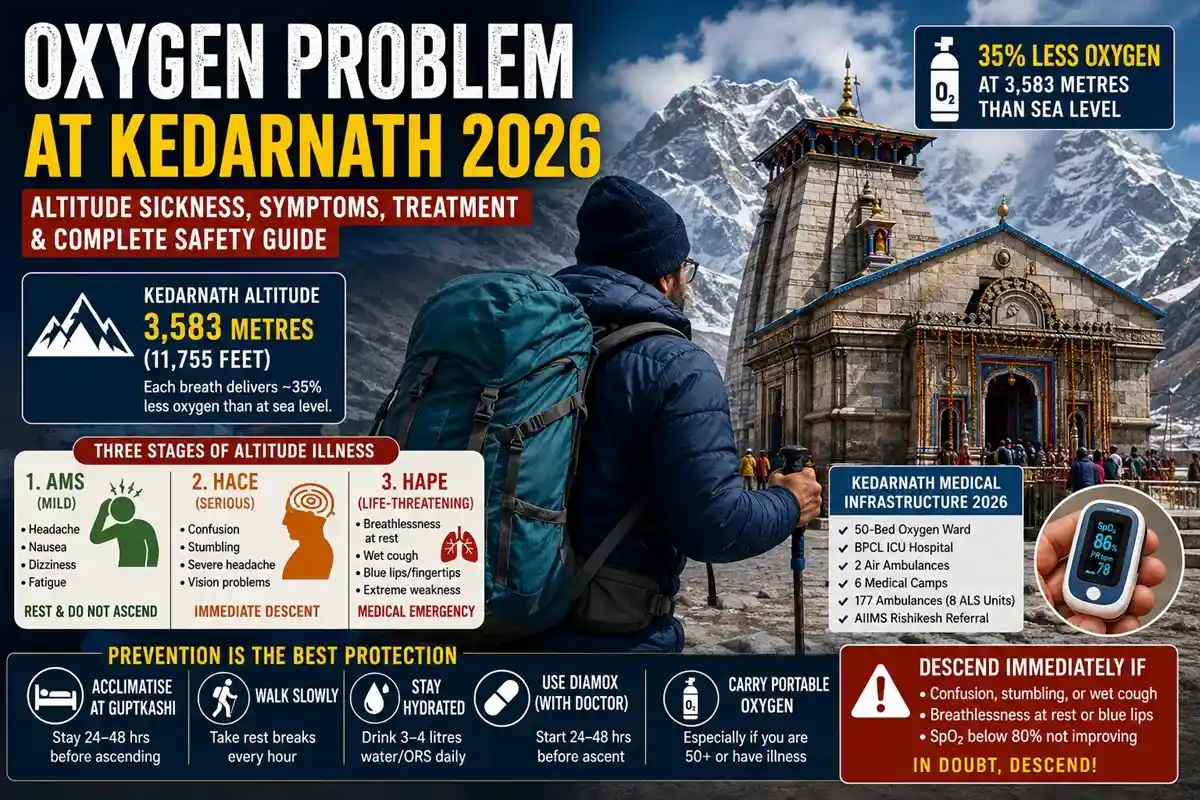
The 16 km route climbs approximately 1,600 metres in altitude — from Gaurikund at around 1,950 m to Kedarnath at 3,583 m. The path is mostly paved stone, maintained properly, and marked throughout. SDRF and police personnel are stationed at intervals during the yatra season.
Most pilgrims take between 5 and 8 hours depending on their fitness, the crowd density and how many stops they take. The first few kilometres out of Gaurikund are relatively gradual. The steepest section comes in the middle stretch, roughly between Bheem Bali and the final approach.
A few things people don’t expect: the descent is harder on your knees than the ascent. Trekking poles cut knee pain significantly. Rent or carry them. Second, the altitude doesn’t just affect breathing — it slows your thinking, raises heart rate and can cause mild headaches. Walk slowly, drink water consistently and don’t push if your body is resisting.
Pony and palki rates vary by weight and operator — roughly Rs 2,500-5,000 one-way for ponies and Rs 4,000-10,000 for palkis. These are negotiated at Gaurikund and can spike during high-demand days. Agree on the fare before starting.
Weather and Monsoon: How It Affects the Kedarnath Route
April to June (Current Window)
The best and most stable travel period. Roads are at their most reliable, the trek path is clear and temperatures are manageable. The current season is operating in this window. However, 2026’s record footfall means even good-weather days carry the Sonprayag jam risk. The IMD issued multiple Orange Alerts in May alone — sudden rain can make sections of NH-107 slippery within an hour, and snowfall above 4,500 m is possible even in late May.
July to August (Monsoon — Highest Risk Period)
The Kedarnath route becomes genuinely dangerous from late June onward. The road near Sirobgad, the Sonprayag stretch and sections around Sitapur are all historically vulnerable to landslides. In September 2025, a major landslide at Munkatiya near Sonprayag completely blocked NH-107, suspending the yatra until September 5. BRO and SDRF teams had to be dispatched for rescue and clearance. This kind of event has happened multiple times across different monsoon seasons.
If your visit falls in July or August, plan 2-3 buffer days, check the Rudraprayag District Administration helpline (01364-233727) every morning before moving, and monitor IMD Uttarakhand and BRO social media for NH-107 closure advisories. Never attempt to cross an active landslide zone.
September to October
Post-monsoon conditions improve steadily. Crowd density is lower than May-June, roads have largely been cleared, and the weather stabilises. For pilgrims who want a quieter experience, September is arguably the best month. The temple closes for winter in November — exact date announced on Diwali.
| Period | Road Condition | Pilgrim Volume | Main Risk |
| April to June | Good to fair | Peak — 30,000-38,000 daily | Traffic jams, crowd pressure at Sonprayag |
| July to August | Unpredictable | Variable — disruptions possible | Landslides, NH-107 closure, flash floods |
| September to October | Improving steadily | Moderate | Low to moderate — occasional rain |
| November (closing) | Winding down | Thin | Early snowfall; closing date weather-dependent |
Full Cost Breakdown: Kedarnath Yatra 2026
| Item | Approximate Cost | Note |
| Delhi to Haridwar overnight bus | Rs 500–1,200 | State (UPSRTC/UTC) or private; book in advance in season |
| Haridwar/Rishikesh to Sonprayag shared jeep | Rs 400–800 per person | Shared jeep fastest; direct buses also run |
| Sonprayag parking | Rs 100–200 per day | Managed government parking lot |
| Sonprayag to Gaurikund shuttle (one-way) | Rs 40–60 per person | Government buses; exact fare posted at counter |
| Pony — Gaurikund to Kedarnath (one-way) | Rs 2,500–5,000+ | Negotiated at Gaurikund; weight-dependent |
| Palki — Gaurikund to Kedarnath (one-way) | Rs 4,000–10,000 | Higher-end option for mobility-limited pilgrims |
| Pitthu (luggage porter) | Rs 500–1,500 | For carrying bags on the trek |
| Helicopter Sirsi — round trip | Rs 6,390 + 18% GST + Rs 300 | UCADA official 2026 rate; all-in ~Rs 7,840 |
| Helicopter Phata — round trip | Rs 10,164 + 18% GST + Rs 300 | UCADA official 2026 rate; all-in ~Rs 12,324 |
| Helicopter Guptkashi — round trip | Rs 12,762 + 18% GST + Rs 300 | UCADA official 2026 rate; all-in ~Rs 15,350 |
| Priority Darshan slip (heli pilgrims) | Rs 1,100 single / Rs 2,100 for 4 | Issued at Kedarnath helipad by temple committee |
| ATM cash buffer | Rs 3,000–5,000 minimum | ATMs at Sonprayag and Gaurikund run dry on peak days |
Mistakes That Will Ruin Your Yatra — And How to Avoid Them
These aren’t generic warnings. They’re patterns from the 2026 season so far.
- Skipping registration and driving to Sonprayag anyway: You will be stopped and sent back. Several pilgrims have wasted full travel days doing exactly this. Register at least 3 days before departure.
- Planning to cover Rishikesh to Kedarnath in a single day during peak season: Not possible with shuttle queues, traffic and trek timing. Minimum two days on the road, with an overnight halt at Rudraprayag or Guptkashi.
- Ignoring the 1:30 PM trek cut-off at Gaurikund: If you miss this window, you don’t start the trek that day. Reaching Gaurikund at 2 PM after a morning Sonprayag jam is a real scenario this season.
- Trusting unverified helicopter booking agents or third-party sites: heliyatra.irctc.co.in is the only authorised portal. Multiple fraudulent sites operate every yatra season. Losses from fake bookings are non-recoverable.
- Assuming ATMs will have cash: They don’t, on peak days. The ATMs at Sonprayag and Gaurikund run out consistently. Withdraw cash before Rudraprayag.
- Underestimating the 16 km Gaurikund to Kedarnath trek: The altitude gain is 1,600 m. Anyone with a cardiac condition, recent knee surgery or low fitness should book ponies, palkis or fly by helicopter. Don’t push it.
- Taking your phone inside the Kedarnath temple: Deposit it at the cloakroom before entering. Violations are penalised.
- Travelling in the monsoon without buffer days: A single landslide near Sonprayag or Sirobgad can close the route for 2-3 days. In August 2024, a collapse near Doliya Devi blocked the Kedarnath highway. In September 2025, Munkatiya blocked it for multiple days. Build margin into your plan.
Practical Tips That Actually Help
- Leave your overnight halt at 5 AM, not 7. Arriving at Sonprayag before 8 AM means you get a shuttle without a long wait. Arriving at 10 AM in May means you join a queue that might stretch for hours.
- Stay in Guptkashi the night before your trek, not Sonprayag. Guptkashi is quieter, has far more hotel options, and sitting at 1,319 m gives your body a useful altitude buffer before the 3,583 m summit. Sonprayag has fewer beds and fills up fast.
- Start the Gaurikund to Kedarnath trek between 4 and 6 AM. Weather is most stable in early morning, crowd density is lowest, and you reach Kedarnath well ahead of the 2 PM temple closure.
- Trekking poles are not optional for the descent. Knee pain going down is the most common physical complaint among pilgrims. If you don’t own poles, rent them at Gaurikund.
- Save 01364-233727 (Rudraprayag District Disaster Control Room), 1077 (Uttarakhand Disaster Helpline) and 112 (SDRF) before you leave home.
- Check IMD Uttarakhand and Uttarakhand Police social media every morning during travel days. These two sources give the most real-time updates on road closures.
- For July-August travel, check BRO (Border Roads Organisation) advisories specifically for NH-107 status updates.
- Carry a printed copy of your Yatra registration QR — phone batteries die on long drives and there’s no guarantee of mobile signal between Rudraprayag and Sonprayag.
What’s Coming: Kedarnath Tunnel and Ropeway Projects
Two major infrastructure projects are in different stages of discussion and planning. The Ministry of Road Transport and Highways has announced a 7 km tunnel from Chaumasi in the Kalimath Valley to Lincholi, approximately 5 km from the Kedarnath temple. If built, this would reduce the current 16 km trek to around 5 km — a transformational change for older and physically limited pilgrims. A motorable road to Chaumasi already exists. The tunnel is in early planning stages and will not affect any current season.
A separate ropeway project worth Rs 4,081 crore has also been under discussion since mid-2025. Both projects, if executed, would fundamentally change the character of the pilgrimage — making it accessible to a far wider group of devotees than the current trek allows. For now, the 16 km walk, the ponies and the palkis remain the only options.
Frequently Asked Questions — Kedarnath Traffic and Road 2026
Q1. Is the Kedarnath road open in May 2026?
Yes. The Kedarnath Yatra began on 22 April 2026 and the route is currently operational. That said, heavy pilgrim traffic is causing daily congestion at Sonprayag — reaching before 8 AM significantly improves the experience. Always check IMD weather updates before departure, as an Orange Alert can change road conditions rapidly.
Q2. How bad is the Sonprayag traffic situation right now?
As of mid-May 2026, pilgrims reaching Sonprayag after 9-10 AM are waiting 2 to 4 hours for the government shuttle bus. On 12 May, the system collapsed entirely for several hours. DM Vishal Mishra confirmed in an ANI interview on 18 May that when crowd pressure becomes extreme, pilgrims are directed to walk the 5 km from Sonprayag to Gaurikund on foot rather than wait indefinitely.
Q3. What are the official helicopter fares for Kedarnath in 2026?
UCADA official round-trip fares on the IRCTC portal: Sirsi Rs 6,390, Phata Rs 10,164, Guptkashi Rs 12,762 — all plus 18% GST and Rs 300 IRCTC convenience fee. Booking only through heliyatra.irctc.co.in. No agents or third-party sites are authorised.
Q4. Is registration compulsory for Kedarnath 2026?
Yes. An Aadhaar-linked QR-coded permit is required. Registration is free and done through the official Char Dham Yatra portal. You’ll be stopped at Sonprayag without it. Register at least 3-5 days before travel, especially if visiting in May or June.
Q5. Can I drive my car beyond Sonprayag?
No. Private vehicles are not permitted past Sonprayag. Park at the designated lot and board the government shuttle bus to Gaurikund.
Q6. How long is the Gaurikund to Kedarnath trek, and how much time does it take?
16 km on the current main route (the older route is approximately 18 km). Most pilgrims take 5 to 8 hours depending on pace and crowd density. Start between 4 and 7 AM. The last permitted departure from Gaurikund is 1:30 PM. The temple opens at 5 AM and closes to visitors at 2 PM.
Q7. How many pilgrims have visited Kedarnath so far in 2026?
6.5 lakh (650,000) as of 18 May 2026, per DM Vishal Mishra in an ANI statement. Opening day (22 April) alone saw 38,000 visitors — the highest single-day opening count on record. Daily average is around 32,000, compared to 18,000 per day in 2025.
Q8. What should I do if a landslide blocks the Kedarnath highway?
Stay at your last halt — Rudraprayag, Guptkashi or Sitapur. Don’t attempt to cross an active slide zone on foot. Contact the Rudraprayag District Disaster Control Room on 01364-233727. Monitor BRO official channels for clearance updates. Build buffer days into your travel plan, especially post-June.
Q9. Are mobile phones allowed inside Kedarnath temple?
No. The BKTC has imposed a complete ban on phones, cameras and video recording inside the temple complex for 2026. Devices must be deposited at cloakrooms before entry. Violations carry penalties.
Q10. What’s the best time to visit Kedarnath in 2026 if I want to avoid the worst crowds?
Late April (22-30 April, immediately after opening) and the September to October window consistently see lower footfall than peak May. Weekdays are significantly quieter than weekends. If you’re visiting in May, arrive at Sonprayag before 8 AM — this single decision affects your entire travel day more than any other factor.
Where to Get Real-Time Updates Before and During Your Trip
- IMD Uttarakhand (weather forecasts and alerts): imdpune.gov.in or the Mausam app
- BRO official social media (NH-107 closure advisories during monsoon)
- Uttarakhand Police official social media (most reliable source for live road conditions on the ground)
- Rudraprayag District Disaster Control Room: 01364-233727
- Uttarakhand Disaster Helpline: 1077
- SDRF emergency: 112
- IRCTC HeliYatra support: 1800110139 and 0755-4090400 (helicopter booking issues)
To Summarise
The Kedarnath Yatra 2026 is running at a scale the route has never handled before. 6.5 lakh pilgrims in under a month, an opening day record of 38,000 visitors, and a daily average that’s nearly double last year’s. The devotion is real and the numbers prove it. The infrastructure — specifically the Sonprayag shuttle system and the 5 km road between Sonprayag and Gaurikund — is genuinely struggling.
If you go with the right information, register before leaving, reach Sonprayag before 8 AM on your travel day, and build an overnight halt into your journey rather than rushing, the pilgrimage is very much possible and deeply worthwhile. Baba Kedar’s doors are open. The route to reach them needs planning.