Every year, families across India save for months — sometimes years — to do the Chardham Yatra. For lakhs of pilgrims, especially elderly parents fulfilling a lifelong wish, this journey is sacred beyond words. And every single year, organised cybercriminals exploit exactly this devotion. The Chardham hotel booking scam in 2026 is not a fringe problem or a few isolated cases. It is a well-funded, professionally operated fraud network — and it is growing.
In April 2026, the Indian Cyber Crime Coordination Centre (I4C) under the Ministry of Home Affairs issued a formal public advisory warning pilgrims about fake Chardham booking websites, fraudulent travel agents, and deceptive social media advertisements. The Uttarakhand Special Task Force (STF) has independently busted organised networks and blocked over 76 fraudulent websites in coordinated police operations. And yet, new fake sites appear within days of every takedown.
This 2026 guide is built entirely on verified, current data — real victim cases, confirmed government advisories, updated scam mechanics, and a step-by-step verification process that takes less than ten minutes but can save your family lakhs of rupees.
Quick Overview
Key Takeaways — Chardham Booking Fraud 2026
- The I4C (Ministry of Home Affairs) issued an official advisory specifically targeting Chardham booking frauds — fake websites, social media pages, and paid Google/Facebook ads are the primary attack vectors
- Uttarakhand STF has blocked 76+ fraudulent websites and 20+ fake Facebook pages in coordinated crackdowns — new ones appear within days
- Victims confirmed from Rajasthan, Tamil Nadu, Karnataka, Andhra Pradesh, Telangana, Uttar Pradesh, Gujarat, and NRI families from UK, US, Canada, and UAE
- A real victim: Bighnaraj Chand from Odisha lost ₹4.40 lakh via PhonePe instalments to a Haridwar-based fake travel agent; agent went silent when the 2026 yatra commenced
- Confirmed fraud: A pilgrim to Badrinath paid for a hotel room online — arrived to find no booking. Accused arrested from Rajasthan
- Booking.com experienced a data breach in April 2026 — ‘reservation hijacking’ scams now also affect users of large platforms
- GMVN (official government accommodation) is available at gmvnonline.com — zero fraud risk
- Personal UPI payment request = immediate fraud signal, no exceptions
- If cheated: call 1930 (National Cybercrime Helpline) and file at cybercrime.gov.in the same day
2026 Alert: Booking.com Data Breach — A New Fraud Vector
NEW IN 2026: In April 2026, Booking.com confirmed a data breach that exposed guest booking details, contact information, and partial payment data. Cybercriminals are using this stolen data to impersonate hotels and send ‘reservation hijacking’ messages to guests, tricking them into making additional payments. If you have a Chardham hotel booking on Booking.com, verify any unexpected payment request directly with the hotel by calling the number from Google Maps — not from the email or message you received.
This is a significant new threat for 2026 specifically. Even pilgrims who booked through a legitimate platform are now being targeted with follow-up scam messages appearing to come from their booked hotel. Malwarebytes and cybersecurity researchers confirmed this attack pattern in April 2026. The message usually says something like: ‘Your reservation requires re-verification’ or ‘Complete your check-in deposit to hold your room.’ Do not click any links in such messages. Call the hotel’s Google Maps number directly.
How Big Is the Chardham Booking Fraud Problem in 2026?
These are not anecdotal stories. NCRB data recorded cybercrime cases rising steadily in UP alone — from 10,117 cases in 2022 to 10,794 in 2023 and 11,073 in 2024 — with religious travel fraud forming a significant and growing subset. Uttarakhand Cyber Crime Cell and the STF have blocked 82 fake websites and 20 fraudulent Facebook pages in formal crackdowns. For every site taken down, multiple new ones launch.
The Uttarakhand STF uncovered a coordinated racket ahead of the 2026 Chardham season where fraudsters operated fake websites and social media accounts offering Kedarnath helicopter bookings. Multiple devotees transferred money believing they were using authorised providers. The I4C confirmed that cybercriminals now also manipulate online ratings — using bot accounts and fake profiles to flood fraudulent agencies with artificial positive reviews to create the appearance of legitimacy.
Victims in 2026 have been reported from across India and abroad. Confirmed victim states include Rajasthan, Tamil Nadu, Karnataka, Andhra Pradesh, Telangana, Uttar Pradesh, and Gujarat. NRI families booking from the United Kingdom, United States, Canada, and the UAE have also been targeted — making this a genuinely national and international-scale fraud.
Real Fraud Cases — What Actually Happened
Case 1: The Odisha Family — ₹4.40 Lakh Lost via PhonePe
Bighnaraj Chand, 50, from Jagatsinghpur, Odisha planned a Chardham Yatra for his family after being referred to a travel agent in Haridwar through a personal contact. The agent promised a complete package — transport, accommodation, and bookings for all four dhams. Trusting the referral, Chand transferred ₹4.40 lakh in eight separate instalments through PhonePe. Air tickets from Bhubaneswar to Dehradun were booked. The trip was deferred from 2025 due to external circumstances. When the agent was contacted for 2026, he assured the family the trip would be accommodated. When the 2026 yatra commenced, the agent stopped responding. The promised hotel confirmations and transport arrangements never came. The family’s pilgrimage savings — collected over months — were gone.
What made this so insidious: the personal referral bypassed normal caution. The agent communicated convincingly across months of instalments. By the time the fraud was clear, there was no recourse available without a formal cybercrime FIR.
Case 2: The Chamoli Ghost Hotel
A pilgrim planning a Badrinath visit paid for hotel rooms online to a person presenting himself as the hotel owner. On arrival at Chamoli, no booking existed and the ‘hotel owner’ was nowhere to be found. The actual hotel management confirmed no reservation had been made. Chamoli Police investigated the phone numbers used and traced the accused to Rajasthan, where an arrest was made. The investigation revealed the fraudster had been operating this scheme for several years, across multiple Chardham seasons, including during the Covid lockdown.
Case 3: The WhatsApp Package Trap
A consistent pattern reported to Uttarakhand Cyber Crime Cell: a pilgrim receives a WhatsApp forward or social media post advertising a complete Chardham package at an attractive price. The agent communicates entirely on WhatsApp, sends a professional-looking PDF quote, requests 50% advance to ‘confirm the booking,’ then goes silent after receiving the money. The number becomes unreachable within hours.
Case 5: The Fake Listing on a Major Platform
Even large international booking platforms carry fraudulent listings. A traveller reviewing Badrinath hotels on a well-known booking site posted: ‘I had a terrible experience post-booking. This is a fraud listing of a hotel on your online platform. When I reached the venue I was shocked to find that this hotel does not exist in reality — locals around the place confirmed this.’ This case confirms that fake listings are not limited to obscure websites — phantom properties are inserted onto mainstream platforms by exploiting gaps in remote-location verification.
How Chardham Hotel Booking Scams Operate in 2026 — The Full Mechanics
Phase 1: Building a Convincing Fake Presence
A fraudulent operation typically deploys three assets simultaneously: a professional-looking website, active social media pages (Facebook, Instagram), and a dedicated WhatsApp number. Websites are built using real hotel photos scraped from Google Images or legitimate travel portals. They include fabricated addresses, copied logos from known properties, made-up testimonials, and fake ‘verified’ and ‘certified’ badges.
In 2026, the I4C confirmed that fraudsters run paid advertisements on Google and Facebook targeting high-intent search terms: ‘hotel near Kedarnath 2026,’ ‘Badrinath accommodation booking,’ ‘cheap Chardham package.’ These sponsored ads appear above organic search results. A pilgrim who clicks a sponsored link may reach a fraud site before ever seeing a legitimate one.
Phase 2: The Convincing Phone Call
When a pilgrim contacts the fake site, a callback follows within minutes. Trained operators know correct Chardham terminology — opening dates, trek distances, helipad names, registration portal names. They reference the official yatra registration portal (registrationandtouristcare.uk.gov.in) to sound authoritative. A professional PDF quote is sent via WhatsApp with realistic pricing. Urgency is introduced: ‘Only two rooms left for May,’ ‘This rate expires tonight,’ ‘We have a group checking in — book before they take it.’
Phase 3: The Payment Trap
The operator requests payment to a personal UPI account — PhonePe, Google Pay, or an individual’s bank account. This is the single most consistent fraud signal across every documented Chardham scam case. A registered business collects payment to a company account where the company name appears in the transfer. Any personal UPI ID in the recipient field is an immediate fraud indicator, regardless of how professional everything else appears.
After payment, a fake confirmation is issued — a professional-looking document with booking reference numbers, hotel letterhead, and QR codes. Rashmi Negi of Udan Aviation noted: ‘The websites are well designed. The voices on the phone know the right terminology. The confirmation documents are indistinguishable from genuine ones. The only protection is verification — and most pilgrims simply do not know what to verify.’
Phase 4: The Vanishing Act
The fraud completes when the pilgrim arrives at the destination to find no booking, or when the contact number goes unreachable days before travel. In the domain-spoofing variant, fraudsters register URLs with one-character differences from legitimate operators — for example, heliyatra-irctc.co.in mimicking the official heliyatra.irctc.co.in — then take the site down after collecting payments.
Official I4C Advisory — 4 Government-Issued Precautions for 2026
The Indian Cyber Crime Coordination Centre (I4C) under the Ministry of Home Affairs officially issued four specific precautions for Chardham pilgrims in 2025, reiterated ahead of the 2026 season:
- Do not immediately trust ‘VIP’ or ‘free’ offers related to Chardham bookings — these are designed to lower your guard
- Watch for suspicious profiles and repetitive reviews — bot-generated reviews are now standard in organised fraud operations
- Cross-check all information through official government sources before making any payment
- Remain cautious while making digital payments — verify the recipient name is a registered company, not an individual
The I4C advisory specifically highlighted: ‘Fake reviews are increasingly becoming part of organised cyber scams. Many victims believe a website is genuine simply because it has high ratings or positive testimonials.’ Verify independently — not on the site itself.
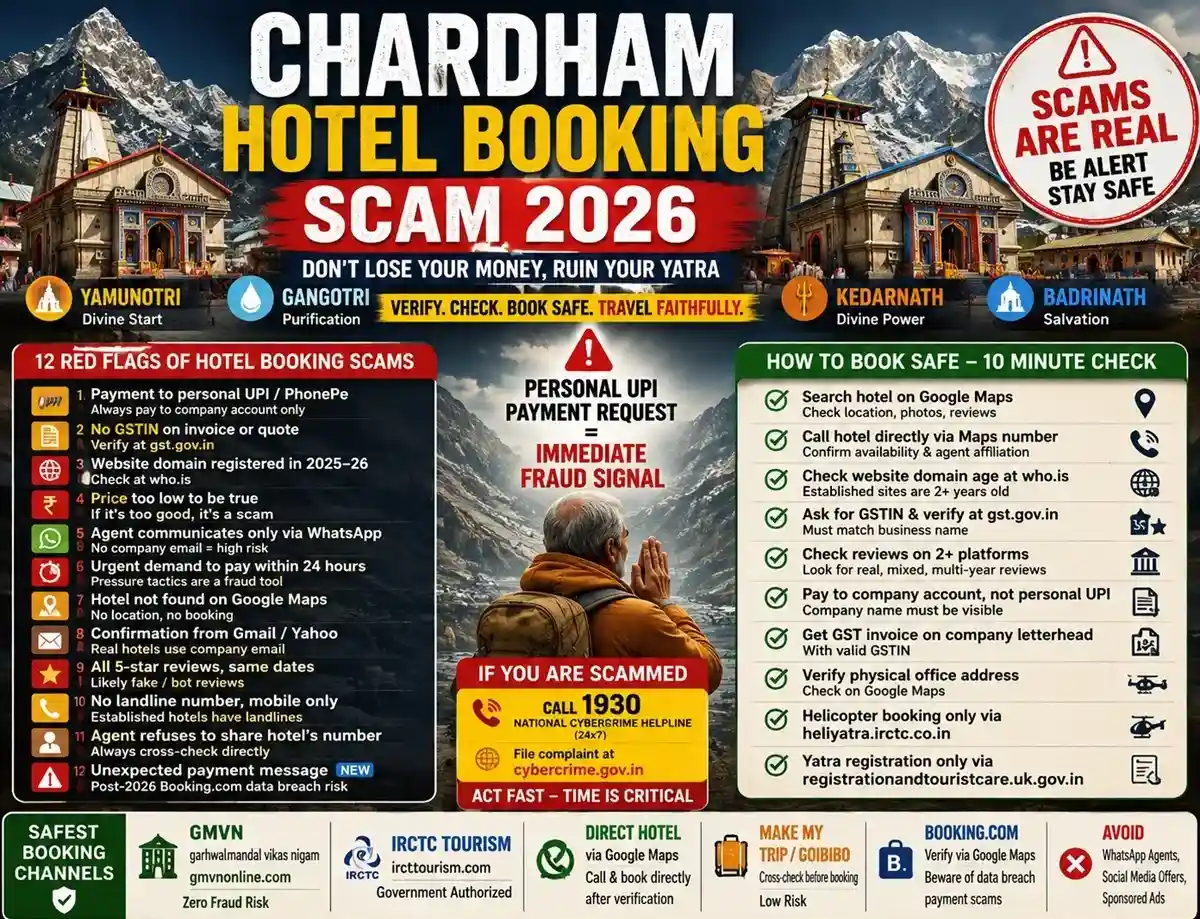
12 Red Flags That Identify a Chardham Hotel Booking Scam
| # | Red Flag | Why It Matters |
| 1 | Payment to personal UPI / PhonePe / individual name | No legitimate hotel or tour operator collects payment this way. Company account only. |
| 2 | No GSTIN on invoice or quote | All registered businesses above ₹20L turnover are GST-registered. Absence is a fraud signal. |
| 3 | Website domain registered in 2025 or 2026 | Verify at who.is. A new domain cannot represent a multi-season established operator. |
| 4 | Price dramatically below real market rates | ₹400/night near Kedarnath peak season does not exist legitimately. See pricing table below. |
| 5 | Agent communicates only via WhatsApp — no company email | Legitimate operators have branded email IDs (info@hotelname.com), not just personal WhatsApp. |
| 6 | Urgent demand to pay within 24 hours | Genuine hotels do not pressure pilgrims this way. Urgency is a manipulation tactic. |
| 7 | Hotel not found on Google Maps with photos and pinned location | If Google Maps shows nothing for the property name, treat as non-existent until proven otherwise. |
| 8 | Confirmation email from Gmail / Yahoo / Hotmail | Real hotel invoices come from company domain emails, not free personal email services. |
| 9 | All reviews are 5-star, generic, and posted within weeks of each other | I4C confirmed bots are used to create artificial positive reviews for fraud portals. |
| 10 | No landline number — mobile number only | Established Chardham hotels have landlines. Mobile-only contact at this scale is a risk sign. |
| 11 | Agent refuses to share the property’s direct contact number | A genuine operator always provides the hotel’s own phone number for verification. |
| 12 | Unexpected payment message from your confirmed hotel (post-2026 Booking.com breach) | New 2026 threat — reservation hijacking using stolen booking data. Always verify via Google Maps number. |
Genuine vs. Fraudulent Hotel Booking — Side-by-Side Comparison
| Parameter | Legitimate Hotel / Agent | Fraudulent Operator |
| Payment recipient | Company bank account — company name visible in transfer | Personal UPI, PhonePe, or individual’s account name |
| GST Invoice | Provided on company letterhead with valid GSTIN | Absent, fake number, or no letterhead |
| Website domain | Established; domain registered years ago | New domain (2025–26); may differ from real site by 1 character |
| Email ID | Branded domain: info@hotelname.com | Gmail / Yahoo / Hotmail |
| Reviews | Mixed, detailed, spread across years, include some criticism | All 5-star, generic phrases, clustered posting dates |
| Google Maps | Pinned location, real photos, call button, address | Absent or pinned to wrong location |
| Direct phone | Landline + mobile on property’s own website | Mobile only; may not answer verification calls |
| Booking confirmation | Official voucher via email with cancellation policy | WhatsApp screenshot or PDF without terms |
| Urgency | No pressure — rooms held with clear cancellation policy | ‘Only 1 room left, pay in 2 hours or lose it’ |
| Response to questions | Provides GSTIN, physical address, references willingly | Deflects, changes subject, or becomes pushy |
| Advance required | Reasonable (20–30%) with written confirmation from hotel | 50–100% demanded upfront; described as ‘non-refundable’ |
Types of Chardham Booking Scams Active in 2026
1. Fake Hotel Websites with Stolen Photos
The most common variant. Fraudsters build professional sites using photos scraped from legitimate properties, fabricate addresses, and list fake phone numbers. Pilgrims book and pay, receive a convincing confirmation, and only discover the fraud on arrival. This type targets all four dhams but is especially prevalent for Badrinath and Kedarnath where demand far outpaces legitimate supply.
2. Advance Payment Ghost Booking
A person presents as a hotel owner or authorised representative, requests advance payment to ‘hold the room,’ and disappears after receiving money. The Chamoli case — where the accused operated from Rajasthan across multiple seasons — is the documented example. This pattern is also deployed for transport and package bookings.
3. Personal Referral Package Scam
The most psychologically effective variant. A fraudster enters a social network — through an acquaintance, a community group, or a temple network — and offers ‘complete Chardham packages’ at reasonable prices. The Odisha family case (₹4.40 lakh lost) followed exactly this pattern. Personal trust overrides normal caution. Instalments collected over weeks or months build false confidence before the agent disappears.
4. Social Media & WhatsApp Broadcast Scams
Fake travel agents post attractive Chardham packages in pilgrimage WhatsApp groups, Facebook pages, and Instagram Stories. Professional-looking graphics, fake testimonials, countdown timers (‘3 spots remaining!’), and competitive pricing are used. Pilgrims who respond receive a private chat from an agent who sounds experienced and sends a polished PDF quotation.
5. Google Ad Domain Spoofing
Fraudsters purchase Google Ads targeting pilgrimage searches and register near-identical domain names — heliyatra-irctc.co.in instead of the official heliyatra.irctc.co.in, or registrationandtouristcare.uk.gov.org instead of the official .uk.gov.in. These ads appear above organic results. The I4C officially warned about this: ‘Verify before clicking on sponsored or unknown links on Google, Facebook, or WhatsApp.’
6. Reservation Hijacking via Platform Data Breach (New — 2026)
Following Booking.com’s April 2026 data breach, a new fraud type emerged: criminals use stolen booking data to send official-looking messages to guests claiming their reservation requires re-verification or an additional deposit. These messages arrive via email and WhatsApp, using the guest’s real booking details to appear legitimate. Never pay in response to such messages without first calling the hotel directly via its Google Maps listing.
How to Verify Any Chardham Hotel Before Paying — Step by Step
The most important rule in 2026: Never pay an advance to anyone — hotel, agent, or package operator — until you have independently verified the property’s existence through at least two sources that are not connected to the seller.
- Open Google Maps and search the exact hotel name. A legitimate property will show a pinned location with real photos, address, phone number, and reviews. If nothing appears — or the pin is in a clearly wrong location — stop immediately.
- Call the hotel directly using the phone number shown on Google Maps (not the number given by the agent). Ask them: (a) do they have rooms available on your dates, (b) is the agent or website affiliated with them, and (c) can they confirm a booking in your name.
- Check the website domain age at who.is. Enter the website URL and check the registration date. Any domain registered in 2025 or 2026 is high risk — established operators have multi-year domain histories.
- Ask for the GSTIN (GST Identification Number) and verify it at gst.gov.in → Search Taxpayer → enter the number. It must match the business name on the invoice. An invalid number or name mismatch means the business is unregistered or fraudulent.
- For any payment, ensure the recipient is a registered company — company name visible in the UPI/bank transfer. Get a GST invoice on company letterhead within 24 hours. If the receipt shows an individual’s name, stop and demand clarification before sending more money.
- For helicopter booking: only heliyatra.irctc.co.in is the official government-authorized portal. No agent, no WhatsApp contact, no third-party site is authorized to sell Kedarnath helicopter shuttle tickets.
- For yatra registration: only registrationandtouristcare.uk.gov.in is official. Registration is 100% free — any site charging for it is a scam.
What Does Chardham Accommodation Actually Cost in 2026? Know the Real Rates
Part of why scams succeed is that pilgrims looking for budget options are vulnerable to artificially low prices. Here is what legitimate accommodation genuinely costs in 2026 — if someone offers something dramatically below these ranges, that price gap is itself a fraud warning.
| Location | Budget (Real 2026) | Mid-Range (Real 2026) | What Fraudsters Advertise |
| Rishikesh / Haridwar | ₹800 – ₹1,500 | ₹2,000 – ₹6,000 | ₹300–500 (non-existent) |
| Barkot (Yamunotri base) | ₹600 – ₹1,500 | ₹1,800 – ₹3,000 | ₹200–400 (phantom listing) |
| Uttarkashi (Gangotri base) | ₹800 – ₹1,800 | ₹2,000 – ₹3,500 | ₹400 (fraud price) |
| Guptkashi / Rudraprayag | ₹700 – ₹1,500 | ₹1,800 – ₹3,000 | ₹350 (doesn’t exist) |
| Joshimath | ₹800 – ₹1,800 | ₹2,000 – ₹3,500 | ₹400 flat (fake listing) |
| Badrinath (GMVN/private) | ₹600 – ₹1,500 | ₹2,000 – ₹4,000 | ₹500 all-inclusive (impossible) |
| Near Kedarnath (Gaurikund) | ₹700 – ₹1,500 | ₹1,800 – ₹3,000 | ₹400 ‘with meals’ (fraud) |
The operating costs of a property at 3,133 m (Badrinath) or 3,583 m (Kedarnath) — with limited road access, supply chain constraints, and altitude-specific infrastructure — make sub-₹600 genuine accommodation structurally impossible in peak season. If the price seems too good, it is.
Special Warning for Senior Citizens and NRI Families
Senior citizens are disproportionately targeted. They are more likely to trust referrals from acquaintances, less likely to independently verify online listings, and — as documented — less likely to file a complaint if cheated.
NRI families booking Chardham from UK, US, Canada, and UAE have also been confirmed as targets. Fraudsters understand that NRI families are willing to pay higher rates for convenience and may be less familiar with the ground realities of which portals are official.
- Never allow elderly family members to transfer advances based on phone or WhatsApp conversations alone
- GMVN government rest houses are the safest option for senior citizens — no fraud risk, no complex verification needed
- Helicopter services for Kedarnath: only via heliyatra.irctc.co.in. A 74-year-old arriving at the helipad to find a fake booking is not a hypothetical — it happened in 2026
- NRI families: engage only operators with verifiable GST registration, physical addresses, and multi-year domain histories
Connectivity & Regional Booking Tips by City
Chardham pilgrims arrive from across India. Haridwar and Rishikesh are the two principal gateways — connected by rail, road, and the nearest airports at Jolly Grant (Dehradun, ~35 km from Rishikesh). Key connectivity facts:
- Jolly Grant Airport (Dehradun): nearest airport; connects Delhi, Mumbai, Bengaluru. Helicopter services to Kedarnath also depart from Dehradun for charter packages
- Haridwar Railway Station: well-connected to Delhi, Lucknow, Kolkata, Mumbai — major pilgrim embarkation point
- From southern states (Tamil Nadu, Karnataka, Andhra Pradesh, Telangana): most pilgrims fly to Delhi or Dehradun and proceed by road
- From Odisha and West Bengal: direct trains to Haridwar are available; also Delhi transit
If you are arriving by train at Haridwar or Rishikesh, do not book accommodation from touts near the station. This is a high-fraud zone during the yatra season. Book your first night’s stay before arriving — GMVN at gmvnonline.com is available for Rishikesh and Haridwar.
If You Have Already Been Scammed — Act Immediately
Time is critical. In cybercrime fraud, the first 24–48 hours are the window for potential transaction reversal. Do not wait to ‘see if they respond.’ File immediately.
- Call National Cybercrime Helpline: 1930 — available 24/7. This is the fastest trigger for transaction freeze requests to banks.
- File online complaint at cybercrime.gov.in — India’s official MHA-authorised National Cybercrime Reporting Portal.
- Contact your bank immediately and request: (a) transaction reversal if within 24 hours, (b) fraud hold / dispute flag on the transfer.
- File an FIR at your local police station — specifically under ‘cyber fraud / online financial crime.’ Keep the FIR receipt.
- Preserve all evidence now: screenshots of the website, WhatsApp conversations, PDF confirmations, payment receipts, booking confirmations, email chains, and all phone numbers.
- Email Uttarakhand Cyber Crime Cell: cybercrime@uttarakhandpolice.uk.gov.in with full evidence.
- If you paid via credit card: file a formal chargeback claim with your card issuer — fraud chargebacks on credit cards are processed more reliably than UPI disputes.
Filing a complaint is not just about recovering your money — every FIR filed adds to the intelligence that the Uttarakhand STF uses to identify and bust these networks. The 76+ websites blocked in the last crackdown happened because pilgrims reported fraud. Your complaint protects the next family.
2026 Safe Booking Checklist — Use Before Every Payment
Go through this checklist before paying any advance for Chardham accommodation, helicopter, transport, or package booking. Print it or save it on your phone.
- Hotel found on Google Maps with pinned location, real photos, address, and phone number
- Called hotel directly via Google Maps number (not the agent’s number) — confirmed availability and booking
- Checked website domain age at who.is — domain registered at least 2+ years ago
- Asked for GSTIN and verified at gst.gov.in — number is valid and matches business name
- Payment going to company account (company name in transfer), not a personal UPI
- Received official GST invoice on company letterhead with GSTIN
- Checked reviews on at least two independent platforms — reviews span multiple years
- Agent provided physical office address — verifiable on Google Maps
- No pressure tactics used — no ‘book in 2 hours or lose the spot’ urgency
- For helicopter: verified booking is through heliyatra.irctc.co.in only
- For registration: using registrationandtouristcare.uk.gov.in only — free, no payment
- Screenshotted all conversations, confirmations, and payment receipts — saved separately
Frequently Asked Questions — Chardham Hotel Booking Scam 2026
Q1. How do I know if a Chardham hotel booking website is fake?
Check the domain registration date at who.is — sites registered in 2025–26 are high risk. Search the hotel name on Google Maps and verify the physical location, photos, and phone number. Legitimate hotels appear with a pinned location and a direct call option. If the site only offers a WhatsApp number and requests payment to a personal UPI, do not proceed under any circumstances.
Q2. Is it safe to book Chardham hotels via WhatsApp?
Only after independently verifying the hotel on Google Maps and calling the property directly to confirm the booking. Never pay an advance based solely on a WhatsApp conversation, regardless of how professional the agent sounds or how convincing the PDF quote looks. Every documented Chardham WhatsApp scam follows an identical pattern: professional presentation, advance payment request, then silence.
Q3. What is the safest way to book Chardham accommodation in 2026?
GMVN (Garhwal Mandal Vikas Nigam) at gmvnonline.com is the safest option — government-operated, zero fraud risk, with properties at all key Chardham halt points including Barkot, Uttarkashi, Guptkashi, Joshimath, and Badrinath. Bookings are open until 30 November 2026. IRCTC Tourism packages (irctctourism.com) are the second safest option for complete structured yatra packages.
Q4. I received a message from my Booking.com hotel asking for additional payment. Is it real?
Be very careful. Following Booking.com’s April 2026 data breach, criminals are sending ‘reservation hijacking’ messages using real booking details to trick guests into fake payments. Never pay in response to an unexpected message. Call the hotel directly using its Google Maps phone number — not any number in the message — to verify. If the hotel confirms the request is fake, report to Booking.com and cybercrime.gov.in.
Q5. What should I do if I arrive at a Chardham hotel and find no booking?
Keep all evidence — confirmation documents, WhatsApp chats, payment receipts. Call 1930 (National Cybercrime Helpline) immediately. File at cybercrime.gov.in the same day. File an FIR at the local police station. For emergency accommodation, approach GMVN rest houses which often have walk-in capacity. Do not let the fraud agent go unreported — your FIR helps STF trace the network.
Q6. Can I get my money back after a Chardham booking scam?
The faster you act, the better your chances. UPI transactions reported to 1930 within hours can sometimes be reversed. Credit card chargebacks for fraud have a stronger success rate than UPI disputes. In documented Chardham cases, police FIRs have successfully traced and arrested accused operators across state lines. File immediately — every hour of delay reduces recovery options.
Q7. How do I verify a Chardham travel agent or package operator?
Ask for their GSTIN and verify at gst.gov.in. Ask for their physical office address and check it on Google Maps. Ask for references from previous clients you can call directly. Confirm payment goes to a company bank account, not a personal UPI. A legitimate operator provides all of this without hesitation. Any deflection or change of subject is itself a red flag.
Q8. The agent is asking for 50% advance. Is that normal for Chardham hotels?
A reasonable advance (20–30%) to hold a peak-season booking at a verified hotel is normal in India. However, verify the hotel independently before paying anything. The advance must go to the hotel’s company account — never to an agent’s personal UPI. Get written confirmation from the hotel (not the agent) acknowledging receipt of your advance with a cancellation policy.
Q9. What is the correct portal for Chardham yatra registration in 2026?
The only official government portal is registrationandtouristcare.uk.gov.in. Registration is completely free of charge. You can also register via the ‘Tourist Care Uttarakhand’ mobile app (Google Play / Apple App Store), WhatsApp (send ‘Yatra’ to +91-8394833833), or call 0135-1364. Any website charging for registration is operating a scam.
Q10. Which states’ pilgrims are most targeted by Chardham scams?
Confirmed 2026 victim geographies include: Rajasthan, Tamil Nadu, Karnataka, Andhra Pradesh, Telangana, Uttar Pradesh, and Gujarat within India. NRI families booking from the United Kingdom, United States, Canada, and UAE have also been targeted. Fraudsters tailor their approach by language and platform — regional WhatsApp groups and Facebook communities in these states are actively targeted with fake package advertisements.
Q11. The hotel has good Google reviews but the agent wants personal UPI payment. Should I pay?
No. A personal UPI payment request is a disqualifying fraud signal regardless of how legitimate everything else appears. A hotel with genuine Google reviews will always accept payment to a company account. Call the hotel directly via Google Maps, confirm your booking, and arrange payment directly with the hotel — not through the agent.
Q12. Is a toll-free ‘Chardham booking helpline’ number safe to call?
Only if it is a verified government number. The official Chardham helpline is 0135-1364 (Uttarakhand government). National Cybercrime Helpline is 1930. Any other ‘toll-free Chardham booking’ number found in a Google ad or WhatsApp message should be verified at the official government portal before calling — fraudsters create fake helplines to collect payment and personal details.
Final Word: Your Devotion Deserves a Safe Journey
Chardham Yatra is among the most sacred acts of faith in Hindu tradition. The people planning this journey are not careless consumers — they are devoted families, elderly parents fulfilling lifelong prayers, and NRI communities maintaining their roots. The fraudsters who target them know this. That is precisely why they target them.
The good news is that these scams are entirely predictable and entirely avoidable. A ten-minute verification process — Google Maps call, who.is domain check, GSTIN verification — consistently exposes every documented type of Chardham fraud before any money changes hands. The tools are all free. The official channels — GMVN, IRCTC, the government registration portal — exist specifically to give pilgrims a safe, verified path.
If you are booking for elderly parents, be especially vigilant. If you are an NRI family planning from abroad, verify GST registration and domain age before trusting any operator. If something feels wrong — an unexpected payment request, a price too low to be real, pressure to pay within hours — trust that feeling, stop, and verify independently.
Book safely. Travel faithfully. Arrive with nothing in your heart but devotion.