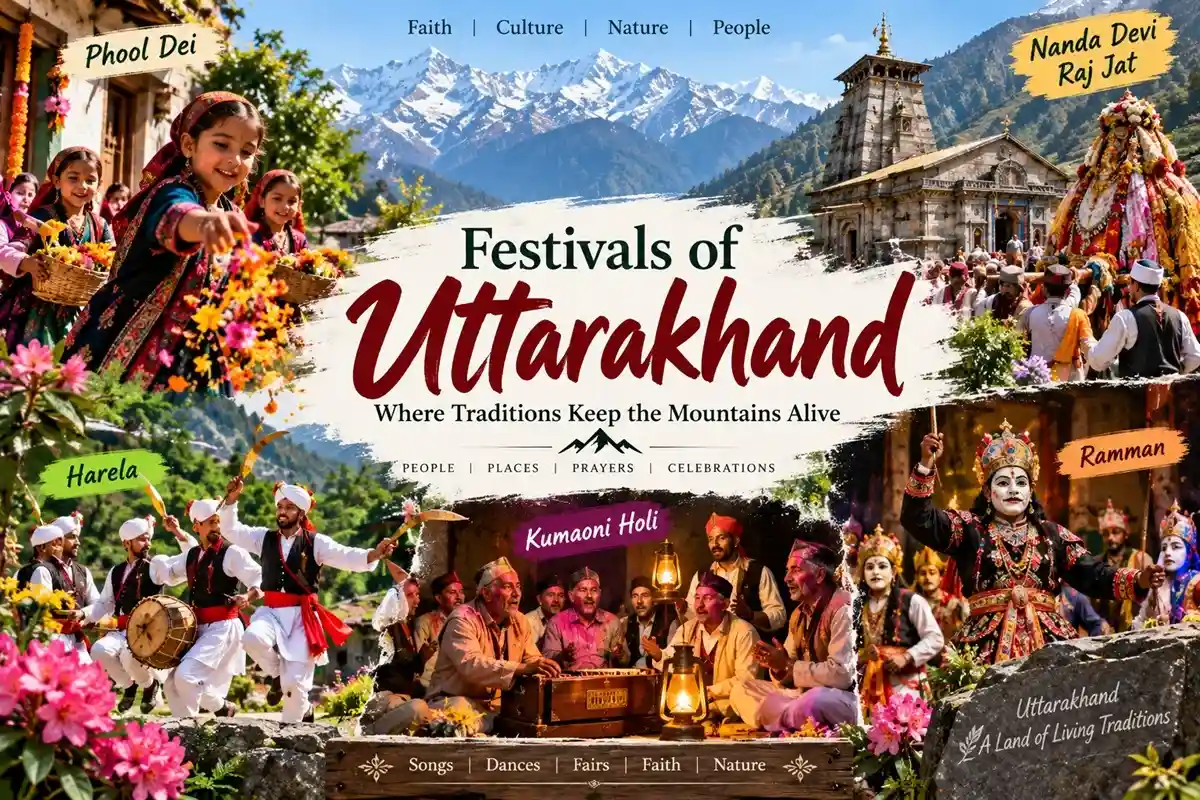
Uttarakhand has earned the name Devbhoomi — Land of the Gods — and its festival calendar proves why. Barely a month goes by without a fair lighting up a village square, a riverbank ghat, or a Himalayan meadow. Kumaoni and Garhwali communities each keep their own rhythm of celebration, built around harvests, the monsoon, and stories tied to local deities. Some festivals of Uttarakhand, like Diwali and Holi, are celebrated across India but take on a distinct hill character here. Others — Harela, Phool Dei, Egaas Bagwal, and the once-in-12-years Nanda Devi Raj Jat — exist almost nowhere else.
This guide covers 21 major fairs and festivals of Uttarakhand, updated with current 2026–27 dates, what actually happens at each one, and where to go if you want to see it for yourself.
Key Takeaways
- Uttarakhand celebrates more than 25 distinct fairs and festivals across its Garhwal and Kumaon regions.
- The full Nanda Devi Raj Jat, held once every 12 years, was postponed from 2026 to 2027 by the official Raj Jat committee — but a separate, shorter Nanda Devi Badi Jat is running in September 2026, which is where the confusion online comes from.
- The next Kumbh Mela at Haridwar (commonly called the Ardh Kumbh, six years after the last one) is scheduled for January–April 2027 — sooner than many travellers assume.
- Harvest festivals like Harela and Phool Dei follow the local Kumaoni almanac, so exact dates shift each year.
- Egaas Bagwal, Uttarakhand’s “second Diwali,” falls eleven days after the main festival and is unique to the Garhwal hills.
The Fairs & Festivals of Uttarakhand
1. Phool Dei — Festival of Flowers
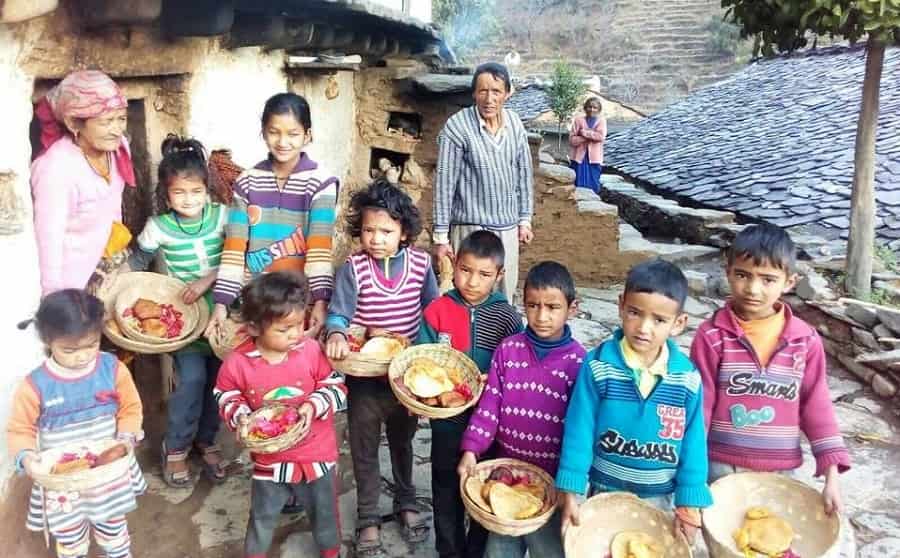
Phool Dei marks the arrival of spring across Uttarakhand’s hills. Young girls visit every house at dawn, scattering flowers and rice on the doorstep while singing traditional songs, and receive jaggery, rice, or small gifts in return. The ritual is believed to invite prosperity and good fortune for the household in the year ahead. In many villages, the celebrations continue for close to a month rather than ending on a single day.
- When: Chaitra Sankranti, mid-March (next major date: 15 March 2027)
- Where: Villages across Garhwal and Kumaon
- Highlight: Girls decorate doorsteps with fresh flowers and rice at sunrise
- Tip: Visit a Kumaoni village early morning to watch the ritual firsthand
2. Harela — Festival of Green

Harela literally means “day of green,” celebrating the monsoon, sowing, and hope for a good harvest. Ten days before the festival, families sow five or seven types of grain in small baskets kept indoors; on Harela day, the young shoots are cut and worn behind the ear or offered to elders as blessings. It’s also linked in local belief to the wedding of Shiva and Parvati, and is marked with folk dance, feasting, and tree-planting drives.
- When: Shravan month — 16 July 2026 (already past); next on 17 July 2027
- Where: Kumaon region, also observed in parts of Nepal
- Highlight: The ten-day grain-sprouting ritual known as Harela ki Dali
- Tip: The state runs mass tree-plantation drives on this day — a good time to see local environmental campaigns in action
3. Bat Savitri
On this day, married women across Garhwal fast and worship the banyan (bat/vat) tree, tying sacred thread around its trunk and praying for their husbands’ long life. The custom recalls the legend of Savitri, who is believed to have won her husband Satyavan back from Yama, the god of death. Women dress in traditional bridal colours and gather at old banyan trees to perform the rituals together.
- When: Jyeshtha Amavasya (May–June; exact date shifts every year with the lunar calendar)
- Where: Pauri, Haridwar, Dehradun, Tehri Garhwal
- Highlight: The thread-tying ritual performed around century-old banyan trees
- Tip: Best observed in older Garhwali villages where ancient banyan trees still stand near the temple
4. Bikhauti Mela (Dwarahat, Almora)

Also called Syalde Bikhauti, this fair marks Baisakhi and the start of the Kumaoni solar new year in Dwarahat. Locals take a ritual bath in nearby rivers at dawn, then gather for the unusual Oda Bhetna — a ceremonial stone-throwing contest between two village groups that dates back to the era of the Katyuri kings. Sweets, folk performances, and a large trade fair round out the celebrations.
- When: Vishuwat Sankranti, mid-April (next: 14 April 2027)
- Where: Dwarahat, Almora district
- Highlight: Oda Bhetna — ceremonial stone-throwing between two groups
- Tip: Arrive at sunrise; the ritual bathing happens before the fair crowds build up
5. Nanda Devi Raj Jat — Postponed to 2027, With a Shorter Yatra Running in 2026
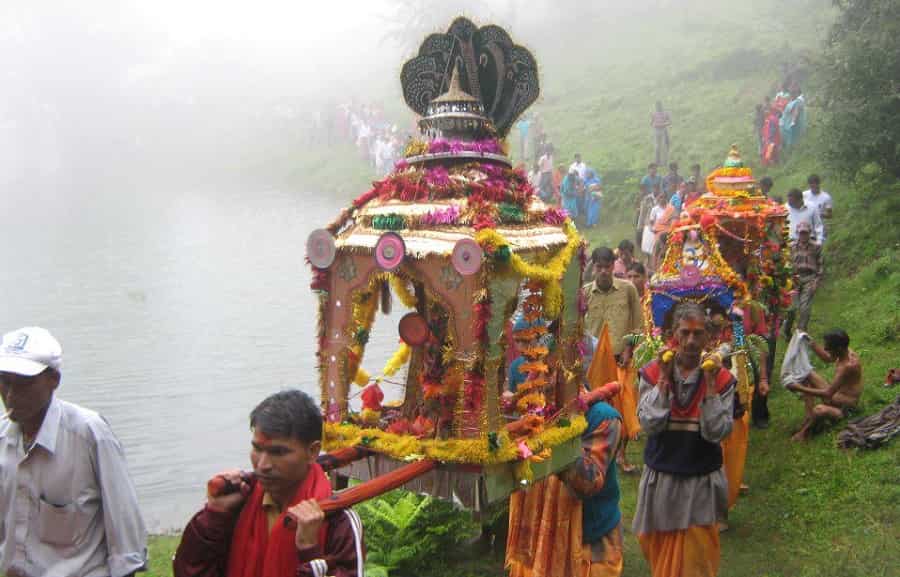
Known as the “Himalayan Mahakumbh,” this is one of Uttarakhand’s most significant pilgrimages, held once every twelve years. A four-horned sheep (chausingya khadu) leads the procession, roughly 280 km, on the traditional route from Nauti village through Chamoli’s high-altitude terrain — past Roopkund — to its final destination at Homkund. The full journey usually takes around 18 to 22 days.
The 2026 edition has been postponed. The official Nauti-based Raj Jat committee decided in January 2026 that weather and infrastructure at the high-altitude stops weren’t ready in time, and pushed the complete pilgrimage to 2027. A separate committee, based at the Kurud/Devrada Siddhpeeth, organised its own shorter version — the Nanda Devi Badi Jat — which is running from 5 to 25 September 2026. It follows a shorter route and isn’t the same event as the full Nauti Raj Jat, even though both get called “Raj Jat” online. Outside this cycle, a smaller annual Nanda Devi Mela is also held every September at temples across Almora and Nainital, timed to Nanda Ashtami.
- When: Full Nauti Raj Jat — postponed to 2027, exact dates not yet officially announced; 2026 Badi Jat (Kurud committee) — 5–25 September 2026; annual Nanda Devi Mela — around Nanda Ashtami, late September (19 September 2026)
- Where: Chamoli district, Nauti to Homkund (full Raj Jat); Almora and Nainital (annual mela)
- Highlight: The sacred four-horned sheep procession, part of the route that passes near Roopkund
- Tip: If you’re planning specifically around the full 2027 Raj Jat, wait for an official announcement from the Nauti committee before booking anything
6. Basant Panchami
Basant Panchami welcomes spring and honours Goddess Saraswati, the deity of knowledge and the arts. Yellow — the goddess’s favourite colour — dominates clothing, sweets, and mustard fields in bloom across the hills. Students and artists place books and instruments before her idol for blessings, and temples hold special aarti through the day.
- When: Magha Shukla Panchami — 11 February 2027
- Where: Across Uttarakhand
- Highlight: Saraswati idol installations and yellow-themed celebrations
- Tip: Temples in Haridwar and Dehradun host particularly elaborate Saraswati pujas
7. Kangdali (Kandali), Pithoragarh
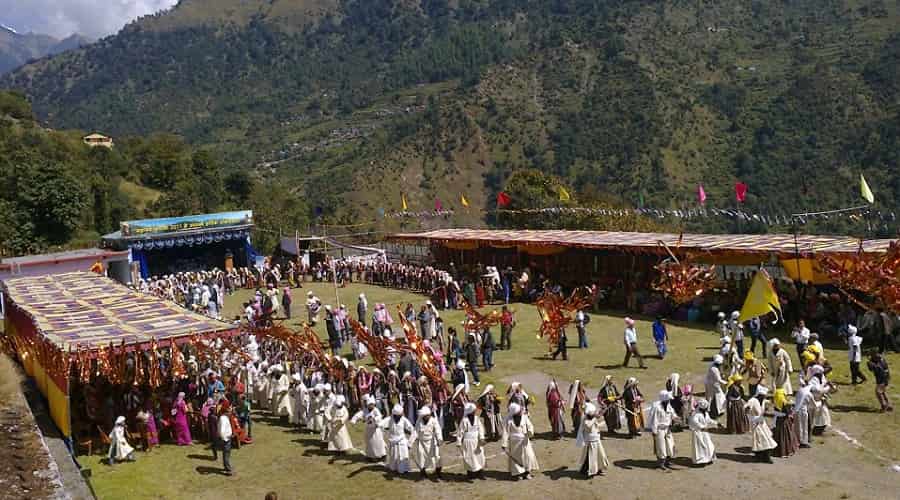
This unusual festival belongs to the Rung community of the Chaundas Valley. Local tradition ties it to a story of women defending the region against Zorawar Singh’s invading force in 1841. It’s timed to the rare flowering of the Kandali plant, a shrub that blooms only once every twelve years — much like the famed Neelakurinji of South India. Women re-enact the uprooting of Kandali plants that once concealed soldiers, alongside traditional dance and processions.
- When: Once every 12 years, timed to the Kandali bloom (roughly August–October)
- Where: Chaundas Valley, Pithoragarh
- Highlight: Re-enactment of the 1841 battle against Zorawar Singh’s forces
- Tip: A genuinely rare cultural event — check with the Pithoragarh tourism office for the confirmed next date
8. Magh Mela, Uttarkashi
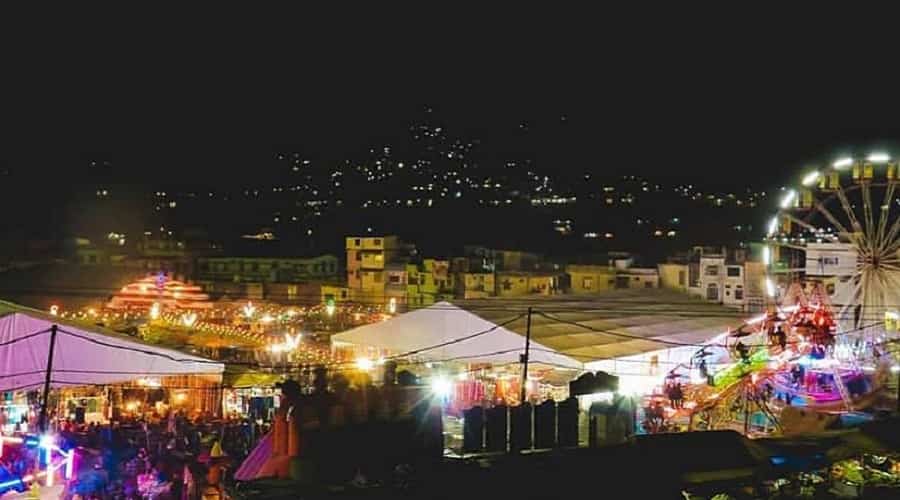
This week-long winter fair coincides with Makar Sankranti and draws growing crowds each year. Pilgrims take a holy dip in the Ganga, and the ghats fill with stalls selling handcrafted woollens, local produce, and Garhwali snacks. What began as a purely religious gathering has become one of Uttarkashi’s biggest tourism draws.
- When: Around Makar Sankranti, mid-January
- Where: Uttarkashi
- Highlight: Riverside handicraft and local produce fair
- Tip: Pack warm layers — January mornings in Uttarkashi are cold enough to make the holy dip a real test of devotion
9. Purnagiri Mela, Champawat
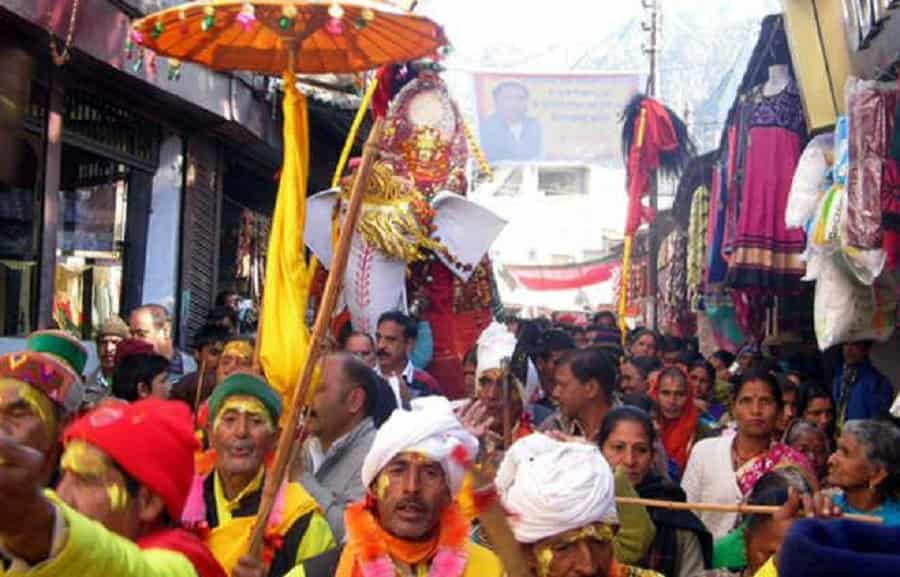
Held at the Purnagiri temple overlooking the Kali River, this fair honours Goddess Sati and is traditionally regarded by devotees as one of the Siddhapeeths — sites believed to mark where a part of her body fell. The main mela runs through Chaitra Navratri and draws pilgrims from across North India and neighbouring Nepal; how long it extends beyond that in any given year depends on the official notification, so it’s worth checking closer to the date rather than assuming a fixed window.
- When: Chaitra Navratri, March–April (exact mela duration varies by year — confirm with Champawat district tourism before travelling)
- Where: Tanakpur, Champawat district (about 20 km from Tanakpur)
- Highlight: One of the Siddhapeeth pilgrimage sites associated with Goddess Sati
- Tip: The route up to the temple has several stages rather than a single climb — budget more time than you’d expect if you’re not used to hill walking
10. Hilljatra, Pithoragarh
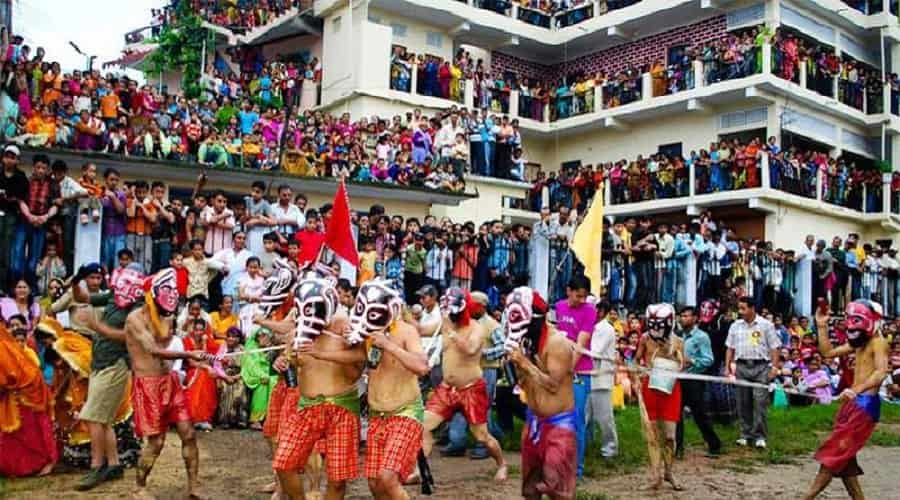
Hilljatra is a farming festival marking paddy transplantation in the fields of Pithoragarh’s hill villages. Traditionally observed on the eighth day of the Bhado (monsoon) month, it unfolds in three stages — worship, ritual performance, and community feasting. Masked folk dances depicting mythical characters and animals are the festival’s most striking feature, alongside songs celebrating the season’s harvest.
- When: Eighth day of Bhado month (roughly August–September)
- Where: Pithoragarh district
- Highlight: Masked folk performances tied to paddy planting
- Tip: Best experienced in interior villages, where the tradition stays closest to its original form
11. Bissu Mela, Jaunsar-Bawar (Dehradun)
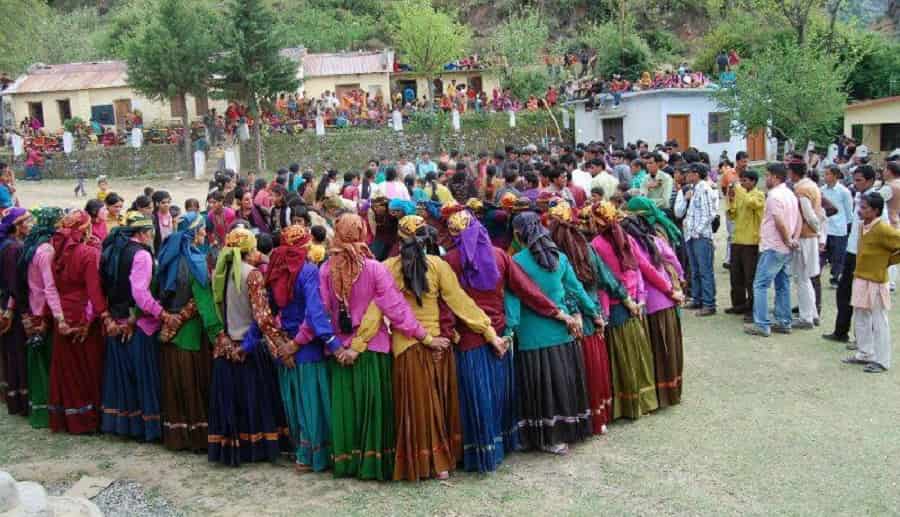
Bissu Mela is the Jaunsari tribe’s week-long harvest festival, held annually around Baisakhi in Dehradun district’s Chakrata block. Communities gather to thank the gods for a good harvest, offering rhododendron flowers to Santura Devi — a local form of Goddess Durga. Traditional Jaunsari dress, folk singing, and group dances are central to the week’s celebrations.
- When: Around Baisakhi, mid-April
- Where: Chakrata tehsil, Jaunsar-Bawar region, Dehradun
- Highlight: Rhododendron flower offerings to Santura Devi
- Tip: Chakrata is a scenic 3–4 hour drive from Dehradun — pair the mela with a short hill getaway
12. Uttarayani Mela (Ghughutiya)
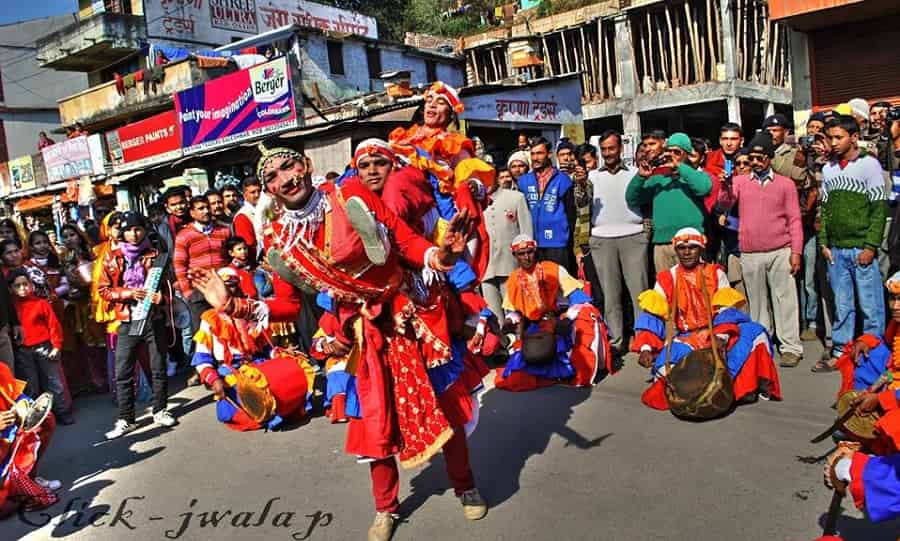
Every January, the banks of the Saryu River near Bagnath temple in Bageshwar come alive for Uttarayani, timed to Makar Sankranti and the sun’s shift into the northern hemisphere. Children string sweet dough birds called “ghughute” into necklaces and feed them to crows at dawn, chanting traditional rhymes. The week-long mela also showcases Kumaoni crafts — copper vessels, cane baskets, and woollens — alongside the sacred river dip.
- When: Makar Sankranti, 14–15 January (next: 14–15 January 2027)
- Where: Bageshwar and across the Kumaon region
- Highlight: Ghughuti-making and the crow-feeding ritual at dawn
- Tip: Ask a Bageshwar homestay to show you how ghughute are shaped and fried — it’s a fun hands-on tradition
13. Kanwar Yatra
Every year during Shravan, lakhs of Shiva devotees, or kanwariyas, collect holy Ganga water from pilgrimage centres including Haridwar, Gangotri, and Gaumukh, carrying it on foot to offer at Shiva temples back home. Haridwar sees by far the largest crowds, though the Gangotri–Gaumukh stretch draws its own dedicated pilgrims. It’s one of India’s largest annual pilgrimages. Expect heavy traffic and crowd-management diversions on the Haridwar–Rishikesh–Uttarkashi stretch through the month.
- When: Shravan month, typically July–August
- Where: Gangotri, Gaumukh, Haridwar, Rishikesh
- Highlight: Devotees walking long distances on foot carrying holy Ganga water
- Tip: If you’re travelling through Haridwar or Rishikesh during Shravan, build extra time into your plans for road diversions
14. Ghee Sankranti (Olgia)

This lesser-known Kumaoni festival marks the first day of Bhado and centres on gift-giving between relatives — sons-in-law and nephews traditionally present sweets and gifts to fathers-in-law and maternal uncles. Eating ghee on this day is considered essential, believed to bring good health through the months ahead. Farmers and artisans also exchange produce and tools with landlords as a mark of the season’s harvest.
- When: Singh Sankranti, first day of Bhado (17 August 2026)
- Where: Nainital, Bageshwar, Almora, Pithoragarh, Champawat
- Highlight: Family gift-giving (Olgia); eating ghee is a traditional part of the day, believed to bring good health
- Tip: A largely household celebration — a Kumaoni homestay is a better way to experience it than a public event
15. Holi (Kumaoni Holi)
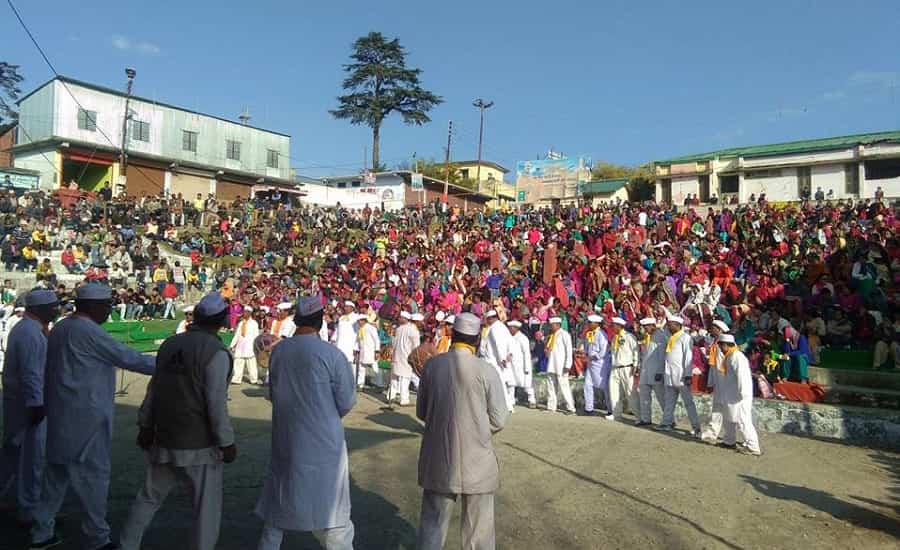
Holi in Uttarakhand goes well beyond colours. Kumaon has its own musical tradition built around Baithki Holi (sung indoors to classical ragas), Khari or Khadi Holi (sung standing in the streets), and Mahila Holi (celebrated by women). The singing season actually begins weeks before the main day and builds through a long calendar of gatherings, before colours, folk music, and community feasts take over on the final day.
- When: Phalguna Purnima — around 21–23 March 2027 (Panchang sources give slightly different days for Holika Dahan and Rangwali Holi; confirm locally closer to the date)
- Where: All over Uttarakhand, with especially strong traditions in Almora and Nainital
- Highlight: Baithki and Khari Holi — musical Holi traditions unique to Kumaon
- Tip: Attend a Baithki Holi gathering in Almora a few weeks before the main day for the most authentic experience
16. Ganga Dussehra
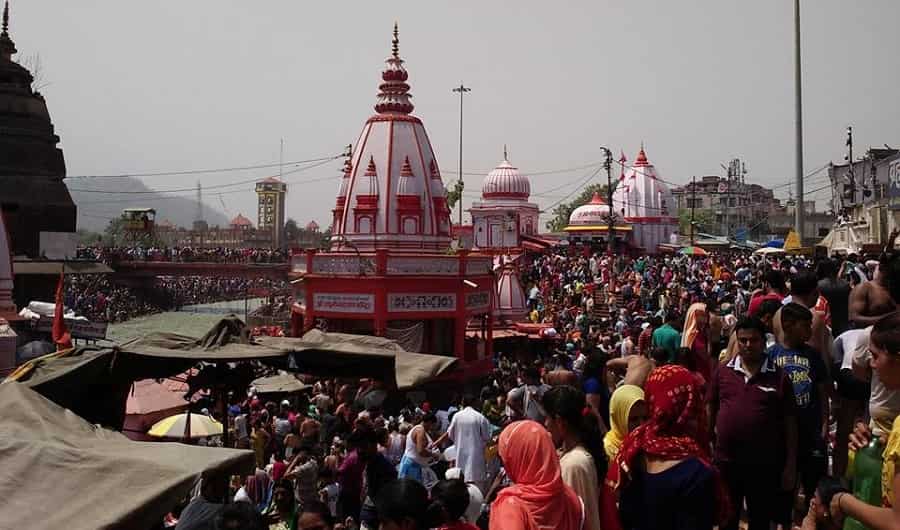
Ganga Dussehra celebrates the descent of the river Ganga to earth, and Haridwar’s ghats are the epicentre of the celebrations. Devotees take part in special aartis, offer watermelons and cucumbers to the river, and bathe at Har Ki Pauri over the ten-day observance. Rishikesh sees equally large gatherings along its own ghats.
- When: Jyeshtha Shukla Dashami, usually late May to June
- Where: Haridwar, Rishikesh
- Highlight: Ten-day riverside celebration culminating in a grand evening aarti
- Tip: The Ganga Aarti at Har Ki Pauri draws especially large crowds during this period — arrive well before sunset for a good spot
17. Diwali
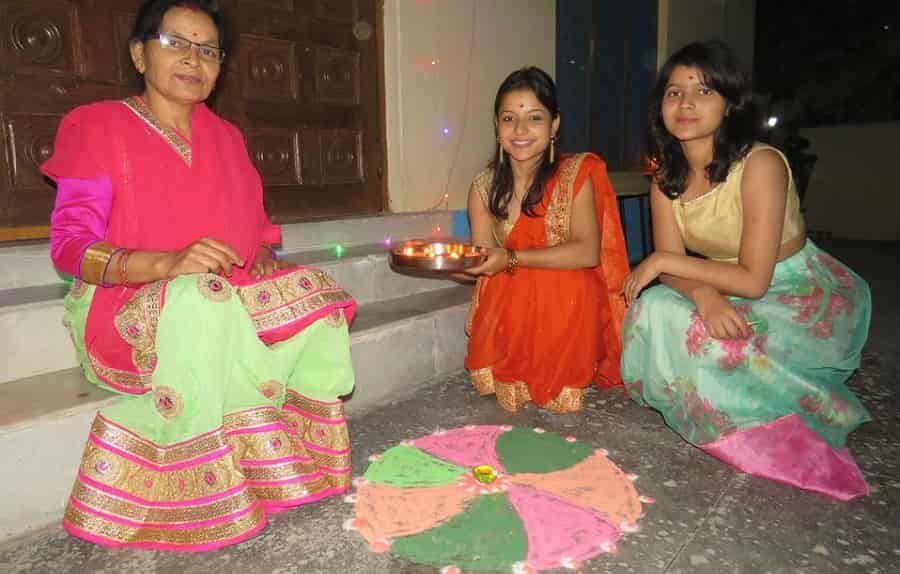
While most of India celebrates Diwali over two days, Uttarakhand stretches the festival across nearly five, from Dhanteras through Bhai Dooj. Homes are lit with diyas, families exchange sweets, and fireworks light up hill towns. One interesting local twist: some Garhwali communities mark their own version of Diwali a full eleven days later, tied to the legend of a shepherd who brought news of Lord Ram’s return late to the remote hills.
- When: 6–10 November 2026 (Dhanteras: 6 Nov; main Diwali: 8 Nov)
- Where: Entire Uttarakhand
- Highlight: An extended five-day celebration across Dhanteras, Govardhan Puja, and Bhai Dooj
- Tip: If you’re in Garhwal, ask locally about Egaas Bagwal — the region’s own follow-up celebration (see below)
18. Egaas Bagwal — Uttarakhand’s “Second Diwali”
Egaas Bagwal, also called Budhi Diwali, is a distinctive Garhwal festival that falls eleven days after the main Diwali. Legend has it that news of Lord Ram’s return to Ayodhya reached remote Garhwal villages late, so they lit their lamps eleven days behind everyone else — and the tradition stuck. Villages celebrate with bhailo, a nighttime fire-swinging ritual performed with burning ropes, along with traditional sweets like arsa and singal, and cattle are specially honoured for their role in farming life.
- When: Kartik Shukla Ekadashi — 20 November 2026
- Where: Garhwal region (Tehri, Pauri, Rudraprayag, Chamoli)
- Highlight: Bhailo — a nighttime fire-swinging ritual
- Tip: Far less publicised than Diwali, but worth timing a Garhwal village visit around it if you want an offbeat cultural experience
19. Kumbh Mela, Haridwar

The Kumbh Mela at Haridwar is one of the world’s largest religious gatherings, drawing millions of devotees to bathe at Har Ki Pauri on the banks of the Ganga. It’s held at four traditional locations — Haridwar, Prayagraj, Nashik-Trimbakeshwar, and Ujjain — with each city hosting its full Kumbh on roughly a 12-year cycle. The next Haridwar edition, commonly referred to as the Ardh Kumbh, is scheduled for January to April 2027 — sooner than many travellers expect. Official terminology and the exact bathing-date schedule will be confirmed closer to the event.
- When: January–April 2027 (often called the Ardh Kumbh; next full 12-year Kumbh at Haridwar: 2033 — check official notifications for exact bathing dates)
- Where: Har Ki Pauri, Haridwar
- Highlight: Multiple major bathing dates (increasingly called Amrit Snan, formerly Shahi Snan) with grand Akhada and Naga Sadhu processions
- Tip: Book Haridwar accommodation well ahead of 2027 — rooms fill up months before the main bathing dates
20. Bhitauli
Bhitauli means “to meet,” and it’s a festival devoted entirely to married women of Uttarakhand. During the Chaitra month, newly married daughters receive their first Bhitauli — home-cooked food and sweets sent from their parental home — as a gesture of love and a reminder of the life they left behind after marriage. It’s a quieter, deeply personal festival rather than a public fair, celebrated within families.
- When: Every year during Chaitra (March–April)
- Where: Pithoragarh, Bageshwar, Champawat, Almora, Nainital
- Highlight: Sweets and food sent from a woman’s parental home
- Tip: Worth knowing if you’re a guest in a Kumaoni household this month — it explains many of the family visits happening around you
21. Tapkeshwar Mahadev Mela, Dehradun
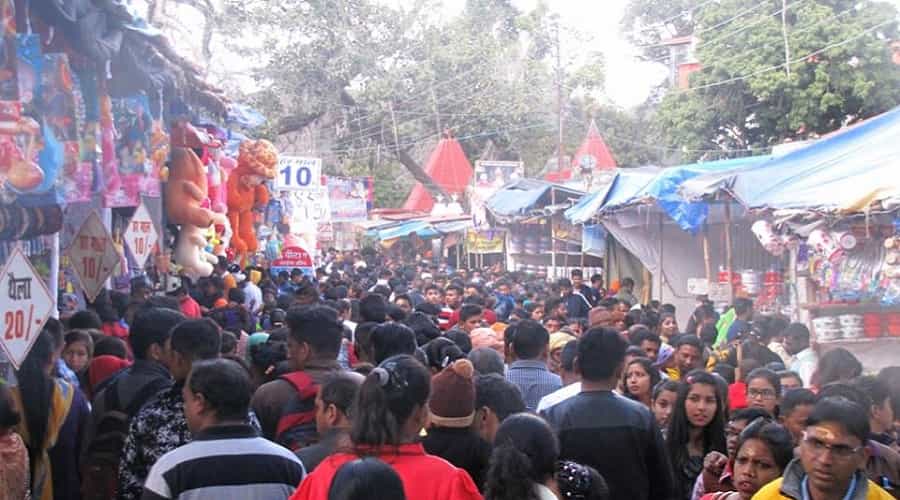
This fair takes over the cave temple of Tapkeshwar Mahadev, a short drive from Dehradun city, during Maha Shivratri. Locally known as Shivratri Mela, it marks the mythological marriage of Shiva and Parvati and draws devotees from across the region for special prayers inside the naturally formed cave shrine. The temple complex, set beside a small stream, is specially decorated for the occasion.
- When: Maha Shivratri, usually February–March
- Where: Tapkeshwar Temple, Dehradun
- Highlight: Rituals performed inside a natural cave shrine dedicated to Shiva
- Tip: Easy to combine with Dehradun’s other temples as part of a Haridwar–Rishikesh–Dehradun itinerary
Planning a Festival Trip: What to Know Before You Go
- Hill festival dates shift slightly every year, since most follow the Kumaoni or Garhwali lunar calendar — always confirm the current-year date before booking.
- Book accommodation early for major events like the Kumbh Mela, Nanda Devi Raj Jat, and Uttarayani Mela; rooms in Haridwar and Bageshwar fill up fast.
- Winter festivals (Magh Mela, Uttarayani, Tapkeshwar Mela) call for genuinely warm clothing — hill mornings are colder than they look on a forecast.
- Road access can get restricted during large pilgrimages like the Kanwar Yatra and Raj Jat — check route advisories a few days before travelling.
- Smaller village festivals (Bhitauli, Ghee Sankranti, Bat Savitri) are best experienced through a homestay rather than as a public event.
FAQs
Which is the most well-known festival of Uttarakhand?
The Nanda Devi Raj Jat is one of the most significant and distinctive, held once every 12 years. Among festivals celebrated every year, Harela, Phool Dei, and Kumaoni Holi are the most widely recognised.
What is the Nanda Devi Raj Jat, and when is the next one?
It’s a roughly 280-km pilgrimage through Chamoli district, from Nauti to Homkund, honouring Goddess Nanda Devi, held once every 12 years. The full official pilgrimage was postponed from 2026 to 2027. A separate, shorter Nanda Devi Badi Jat is running from 5–25 September 2026, organised by a different committee — it’s not the same event.
When is Harela celebrated in Uttarakhand?
Harela falls in the Shravan month. It was celebrated on 16 July 2026; the next date is 17 July 2027.
Is Phool Dei the same as Basant Panchami?
No. Basant Panchami welcomes spring in January–February and honours Saraswati, while Phool Dei is a separate mid-March harvest festival where young girls decorate doorsteps with flowers.
When is the next Kumbh Mela in Haridwar?
The next Haridwar Kumbh, generally called the Ardh Kumbh, is scheduled from January to April 2027. The following full 12-year Kumbh Mela at Haridwar will be in 2033.
What is Egaas Bagwal?
Egaas Bagwal, or Budhi Diwali, is a Garhwal-only festival held 11 days after Diwali, marking the delayed news of Lord Ram’s return reaching the remote hills. It falls on 20 November 2026.
Which festivals are unique to Kumaon versus Garhwal?
Harela, Uttarayani, Ghee Sankranti, and Kumaoni Holi are Kumaon traditions, while Bat Savitri, Bissu Mela, and Egaas Bagwal are specific to Garhwal and the Jaunsar-Bawar region.
What is the best time to visit Uttarakhand for festivals?
July (Harela), September (Nanda Devi Raj Jat/Nanda Ashtami), and October–November (Diwali and Egaas Bagwal) offer the richest festival experiences, alongside the major Kumbh year of 2027.
What is Uttarayani Mela and where is it held?
Uttarayani is a week-long mela held around Makar Sankranti (mid-January) on the banks of the Saryu River in Bageshwar, featuring a ritual river dip, the ghughuti tradition, and a large Kumaoni handicrafts fair.
Is the Nanda Devi Raj Jat open to tourists, or only pilgrims?
Yes, thousands of non-pilgrim visitors typically join to watch. Just be clear on which yatra you’re attending — the shorter 2026 Badi Jat or, once dates are announced, the full 2027 Nauti Raj Jat — since they follow different routes on different years.
What should I pack for a winter festival like Magh Mela or Uttarayani Mela?
Heavy woollens, thermal layers, and sturdy closed shoes — January mornings in Uttarkashi and Bageshwar regularly drop close to freezing, especially near the river ghats at dawn.
Do festival dates in Uttarakhand change every year?
Yes. Most follow the Hindu lunar calendar or the local Kumaoni/Garhwali almanac, so the Gregorian date shifts by days or weeks each year — always confirm the current year’s date before booking travel.
Conclusion
Uttarakhand’s festival calendar is really a map of its culture — every fair here is tied to a season, a harvest, or a legend passed down through generations of Kumaoni and Garhwali families. Whether you time your trip around the vibrant chaos of Uttarayani, the rare spectacle of the Nanda Devi Raj Jat, or the upcoming 2027 Kumbh Mela at Haridwar, festival season adds a layer to Uttarakhand travel that a regular sightseeing trip simply can’t match. If you’re planning a Chardham Yatra or a Haridwar–Rishikesh trip around any of these dates, it’s worth checking current-year festival calendars first — the crowds, availability, and experience all shift significantly during major melas.