Garhwali is an Indo-Aryan language from the Central Pahari group, spoken across the Garhwal region of Uttarakhand. It carries its own ISO code — gbm — and its own grammar, separate from Hindi, even though the two share a common ancestry and most Garhwali speakers move between both languages without thinking about it.
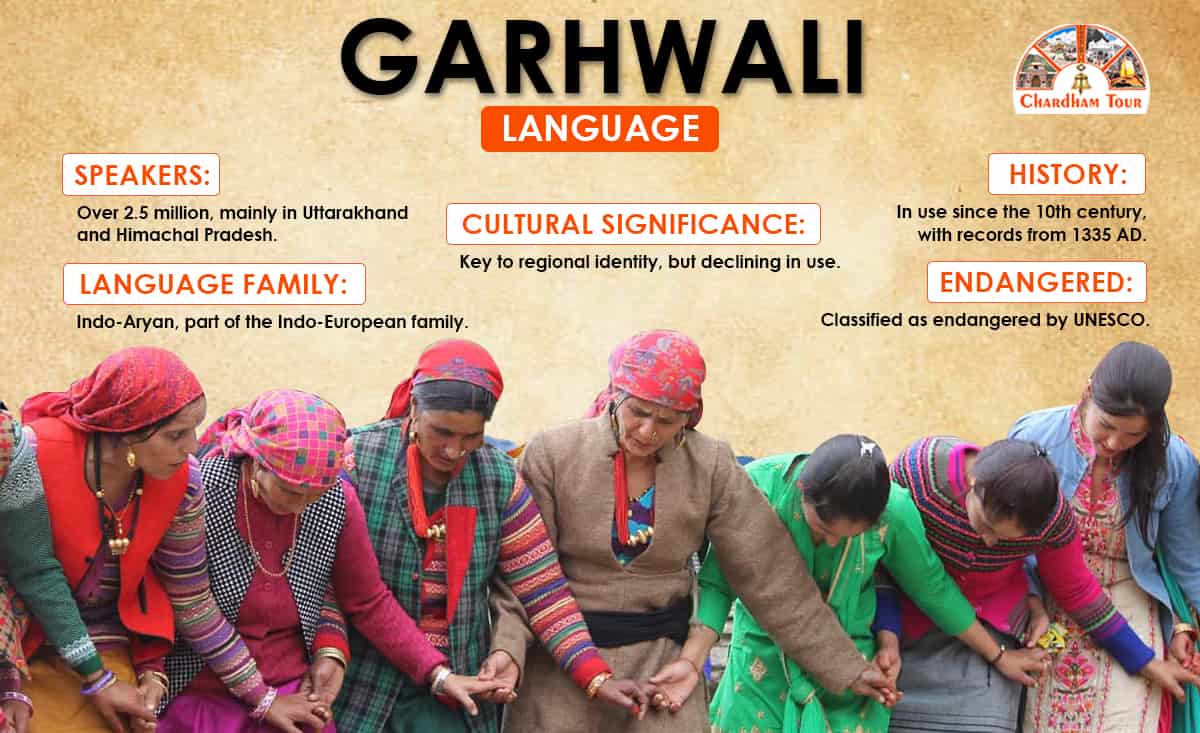
The 2011 Census recorded 2,482,089 people in India who gave Garhwali as their mother tongue. Of those, 2,322,406 live in Uttarakhand itself; the remaining 159,683 are spread across states like Delhi, Uttar Pradesh, and Haryana, mostly through migration. That’s the last hard count available — India hasn’t run a fresh census since, so any number you see claiming to reflect “2026 speakers” is an estimate dressed up as a fact.
What Garhwali Is, and What It Isn’t
Garhwali belongs to the Central Pahari branch of Indo-Aryan languages. Kumaoni is its closest relative, spoken one region over in the Kumaon hills. Linguists classify Garhwali as its own language rather than a Hindi dialect, and the separate ISO 639-3 code (gbm) reflects that. Census forms complicate the picture a little, since some mother-tongue returns get grouped administratively under broader Hindi-language categories. That’s an administrative quirk, not a linguistic verdict.
Most people who grow up speaking Garhwali also speak fluent Hindi — school, television, and administration make sure of that. The reverse doesn’t hold. A Hindi speaker with no prior exposure to the hills will catch some of what’s being said and miss a lot of it, and how much depends entirely on how much contact they’ve had with the region.
Where the Language Comes From
Garhwali’s development traces back to the Middle Indo-Aryan period, when a family of related Prakrits — including one called Khas — were spoken across the western Himalayan foothills. Regional histories of Garhwal commonly cite a 1335 AD temple grant inscription from Devprayag, issued under King Jagatpal, as one of the earliest surviving records connected to the language. I’d treat that date as widely repeated rather than independently verified by me — it shows up consistently in Garhwal-focused sources, but I haven’t traced it to a primary epigraphic study.
What’s better documented is the political history. Garhwal ran as an independent kingdom until the region came under British administration in the 19th century. Garhwali held cultural and literary importance through that period. Calling it the formal “court language” of the kingdom is a claim I’d want a dedicated historical source for before stating it as settled fact — so I’m leaving it as a claim worth checking rather than repeating it here.
The Dialects Aren’t All the Same
Garhwali isn’t one uniform way of speaking. Glottolog’s classification lists more than a dozen regional varieties under Garhwali, including Srinagaria, Salani, Rathi, Tehri Garhwali (also called Gangapariya), Nagpuriya, Jaunpuri, Badhani, Dasaulya, and Lohbya. Linguists don’t fully agree on how to rank or group them, so treat any claim of one definitive “standard” dialect with some caution.
That said, Srinagaria — spoken around Srinagar in Pauri Garhwal — is commonly described as closest to the standard form, and Salani is often cited as the most widely spoken variety within Pauri district. Someone from Srinagar and someone from the Rathi belt can usually follow each other in conversation. The differences show up mostly in specific vocabulary and pronunciation, not in basic grammar.
Script and the Oral Tradition
Modern Garhwali is written in Devanagari — the same script used for Hindi and Sanskrit. It never developed a separate writing system of its own; what it does have is a strong oral tradition that predates any of its written material.
The best-known example is the Dhol Sagar — a body of traditional knowledge on playing the dhol and damau, the folk drums used across Garhwal for weddings, festivals, and ritual occasions. It was never compiled into a single fixed manuscript. It survived instead through direct transmission inside drumming families, passed down as spoken and performed knowledge rather than text. Alongside it sit jagar songs, sung to invoke local deities, and mangal songs, performed at weddings and festivals. Parashar Gaur, the filmmaker behind Garhwali cinema’s first feature, also established the Garhwali Sahitya Puraskar — the language’s first dedicated literary award — named after his father.
Is Garhwali Actually Endangered?
This is where most articles online get sloppy, so here’s the precise picture. Glottolog’s current entry for Garhwali, citing a 2022 assessment by Campbell et al., gives it an AES status of “threatened.” A separate note in the same record cites the language as “Vulnerable” based on older Ethnologue data from 2013. These aren’t contradictory positions from rival camps — they’re two different vitality frameworks measuring the same underlying trend: the language is still widely spoken, but it’s losing ground.
What I won’t do is repeat the version of this claim that says UNESCO has declared Garhwali “rapidly becoming extinct.” No current classification supports that. “Vulnerable” and “threatened” both sit well short of “critically endangered,” let alone extinct — they mean children still learn the language at home in most Garhwali households, but its use is shrinking in schools, offices, and increasingly in cities where Garhwali families have settled for a generation or two.
What’s Actually Putting Pressure on It
- Migration out of hill villages toward Dehradun, Delhi, and other cities
- Hindi becoming the default home language for second-generation migrant families
- No formal role for Garhwali in schooling or government offices
- Younger speakers associating the language with rural life rather than opportunity
- Limited Garhwali-language content in mainstream digital media compared to Hindi
Why Garhwali Isn’t Uttarakhand’s Official Language
Hindi is Uttarakhand’s official language. Sanskrit holds second official-language status — Uttarakhand became the first Indian state to grant Sanskrit that position, in January 2010. Garhwali and Kumaoni sit outside this framework entirely; neither has any official administrative status in the state, despite being the languages most people in the hills actually grow up speaking at home.
Part of the reason is bureaucratic inertia — building out Garhwali’s use in schools and offices would take real investment that state governments haven’t prioritized since Uttarakhand’s formation in 2000. Part of it is the language-versus-dialect debate itself, which keeps getting treated as unresolved even though linguists working on Central Pahari languages generally don’t.
The Eighth Schedule Question
Garhwali, listed as “Garhwali (Pahari),” appeared among 38 languages seeking inclusion in the Eighth Schedule of the Indian Constitution in a 2017 Ministry of Home Affairs reply to Parliament. That’s a documented historical position, not a live 2026 count — I haven’t found a more recent MHA figure updating that number, so I’m not going to present 38 as a current tally. What hasn’t changed is the outcome: Garhwali remains outside the Eighth Schedule, and the Ministry has acknowledged the demand without committing to a timeline or fixed criteria for acting on it.
One thing this inclusion would not automatically do: make Garhwali usable as a UPSC exam medium. That’s a separate rule with its own criteria, and I’m not aware of any provision that ties Eighth Schedule status directly to UPSC eligibility. Articles claiming otherwise are overreaching.
Garhwali Compared to Kumaoni
People mix these up constantly, so here’s the distinction in one place.
| Feature | Garhwali | Kumaoni |
|---|---|---|
| Region | Garhwal division (Tehri, Pauri, Chamoli, Uttarkashi, Rudraprayag) | Kumaon division (Almora, Nainital, Pithoragarh, Bageshwar, Champawat etc.) |
| Family | Indo-Aryan, Central Pahari | Indo-Aryan, Central Pahari |
| Script | Devanagari | Devanagari |
| Eighth Schedule status | Not included | Not included |
| Speakers (2011 Census, India) | 2,482,089 | Recorded separately under its own mother-tongue category |
Both descend from the same Central Pahari branch, and both carry heavy Sanskrit-derived vocabulary. A Garhwali speaker and a Kumaoni speaker can usually place each other’s region within a sentence, even without formal linguistic training.
Garhwali on Screen
Garhwali cinema exists, even if it’s never been large. Jagwal — written, produced, and directed by Parashar Gaur — premiered on 4 May 1983 at Mavalankar Hall in Delhi, and is widely credited as the first Garhwali-language feature film. It’s the story of a young wife waiting years for a husband imprisoned shortly after their wedding. Gaur had conceived the project in 1975 but couldn’t get it made until 1982; the film itself was shot in 28 days. Its premiere gave Garhwali-language filmmaking its actual starting point, and a handful of films — along with a much larger volume of Garhwali folk music on YouTube — have kept that thread going since.
What Conservation Actually Requires
Most conservation advice for Garhwali stops at nostalgia — folk festivals, traditional dress, song competitions. Those things matter for cultural memory, but they don’t change why the language is losing speakers. Garhwali has no functional role in getting a job, passing an exam, or dealing with a government office. Fix that gap and the language gets a reason to survive beyond sentiment.
Practical steps that would matter more than another cultural fair:
- Digital tools — apps, podcasts, structured vocabulary resources — that reach migrant Garhwali families who no longer live near fluent speakers
- Garhwali-language film and music content aimed at younger, urban audiences, not just older generations
- Documentation of the less-common dialects, like Jaunpuri and Nagpuriya, while fluent older speakers are still around to record
- Some formal presence in Uttarakhand’s schools, even as an optional subject, rather than none at all
FAQs
What language family does Garhwali belong to?
Indo-Aryan, within the Central Pahari subgroup — the same branch as Kumaoni.
How many people speak Garhwali?
The 2011 Census recorded 2,482,089 mother-tongue speakers in India, with 2,322,406 of them in Uttarakhand. No more recent census exists.
Is Garhwali an official language of Uttarakhand?
No. Hindi is the state’s official language, and Sanskrit holds second official-language status since 2010. Garhwali has no official standing.
Is Garhwali endangered?
Assessments differ by framework. Glottolog’s current entry lists it as “threatened” (2022 data); an earlier Ethnologue-based note calls it “vulnerable.” Neither reaches critically endangered or extinct.
What script is Garhwali written in?
Devanagari — it has no separate script of its own.
How is Garhwali different from Kumaoni?
Both are Central Pahari languages from neighboring regions of Uttarakhand, with distinct vocabulary and dialects, but a shared linguistic ancestry.
What are Garhwali’s main dialects?
Srinagaria, Salani, Rathi, Tehri Garhwali, Nagpuriya, and Jaunpuri are among the most commonly cited.
Is Garhwali in the Eighth Schedule of the Constitution?
No. It was listed among 38 languages seeking inclusion in a 2017 Ministry of Home Affairs reply to Parliament, and it remains outside the Schedule.
What is the Dhol Sagar?
A body of traditional knowledge on playing the dhol and damau folk drums of Garhwal, preserved orally within drumming families rather than in a fixed written text.
What was the first Garhwali film?
Jagwal, produced and directed by Parashar Gaur, which premiered on 4 May 1983 in Delhi.
Can Hindi speakers understand Garhwali?
Partly. Shared vocabulary helps, but comprehension depends heavily on prior exposure to the region and its speech.
The Short Version
Garhwali is a living regional language with over 2.4 million recorded speakers, its own ISO code, and a documented history stretching back through the Middle Indo-Aryan period. It’s under real pressure — migration and Hindi’s dominance in schools and offices are doing what they usually do to regional languages — but it isn’t disappearing overnight, and treating it that way does the language a disservice rather than a favor. If you’re travelling through Garhwal on a Char Dham route, the local greetings you hear along the way are Garhwali, not Hindi with an accent.