
“Flowers are sweet. They have short, beatific lives…” (Mary Oliver)
The Brahma Kamal is far more than just a beautiful flower. It is Uttarakhand’s state flower, one of the rarest Himalayan blooms, and a deeply sacred offering at the shrines of Kedarnath and Badrinath. Understanding this flower means understanding something essential about the Garhwal Himalayas themselves.
What can one say about the glory of flowers? The mere sight of flowers reminds us of the sublime horizons that lie beyond the corporeal. What can one then say of a flower whose very name speaks of its exaltation as the supreme — Brahma Kamal? The name translates to ‘The Lotus of Lord Brahma’. In pictorial depictions of Lord Brahma, the Creator of the Cosmos, he is often shown holding this specific lotus. Some myths even claim that the Creator was born from this flower, hence the name.
Brahma Kamal is venerated as the official state flower of Uttarakhand — the Devbhoomi. It holds significant spiritual importance in many Hindu Puranic texts.
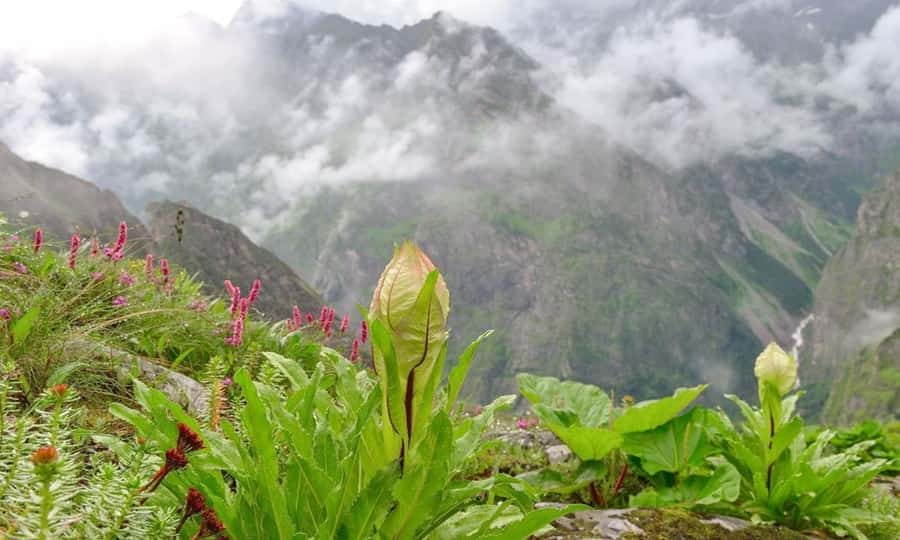
Brahma Kamal: Quick Facts at a Glance
| Feature | Detail |
|---|---|
| Botanical Name | Saussurea obvallata |
| Family | Asteraceae |
| Common Local Names | Kon, Kapfu, Brahma Kamal |
| Altitude Range | 3,000 – 4,800 metres above sea level |
| Blooming Season | July – August (peak mid-monsoon) |
| Plant Height | Up to 1 foot (approx. 0.3 metres) |
| Colour | Purple flower heads enclosed in greenish-yellow bracts |
| Conservation Status | Protected under Wildlife Protection Act in Nanda Devi Biosphere, Askot Wildlife Sanctuary, and Kedarnath Wildlife Sanctuary |
| State Symbol | Official state flower of Uttarakhand |
Legends and Mythical References of Brahma Kamal
One of the frequent attributes of Brahma Kamal in Hindu texts is that it is considered ‘life-giving’. The origin of this association may lie in the legend of the birth of Lord Ganesha. When Lord Shiva gave Ganesha an elephant’s head to revive his beheaded son, Lord Brahma created the Brahma Kamal so that its magically rejuvenating water could be sprinkled on Ganesha, restoring him to life. The devas praised the flower as ‘life-giving’.
The flower also appears in the Ramayana: the miraculous healing of Lakshmana was celebrated by the devas, who showered Brahma Kamal flowers. These flowers are said to have taken root in the land now known as the Valley of Flowers.
In the Mahabharata, Draupadi, troubled by the hardships of exile, witnessed the rare blooming of a golden lotus — the very Brahma Kamal. The blooming of Brahma Kamal is a rare occurrence; it is believed that those who witness this divine event will have their wishes fulfilled. Brahma Kamal blooms at night and stays open for only a few hours.
This claim is a popular myth with no scientific basis. The Brahma Kamal (Saussurea obvallata) blooms annually during July–August at high altitudes. The confusion may stem from stories surrounding the Epiphyllum oxypetalum, a houseplant also colloquially called ‘Brahma Kamal’ that blooms rarely at night. The true Himalayan Brahma Kamal blooms every year but is only accessible at altitudes above 3,000 metres during a narrow monsoon window.
Some Biological Facts of Brahma Kamal
Brahma Kamal is endemic to the high-altitude Himalayas. Known as ‘the king of Himalayan flowers’, it grows at altitudes between 3,000 and 4,800 metres. Its botanical name is Saussurea obvallata, and it belongs to the Asteraceae family. The plant grows up to about 0.3 metres (1 foot) in height.
The blooming season is July–August. Plants become visible between April and October. The purple flower heads are enclosed by greenish-yellow bracts, which protect them from the Himalayan cold. Local names include Kon, Kapfu, and Brahma Kamal.
Confusion of Brahma Kamal with Another Flower
People sometimes claim to have grown Brahma Kamal at home and seen it bloom at night. However, the house plant they are referring to is most likely Epiphyllum oxypetalum — an orchid cactus known for its rare nighttime blooming. This is not the true Brahma Kamal (Saussurea obvallata). The real Brahma Kamal only grows naturally above 3,000 metres and cannot survive in plains conditions.
Religious Importance of Brahma Kamal
Brahma Kamal grows abundantly in the Himalayan regions, including the Valley of Flowers, Kedarnath, Tungnath, Satopanth Lake, and Srikhand Mahadev. These flowers are offered at the shrines of Kedarnath and Badrinath. Especially during the festival of Nanda Ashtami (around September–October), Brahma Kamal flowers are offered in large numbers.
The flowers offered to the deity are distributed as prasad among the devotees. They can also be seen as offerings at Yamunotri, Gangotri, Badrinath, and Kedarnath.
Where to See Brahma Kamal in Bloom
| Location | Best Month to See | Notes |
|---|---|---|
| Valley of Flowers, Chamoli | July–August | UNESCO World Heritage Site. Most accessible location for tourists. |
| Vasuki Tal, near Kedarnath | July–August | At 4,135m altitude. Requires a 8 km trek from Kedarnath. |
| Kedarnath Wildlife Sanctuary | July–August | Large natural habitat. Protected area. |
| Hemkund Sahib surroundings | July–August | High altitude Sikh shrine with dense Brahma Kamal beds nearby. |
| Satopanth Lake, Chamoli | August–September | Difficult trek, high-altitude lake surrounded by the flower. |
Brahma Kamal Facing Extinction
Human intervention has disrupted the delicate balance of many ecosystems. Excessive harvesting of Brahma Kamal for religious purposes and their value in traditional medicinal sciences has put survival at risk. Some regions where the flower is protected include the Nanda Devi Biosphere, Askot Wildlife Sanctuary, and Kedarnath Wildlife Sanctuary.
Due to the high prices Brahma Kamal fetches on the black market because of its medicinal properties, illegal harvesting by locals continues. A study conducted by the Wildlife Institute of India in the Panch Kedar region revealed a 70% decline in numbers. Remedial measures proposed include recovery programs and cultivation in naturally confined spaces in higher altitude regions such as Chamoli, Uttarkashi, Pithoragarh, and Bageshwar.
Important: Plucking or collecting Brahma Kamal from protected areas (national parks, wildlife sanctuaries, biosphere reserves) is illegal under the Wildlife Protection Act, 1972 and the Forest Conservation Act. Violators can face fines and imprisonment. If you are visiting the Valley of Flowers or Kedarnath Wildlife Sanctuary, you may photograph the flower but must not pick it.
3 thoughts on “Brahma Kamal State Flower of Uttarakhand”
Leave a Reply

Related Posts
Dharchula: Gateway to Adi Kailash, Om Parvat & Kailash Mansarovar
17 Best Waterfalls in Uttarakhand
wow! the flower is precious and glorified but I exactly didn’t know the reasons for it. Wonderful information. Thanks for sharing.
Any plant nurseries nearby sell the plant seedlings?
I am from Kolkata, please let me/us know? Whether Brahma kamal will be blooming in indore in our city, Kolkata. THANKS,