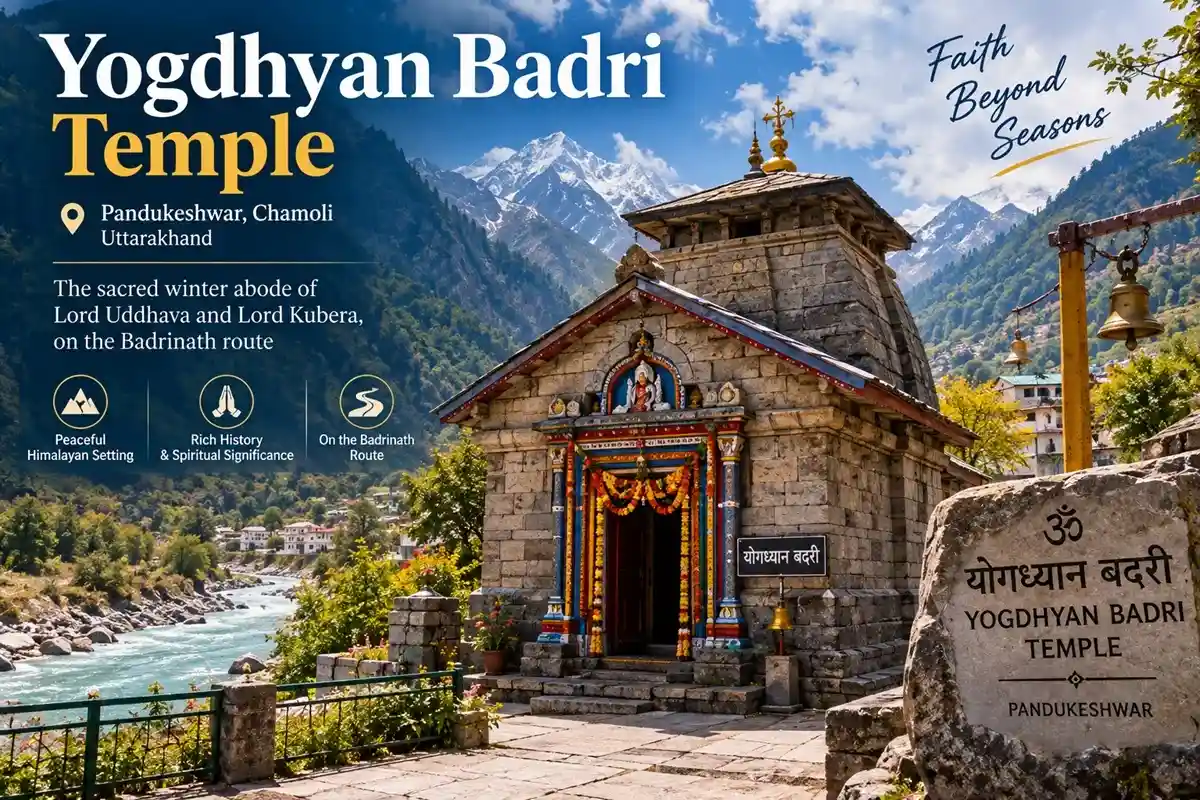
Yogdhyan Badri Temple sits in Pandukeshwar, Chamoli district, on the Joshimath–Badrinath road. It’s one of the Sapta Badri shrines and also counted among the five temples of the Panch Badri circuit, dedicated to Lord Vishnu. The Shri Badarinath-Kedarnath Temple Committee (BKTC), which manages both the main Badrinath and Kedarnath temples along with 45 associated shrines, lists it as the winter abode of the Utsava Murti — the festival idols — of Uddhava and Kubera. That single fact is what separates this temple from every other stop on the route: it’s not a scenic detour, it’s where part of Badrinath’s own worship continues once the main temple shuts for winter.
The idol here is Vishnu seated in padmasana, in dhyan mudra — eyes closed, hands in meditation. BKTC’s own listing describes it as bronze, installed according to legend by King Pandu.
Quick Facts
| Detail | Information |
|---|---|
| Deity | Lord Vishnu (meditative form) |
| Temple Group | Sapta Badri; also part of the Panch Badri circuit |
| Location | Pandukeshwar village, Chamoli district |
| Distance | 18 km from Joshimath, 23 km from Badrinath (BKTC) |
| Altitude | 1,929 metres (BKTC) |
| Timings | Not published by BKTC — confirm locally |
| Entry Fee | Not published by BKTC |
| Best Months | May, June, September, October (BKTC) |
| Special Status | Winter abode of Uddhava and Kubera’s Utsava Murti |
Quick Answer: What Is Yogdhyan Badri Famous For?
Yogdhyan Badri is famous for one thing above all: it’s where the Utsava Murti of Uddhava and Kubera — Badrinath’s ceremonial idols — spend winter once the main temple closes. BKTC confirms this on its own temple listing. The site is also where local tradition places King Pandu’s final penance, father of the Pandavas.
Deity Worshipped at Yogdhyan Badri
Yogdhyan Badri is dedicated to Lord Vishnu, worshipped in dhyana (meditative) posture — padmasana, eyes closed. BKTC’s own listing calls the idol bronze and attributes its installation, according to legend, to King Pandu. Wikipedia’s entry on Sapta Badri describes the idol differently, as Shaligram stone — one of the few places where the temple committee and a widely used secondary source don’t agree. Where the two conflict, BKTC is the temple authority, so its version carries more weight here.
The temple precinct also holds images of Uddhava (Krishna’s friend and counsellor) and Kubera (the god of wealth) — the same two whose festival idols winter here, which is covered in more detail below. Worship follows Vaishnav tradition, in line with Badrinath’s own rituals.
King Pandu’s installation of the idol is tradition, not an archaeologically dated fact. No source claims otherwise, and none of the temple’s own materials date the structure precisely either.
Location & Geographic Setting
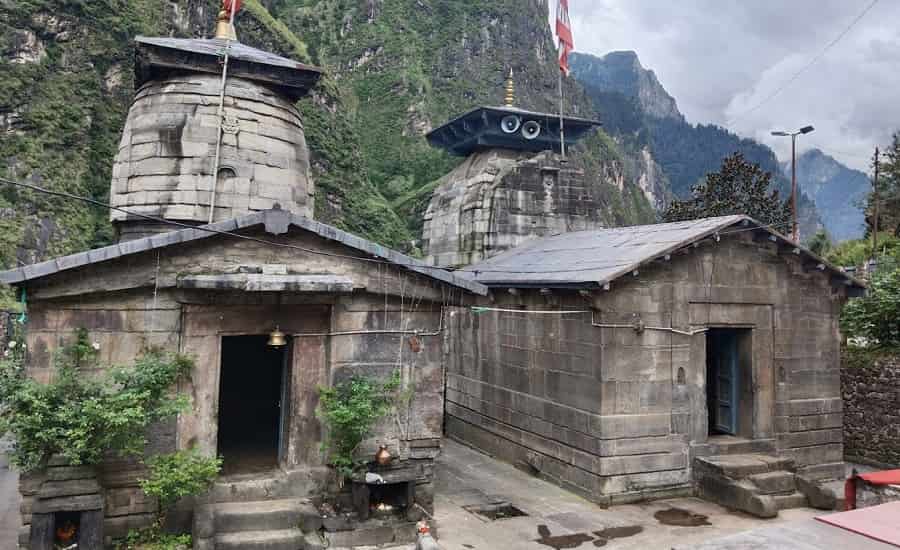
Pandukeshwar sits on the ancient pilgrimage route linking Joshimath, Badrinath, and Hemkund Sahib, right along the Alaknanda river valley.
Key distances (BKTC):
- Joshimath: 18 km
- Badrinath: 23 km (a separate BKTC page lists this stretch as 24 km — the two internal figures don’t quite agree, so treat it as 23–24 km in practice)
- Hanuman Chatti: 9 km
- Govind Ghat: nearby, on the same stretch used for Hemkund Sahib and Valley of Flowers access — no official road-distance figure found for this specific leg
The area is alpine, low-key, and gets nowhere near the footfall Badrinath does.
Historical Background
Pandavas & King Pandu
Pandukeshwar is traditionally believed to be named after King Pandu. Textual tradition holds that after the Mahabharata war, Pandu came here to atone for killing a sage (in the form of a deer) and spent his final days in meditation — which is where the name Yogdhyan (yoga + dhyan, meaning meditation) comes from. Some local legends also connect the birth of the Pandavas to this region, and to the nearby hot-water spring of Suryakund.
Inscriptions & Records
Copper-plate inscriptions found in Pandukeshwar date back to early medieval Garhwal rulers and reference land grants to Brahmins and temple upkeep — solid evidence that organised worship existed here centuries ago. Historians don’t back exaggerated Mahabharata-era architectural claims; the structure standing today reflects later Himalayan stone architecture, restored over the centuries.
Why Yogdhyan Badri Matters: Winter Home of Uddhava and Kubera
Most travel pages either skip this or blur it into vague “winter importance” language. BKTC’s own record is specific: Yogdhyan Badri is the abode of the Utsava Murti of Uddhava and Kubera in winter, once Badrinath’s kapat close and the main pilgrimage season ends.
Keep this separate from the main Badrinarayan idol. Badrinath’s principal deity is worshipped through winter at Narsingh Temple, Joshimath — BKTC’s own listing for Narsingh Temple states pujas continue there “especially during the period when Badarinath temple is closed due to heavy snowfall.” Two different idols, two different winter homes, both under BKTC’s management. A fair number of sites online collapse this into one, saying Yogdhyan Badri is “the winter seat of Badrinath” without specifying which idol they mean. It isn’t the main idol. It’s Uddhava and Kubera.
Pilgrims following the Badri circuit generally treat a stop here as part of completing that circuit properly, not as optional.
Devwar Festival
The movement of these idols is marked by Devwar, Pandukeshwar’s local festival tied to this transfer — once when the idols leave for Badrinath ahead of the opening, again when they return for winter. The exact dates shift each year with Badrinath’s own opening and closing schedule, so there’s no fixed calendar date to plan around; check closer to your travel dates if you want to time a visit around it.
Religious Significance
- Meditative form of Vishnu — focused on inner discipline, not grandeur
- Winter home of Uddhava and Kubera’s Utsava Murti — its single biggest religious distinction
- Associated with year-round worship — unlike Badrinath’s temple itself, which shuts completely
- Ascetic heritage — tied to King Pandu’s penance, not royal pilgrimage
Most pilgrims visit as part of a Joshimath–Pandukeshwar–Badrinath circuit, especially during the quieter shoulder months.
Best Time to Visit Yogdhyan Badri
BKTC lists May, June, September, and October as the recommended months. Some independent travel guides extend this into April and November as shoulder-season options, but that’s editorial advice, not the official window. Winter visits are possible, given the year-round worship association, but expect snowfall and thin transport options. July and August bring monsoon rain to this stretch of road, and landslide-driven delays are common enough that most pilgrims plan around those two months entirely — check current road advisories before you commit to travel dates in that window.
Things to Do at Yogdhyan Badri
- Quiet meditation and prayer — the core experience here
- Panch Badri pilgrimage circuit — combine with Badrinath, Bhavishya Badri, Vridha Badri, and Adi Badri
- Short nature walks around Pandukeshwar’s alpine surroundings
- Village interaction — genuine Garhwali culture, especially lively during Devwar
This is a pilgrimage site first, sightseeing stop second.
Dress Code & Visitor Etiquette
- Dress modestly
- Head covering is customary at most Badri shrines — carry a scarf or cap
- Keep noise down inside the temple
- Follow temple staff instructions on photography inside the sanctum
Places to Visit Near Yogdhyan Badri
- Badrinath Temple — 23 km
- Joshimath — 18 km
- Auli — roughly 40 km via Joshimath; exact figure depends on route
- Valley of Flowers National Park — via Govind Ghat
- Hemkund Sahib — accessible via the same route
How to Reach Yogdhyan Badri
By Road
Joshimath to Pandukeshwar is 18 km, covered by shared jeep or taxi. Road conditions shift with weather, snowfall, and landslide activity — check current advisories rather than assuming the route is clear.
By Rail
Nearest railhead is Rishikesh, 274 km away per BKTC’s own figure.
By Air
Nearest airport is Jolly Grant Airport, Dehradun, 290 km away per BKTC. From there, it’s a road transfer through Joshimath to Pandukeshwar.
Accommodation Near Yogdhyan Badri
- GMVN Tourist Rest Houses in Badrinath and Joshimath
- Basic guesthouses and a couple of small hotels right in Pandukeshwar
- A wider range of hotels in Joshimath, better suited for longer stays
Don’t expect luxury resorts here — that’s intentional, and it’s part of what keeps the area’s spiritual character intact.
Common Mistakes Pilgrims Make
- Skipping Char Dham registration, then getting stopped at checkpoints
- Booking travel in July–August without checking current landslide advisories
- Assuming online sources agree on distances and altitude — several BKTC pages themselves don’t, so cross-check before planning around a single figure
- Confusing this temple’s winter role with Badrinath’s — the main idol winters at Narsingh Temple, Joshimath, not here
Pro Tips
- Visit early morning for a quieter, more personal darshan
- Carry warm layers even in May–June — altitude here still bites in the evenings
- If your dates fall near Badrinath’s opening or closing, try to time your visit around Devwar for a genuinely unique experience
- Combine this stop with Badrinath and Joshimath rather than visiting as a separate trip — the route makes it efficient either way
Why Plan This With Chardham Tour
Pandukeshwar sits on a narrow mountain stretch where road conditions, temple timings, and festival dates shift year to year. Booking through an operator familiar with the Panch Badri and Char Dham route means your itinerary, permits, and stays are handled without the guesswork — useful if you’re combining Yogdhyan Badri with the full Badrinath Yatra or a wider Panch Badri circuit.
Frequently Asked Questions
What is Yogdhyan Badri Temple famous for?
It’s the winter home of the Utsava Murti of Uddhava and Kubera, Badrinath’s festival idols — confirmed on BKTC’s own temple listing. It’s also known for its bronze idol of Vishnu in a meditative posture.
Where is Yogdhyan Badri Temple located?
Pandukeshwar village, Chamoli district, Uttarakhand — 18 km from Joshimath and 23 km from Badrinath, per BKTC.
Is Yogdhyan Badri Temple open throughout the year?
It’s associated with year-round worship, unlike the main Badrinath temple, which closes completely for roughly six winter months. BKTC doesn’t publish fixed daily timings, so confirm hours locally before visiting.
Who built Yogdhyan Badri Temple?
Tradition attributes the idol’s installation to King Pandu, father of the Pandavas. This is religious tradition rather than a dated historical fact — no source, including BKTC, gives a construction date.
Is Yogdhyan Badri really the winter seat of Badrinath?
Specifically for the Utsava Murti of Uddhava and Kubera — yes, per BKTC. The main Badrinarayan idol winters separately, at Narsingh Temple in Joshimath.
What is the Devwar festival?
It marks the ceremonial movement of Uddhava and Kubera’s idols between Pandukeshwar and Badrinath, once each way. Exact dates follow Badrinath’s own opening and closing schedule each year.
What is the best time to visit Yogdhyan Badri Temple?
BKTC recommends May, June, September, and October. July–August brings monsoon-related road risk on this stretch.
Do I need Char Dham registration to visit Yogdhyan Badri?
If you’re combining it with the Badrinath Yatra, yes. Registration is mandatory and done through the official Tourist Care Uttarakhand portal.
How can devotees reach Yogdhyan Badri Temple?
By road from Joshimath — 18 km, by shared jeep or taxi. Joshimath itself connects to Rishikesh, 274 km away by BKTC’s figure.
Are there accommodation facilities near Yogdhyan Badri?
Limited options in Pandukeshwar itself; a wider range is available in Joshimath, 18 km away. Confirm current availability before travelling.
What is the idol at Yogdhyan Badri made of?
BKTC describes it as bronze. Wikipedia’s entry on Sapta Badri describes it as Shaligram stone instead — the two sources disagree, and BKTC is the more authoritative one for temple-specific facts.
Can Yogdhyan Badri be combined with the Panch Badri Yatra?
Yes — it’s typically visited alongside Badrinath, Bhavishya Badri, Vridha Badri, and Adi Badri.
Conclusion
Yogdhyan Badri’s importance comes down to one fact: it’s where Uddhava and Kubera’s Utsava Murti winters once Badrinath closes. Everything else — the King Pandu legend, the bronze idol, the Devwar processions — sits around that core role. Plan around BKTC’s recommended months (May, June, September, October), register for the Char Dham Yatra in advance if you’re continuing to Badrinath, and confirm distances and timings locally rather than trusting any single online source blindly — including this one.
Suggested Tour: Panch Badri Yatra Tour Packages

Related Posts
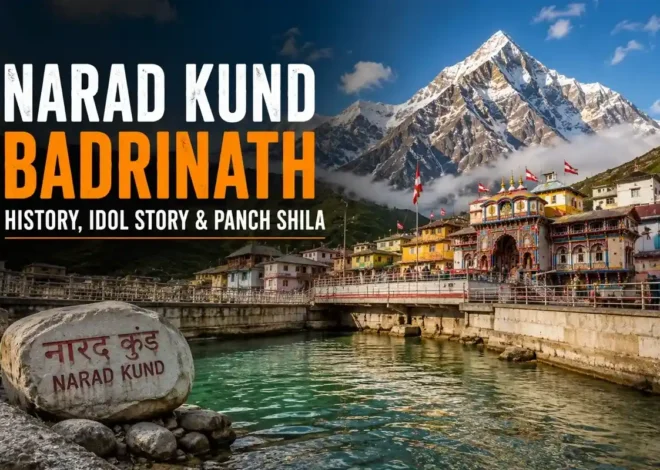
Narad Kund, Badrinath
Neelkanth Peak, Badrinath