
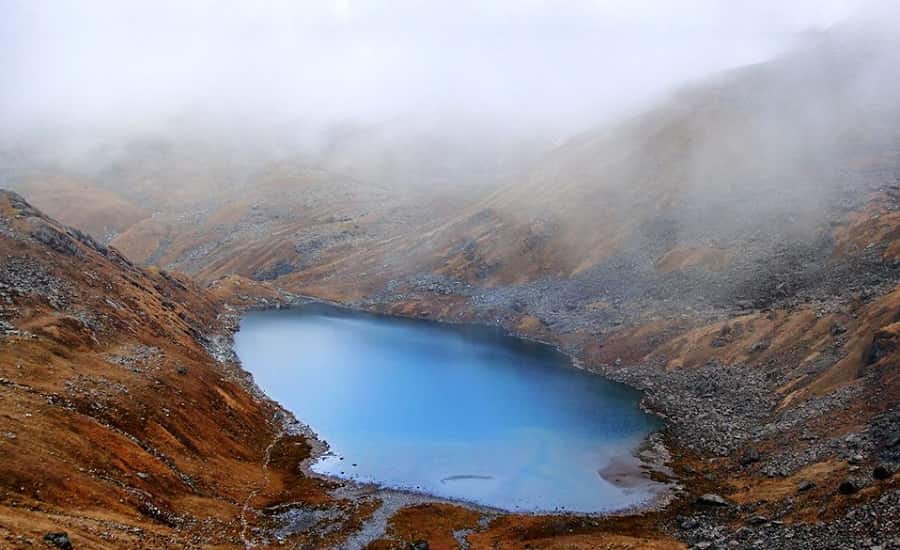
Situated at an altitude of 4,135 metres above sea level in the district of Rudraprayag, Vasuki Tal is a high-altitude, clear blue glacial lake. The gloriously majestic, snow-laden Himalayan ranges outline and overlook the lake, forming a beautiful backdrop for this holy site. This is also one of the least visited and less frequented trekking trails in Uttarakhand. It is located about 8 km from the holy Char Dham site and one of the holiest Jyotirlingas of Kedarnath. Once you reach there, you will be able to savour some of the most splendid views of the surrounding Chaukhamba peaks, which look like they protect the entire lake region.
- Location: Rudraprayag, Uttarakhand
- Altitude: 4,135 meters (14,200 feet)
- Distance from Kedarnath: 8 km
- Trek Difficulty: Difficult
- Best Time to Visit: May–June, Sept–Oct
- Significance: Sacred site for Hindus, associated with Lord Vishnu
- Route: Gaurikund → Kedarnath → Vasuki Top → Vasuki Tal
- Kedarnath Opens 2026: 22 April 2026 at 8:00 AM (BKTC officially announced)
- Permit Required: National Park permit from forest office at Kedarnath before starting trek

History of Vasuki Tal
The pristine glacial waters of Vasuki Tal are set amidst the massive and towering Himalayan peaks, which add a charming tone to the entire environment. The entire lake is outlined with the unique and beautiful Himalayan flowers known as Brahma Kamal. This trek is not only a famous destination for adventure lovers, but it is also an important spiritual site for people seeking spiritual vitality. This place is considered extremely holy because, according to Hindu mythology, Lord Vishnu descended onto the earthly realm into this lake for a holy bath during the auspicious festival of Raksha Bandhan.
Location
Perched at an elevation of 14,200 feet above sea level on the charming hills of Kedarnath Dham, Vasuki Tal is quickly becoming one of the most sought-after tourist destinations in northern India. This place is visited not only by adventure seekers but also by pilgrims and people seeking to amplify spirituality in their lives. The lake is surrounded by colourful fauna and the beautifully unique Brahma Kamal, which is only found at high-altitude zones. Trekking to this region is a difficult route, so people suffering from BP problems or any physical or mental ailment are advised against taking this journey.
A trekking journey to Vasuki Tal is every trekker’s dream come true. The trekking grade for this lake is difficult, and hiring a local guide is strongly recommended to ensure you stay on the correct trail — particularly on the stretch between Vasuki Top and the lake, which is not clearly marked.
The trek starts from Gaurikund via Rambara, reaching up to Garud Chatti, and finally passing through the holy Kedarnath Dham temple. The downward-flowing holy River Mandakini, which lines the entire route of the Kedarnath trek, offers the pilgrims and visitors an opportunity to marvel at its beauty.
From Kedarnath, you will make your way to the grassy location of Vasuki Top. From here, you will be able to view some of the most magnificent sights of the Chaukhamba Hill and Mandakini Valley. Once you reach Vasuki Hilltop, Vasuki Tal is located 1 km downward, requiring a short trek.
Here is a brief route leading up to Vasuki Tal:
Dehradun → Rishikesh → Narendranagar → Chamba → Tehri → Ghansali → Chibitiga → Mayali → Tilwada → Agastyamuni → Kund → Guptkashi → Phata → Gaurikund → Kedarnath → Chorabari → Bamak Glacier → Vasuki Tal.
Best Time to Visit
This place can be visited and trekked during the summer and spring months, from May to mid-June and from mid-September to mid-October. Since the lake is situated at an extremely high altitude, it experiences low temperatures during the winter months, along with freezing weather conditions and occasional snowfall. Trekking is not possible during the winter months. Trekking during the rainy and winter seasons is not allowed, as the entire region becomes prone to unpredictable landslides.
How to Reach Vasuki Tal
Vasuki Tal is reached via Kedarnath. The base camp for the entire journey is Gaurikund.
By Air
The nearest airport is Jolly Grant Airport in Dehradun, approximately 250 km from Gaurikund. From the airport, hire a taxi to Gaurikund (8–9 hours via Guptkashi or Sonprayag). Helicopter services from Phata, Sirsi, and Guptkashi helipads go directly to Kedarnath — book at heliyatra.irctc.co.in for the helicopter leg.
By Rail
The nearest railway stations are Rishikesh and Haridwar. From Rishikesh, Gaurikund is approximately 216 km by road (7–8 hours). Taxis and shared cabs are available from Rishikesh bus stand toward Guptkashi and Sonprayag, from where Gaurikund is 5 km further.
By Road
Gaurikund is well connected by road from Delhi (460 km, 13–14 hours), Haridwar (260 km), and Rishikesh (216 km). GMOU buses and shared taxis operate from Haridwar and Rishikesh to Sonprayag. From Sonprayag, shared jeeps go to Gaurikund. Private vehicles are not permitted beyond Sonprayag.
Gaurikund to Kedarnath (Trek / Helicopter)
From Gaurikund, the trek to Kedarnath is 16–18 km and takes 6–8 hours on foot via Rambara and Garud Chatti. Alternatively, helicopter service from Phata, Sirsi, or Guptkashi helipads reaches Kedarnath in 7–10 minutes. Once at Kedarnath, the Vasuki Tal trek begins.
Sightseeing Places Near Vasuki Tal
Kedarnath Temple
One of the 12 Jyotirlingas of Lord Shiva and the third Char Dham, Kedarnath temple is the starting point of the Vasuki Tal trek. The temple dates to the 8th century (or earlier by some accounts) and is one of the most significant pilgrimage sites in India. Allow at least 2–3 hours for darshan before starting the trek.
Vasuki Top Viewpoint
On the way to Vasuki Tal, Vasuki Top offers panoramic views of the Chaukhamba massif and the Mandakini Valley. This viewpoint is accessible before the final descent to the lake and is often as rewarding as the lake itself on clear days.
Chorabari Lake (Gandhi Sarovar)
A small glacial lake approximately 3.5 km from Kedarnath temple, Gandhi Sarovar (also called Chorabari Lake) is formed by meltwater from the Chorabari Glacier. It is a short side trek from Kedarnath and is significantly less visited than the main temple. The lake and surrounding moraines offer a completely different kind of silence from the busy temple complex.
Bhairav Nath Temple
Located close to the Kedarnath temple, Bhairav Nath Temple is dedicated to the Kshetrapala (protector) of Kedarnath. Local tradition holds that no journey from Kedarnath is complete without visiting this temple. It is often missed by pilgrims who are focused only on the main shrine.
Brahma Kamal Fields
The trail from Kedarnath to Vasuki Tal passes through natural fields of Brahma Kamal — a rare high-altitude flower found only above 3,500 metres and sacred throughout Uttarakhand. The best time to see them in bloom is July and August — but note this overlaps with the monsoon window, making the trek risky. Late June and mid-September offer a reasonable compromise.
Travel Tips for Vasuki Tal Trek
Before You Leave
- Complete Char Dham registration at registrationandtouristcare.uk.gov.in before arriving at Sonprayag. Print your e-pass — mobile network is weak or absent beyond Sonprayag.
- Book Kedarnath helicopter (if using) at heliyatra.irctc.co.in well in advance — slots fill within hours of opening during peak season.
- Obtain the National Park permit from the forest office at Kedarnath before starting the Vasuki Tal trek. This cannot be done online.
- Acclimatize at Kedarnath for at least one full night before attempting the Vasuki Tal trek — the lake is at 4,135m and altitude sickness is a real risk if you rush.
On the Trek
- Start early — leave Kedarnath no later than 6:00 AM. The round trip takes 6–8 hours and afternoon weather in the Himalayas changes fast.
- The trail beyond Kedarnath toward Vasuki Top is not well signposted. Hiring a local guide is strongly recommended — especially for first-time trekkers in this region.
- No shops or dhabas exist on the Vasuki Tal trail beyond Kedarnath. Carry sufficient water (minimum 2 litres) and food for the full day.
- Do not linger at the lake after 1:00 PM if clouds are building. Descend immediately if weather changes — lightning risk is high at exposed ridges above 4,000m.
- If you experience severe headache, vomiting, or loss of coordination at altitude — descend immediately. These are signs of Acute Mountain Sickness (AMS).
Things to Carry for the Vasuki Tal Trek
- Warm layered clothing — temperatures near the lake drop to 0°C to -5°C even in May and June. Carry thermal inner layers, a fleece mid-layer, and a windproof outer jacket.
- Good quality trekking boots with ankle support and non-slip soles — the terrain above Kedarnath is rocky and uneven.
- Trekking poles — essential for the descent from Vasuki Top to the lake and back.
- Rainproof jacket or poncho — afternoon showers are common in summer months even outside the monsoon.
- Water (minimum 2 litres) and high-energy snacks — no water points or food stalls exist on the trail beyond Kedarnath.
- First aid kit — include altitude sickness medication (consult your doctor before use), pain relievers, blister treatment, and ORS sachets.
- Headlamp with spare batteries — useful for very early morning starts.
- Sunscreen (SPF 50+) and UV-protection sunglasses — UV radiation is significantly stronger at 4,000+ metres.
- Valid government photo ID (Aadhaar card, passport, or voter ID) and printed Char Dham e-pass — required at multiple checkpoints.
- Portable power bank — no charging points exist on the trail.
Frequently Asked Questions
Q-1: What is the altitude of Vasuki Tal?
Vasuki Tal is at approximately 4,135 metres (14,200 feet) above sea level, about 8 km from the Kedarnath temple.
Q-2: When does Kedarnath open in 2026?
Kedarnath opens on 22 April 2026 at 8:00 AM, as officially announced by the Badrinath-Kedarnath Temple Committee (BKTC) on Mahashivratri, 15 February 2026. The temple closes around 11 November 2026 (Bhai Dooj). The Vasuki Tal trek season falls within this open window.
Q-3: Is Char Dham registration mandatory for visiting Kedarnath?
Yes. All pilgrims must register and carry a valid e-pass (QR code) from registrationandtouristcare.uk.gov.in. Registration is free. Aadhaar card is required. The e-pass is checked at the Sonprayag checkpost — pilgrims without it cannot proceed to Kedarnath.
Q-4: Do I need a separate permit for the Vasuki Tal trek?
Yes. A National Park permit is required for the Vasuki Tal trek, as the trail falls within a protected forest zone. This permit is obtained from the forest office at Kedarnath before starting the trek — it cannot be obtained online in advance.
Q-5: Can beginners attempt the Vasuki Tal trek?
No. This is a difficult-grade high-altitude trek. At minimum, you need prior trekking experience above 3,500m, good physical fitness, and full acclimatization at Kedarnath (at least one night) before attempting this route. People with BP problems, heart conditions, or breathing difficulties should not attempt it.
Q-6: How long does the Vasuki Tal trek take?
The round trip from Kedarnath to Vasuki Tal and back takes approximately 6–8 hours. Start no later than 6:00 AM and aim to be back at Kedarnath by 2:00–3:00 PM to avoid afternoon weather changes.
Q-7: Is a guide mandatory?
There is no official regulation making a guide mandatory, but hiring a local guide is strongly recommended. The trail is not well signposted beyond Kedarnath, and the path between Vasuki Top and the lake can be unclear, especially in misty or cloudy conditions.
Q-8: Are mobile phones allowed inside Kedarnath temple?
No. From 2026, mobile phones and cameras are banned inside the Kedarnath temple premises. No photography, reels, or videos are permitted inside the shrine area.
Q-9: What can be seen from Vasuki Top?
From Vasuki Top (the ridge before the descent to the lake), you can see panoramic views of the Chaukhamba massif, the Mandakini Valley below, and the surrounding Garhwal Himalayan peaks. On clear days, the view is one of the finest in the entire Kedarnath region.
2 thoughts on “Vasuki Tal: A High Altitude Mountain Lake in Kedarnath”
Leave a Reply

Related Posts

Sayanachatti to Yamunotri Guide
Dharchula: Gateway to Adi Kailash, Om Parvat & Kailash Mansarovar
Guide is required for this trek?
Please send your contact number . vasuki tal trek guide