
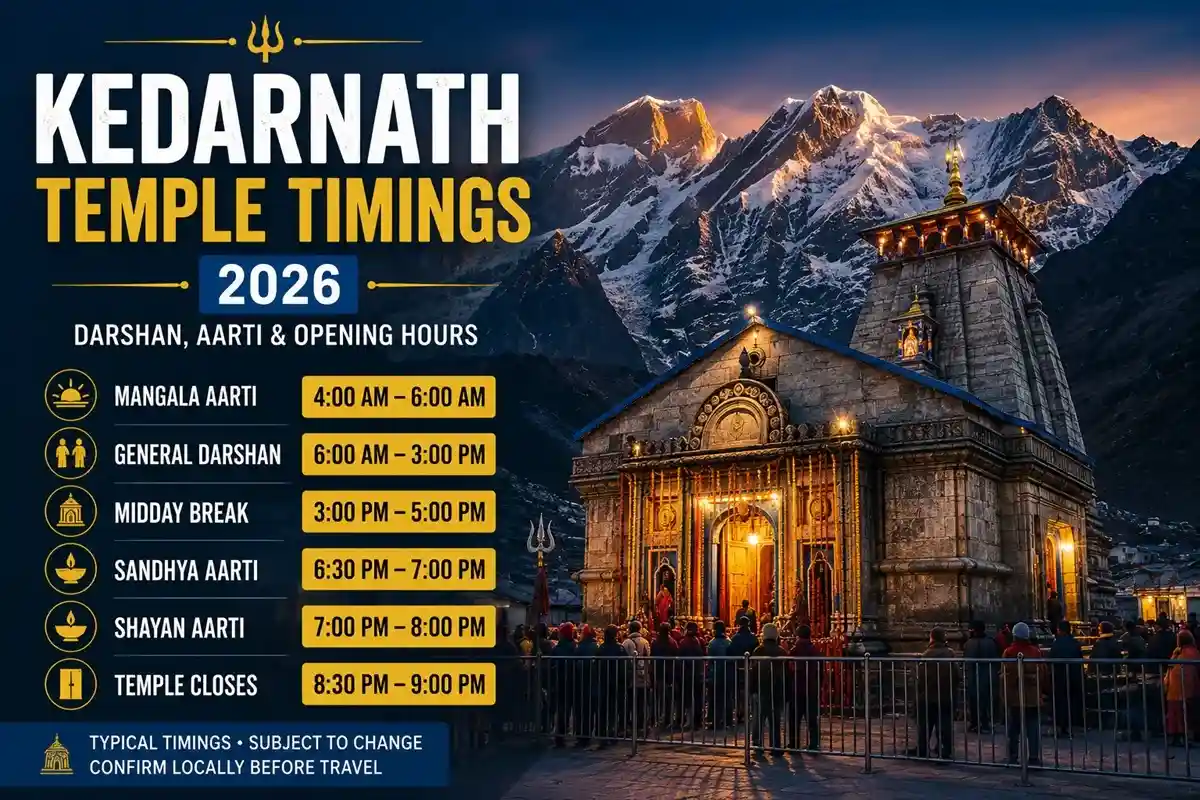
The Kedarnath Temple holds immense religious significance for Hindus worldwide and sits in the majestic Himalayas of Uttarakhand at an altitude of roughly 3,583 metres (11,755 ft). Dedicated to Lord Shiva, it draws large numbers of devotees seeking blessings in its serene, high-altitude surroundings.
Knowing the typical Kedarnath Temple timings helps you plan darshan properly, since the temple follows a broad daily rhythm with a midday break and a specific window for touching the deity. This guide lays out that rhythm clearly, along with what’s officially confirmed versus what varies day to day.
Quick Overview
During the 2026 pilgrimage season, Kedarnath Temple typically opens for early rituals around 4:00–6:00 AM, closes for a midday break from roughly 3:00 PM to 5:00 PM, and shuts for the night around 8:30–9:00 PM after the Shayan Aarti. These are typical seasonal timings, not a fixed BKTC-published timetable, so daily hours can shift. The temple itself is accessible only about six to seven months a year — opening around Akshaya Tritiya and closing on Bhai Dooj.
Kedarnath Temple Daily Timings (Typical Seasonal Schedule)
| Event | Approximate Time | Status |
|---|---|---|
| Early rituals begin (before public darshan) | Before 4:00 AM | Priest-only |
| Mangala Aarti / temple opens to pilgrims | Around 4:00–6:00 AM | Typical |
| General darshan begins | Around 6:00–7:00 AM | Typical |
| Sparsh Darshan (touching the Shivling) | Morning session, roughly till 10:00 AM | Subject to current BKTC rules |
| Midday closure for Bhog | Approx. 3:00 PM – 5:00 PM | Fairly consistent |
| Darshan resumes | Approx. 5:00 PM | Typical |
| Sandhya (evening) Aarti | Approx. 6:30 PM – 7:00 PM | Typical |
| Shayan Aarti (final ritual) | Approx. 7:00 PM – 8:00 PM | Typical |
| Temple closes for the night | Approx. 8:30–9:00 PM | Typical, not guaranteed |
Important: BKTC does not publish a single fixed public timetable for every day of the season. Priests begin rituals before public darshan opens, and exact hours shift with weather, festivals, and crowd volume. Treat this table as a planning guide, and confirm the actual day’s schedule locally before you travel.
Morning vs Evening Darshan: Which Should You Plan For?
- Morning visit — best if you want Sparsh Darshan (subject to current guidelines) and a cooler trek; expect the largest crowds.
- Evening visit — best for a calmer, less rushed darshan and the Shayan Aarti, though touch-darshan usually isn’t available at this time.
- Helicopter pilgrims — often get a shorter, fixed darshan window tied to your return flight slot, so plan for a quicker visit rather than a leisurely one.
Kedarnath Temple Aarti Timings
- Mangala Aarti — early morning, alongside the Maha Abhishek of the Shiva Linga, roughly 4:00–6:00 AM.
- General Darshan — from around 6:00–7:00 AM through the midday break.
- Sandhya Aarti — the evening aarti, roughly 6:30–7:00 PM.
- Shayan Aarti — the final ritual of the day, roughly 7:00–8:00 PM, after which the temple closes for the night.
These times are typical, not officially fixed. It’s advisable to verify the schedule locally before planning your trip.
Kedarnath Temple Opening and Closing Dates (Seasonal)
This is separate from the daily schedule above.
- Opening: Announced on Maha Shivratri, the temple typically opens in late April, timed around Akshaya Tritiya. In 2026, it opened on 22 April at 8:00 AM, confirmed by BKTC and multiple national news reports.
- Closing: The temple closes on Bhai Dooj, two days after Diwali — scheduled for 11 November 2026 for this season.
- Winter arrangement: Before closing, the idol of Lord Kedarnath is ceremonially moved to Omkareshwar Temple in Ukhimath, where worship continues through winter, with an Akhand Jyot (continuously burning lamp) left inside the sealed temple.
Outside this window, the temple isn’t accessible at all — heavy snowfall blocks the trekking route and makes the region unsafe.
Daily Rituals vs Special/Bookable Pujas
Not every ritual performed at Kedarnath happens every day for every pilgrim — it’s worth knowing the difference.
Performed as part of the regular daily schedule:
- Mangala Aarti and Maha Abhishek (morning)
- General Abhishek and darshan through the day
- Sandhya Aarti and Shayan Aarti (evening)
Special or separately bookable, not routine daily events:
- Rudrabhishek — often available on request or through paid booking.
- Rudra Homa — a fire ritual usually performed on specific occasions rather than daily.
- Maha Aarti — a grander version reserved for festivals and special days.
- Panchamrit Puja and Bhog Aarti — offered as part of daily worship, but the enhanced/personalised versions are usually paid pujas booked through BKTC.
If you want a specific puja performed in your name, check the current booking process directly with BKTC rather than assuming it’s freely available.
Significance of Timings and Rituals
The temple’s timings aren’t just practical scheduling — many pilgrims consider each ritual window spiritually significant. A quick look at what each ritual involves:
Rudrabhishek: Ceremonial bathing of the Shiva Linga with milk, honey, ghee, water, and Ganga jal, accompanied by mantra chanting.
Aarti: A devotional ceremony with lamps or camphor waved before the deity, performed multiple times daily.
Bhog Aarti: Food offerings — sweets, fruits, vegetarian dishes — presented to the deity and later distributed as Prasad.
Abhishek: Ritual offering of sacred substances to the Shiva Linga, accompanied by chanting.
Utsav (Festivals): Maha Shivratri, Navratri, and Diwali bring special rituals and larger crowds, often shifting the day’s regular timings.
Practical Tips for Your Visit
- Arrive early if Sparsh Darshan matters to you — but confirm with BKTC or local authorities that it’s currently permitted, since rules change season to season.
- The morning queue typically starts forming well before sunrise; factor that into your trek or stay planning.
- Plan around the 3–5 PM closure so you’re not stuck waiting right at the gate.
- Photography inside the sanctum is generally not allowed, and mobile phone use is restricted near the deity — keep your phone away during darshan.
- Simple, modest clothing is recommended; heavy woollens are fine given the cold.
- Wheelchair assistance and porter support are available for elderly or mobility-limited pilgrims — ask at the base camp counter.
- If you’re flying in by helicopter, confirm your darshan window in advance since return flight schedules can limit your time at the temple.
FAQs
What time does Kedarnath Temple typically open?
Early rituals begin before dawn, and the temple is usually open to pilgrims from around 4:00–6:00 AM, though this isn’t a fixed official time every day.
What time does Kedarnath Temple close for the night?
Around 8:30–9:00 PM after the Shayan Aarti, though this can shift with weather or crowd levels.
Is there a midday break in Kedarnath Temple timings?
Yes, the temple generally closes for Bhog from about 3:00 PM to 5:00 PM.
What time is the Mangala Aarti at Kedarnath?
Typically early morning, around 4:00–6:00 AM, alongside the Maha Abhishek.
What time is the Shayan Aarti?
Usually between 7:00 and 8:00 PM, the final ritual before the temple closes for the night.
Can I touch the Shivling at Kedarnath Temple?
It depends on the current season’s BKTC guidelines — Sparsh Darshan is often allowed in the morning but isn’t guaranteed every day.
When did Kedarnath Temple open for the 2026 season?
It opened on 22 April 2026 at 8:00 AM, as officially announced by BKTC.
When will Kedarnath Temple close for winter 2026?
The temple is scheduled to close on 11 November 2026, on Bhai Dooj.
Do temple timings change during festivals?
Yes, timings can shift during Maha Shivratri, Navratri, and other major festivals — confirm locally before visiting.
Is Rudra Homa or Maha Aarti performed daily?
No, these are generally special or festival-specific rituals rather than routine daily events; check BKTC for booking availability.
How much darshan time do helicopter pilgrims get?
Usually a shorter, fixed window tied to your return flight schedule, so plan for a quicker visit than trekkers typically have.
Is entry to Kedarnath Temple free?
Yes, general darshan is free; only special or personalised pujas booked through BKTC involve a fee.
Conclusion
Kedarnath Temple timings follow a broad daily rhythm — early morning rituals, a midday break, and evening aartis — but they aren’t a rigid, published timetable, so build in flexibility. Keep the typical schedule and the confirmed seasonal opening/closing dates in mind, check with BKTC closer to your travel date, and plan your darshan timing with a buffer for the unexpected.
Suggested Tour:
One thought on “Kedarnath Temple Timings 2026: Darshan, Aarti & Opening Hours”




We r intrested in two dham kedarnath n badrinath by helicopter