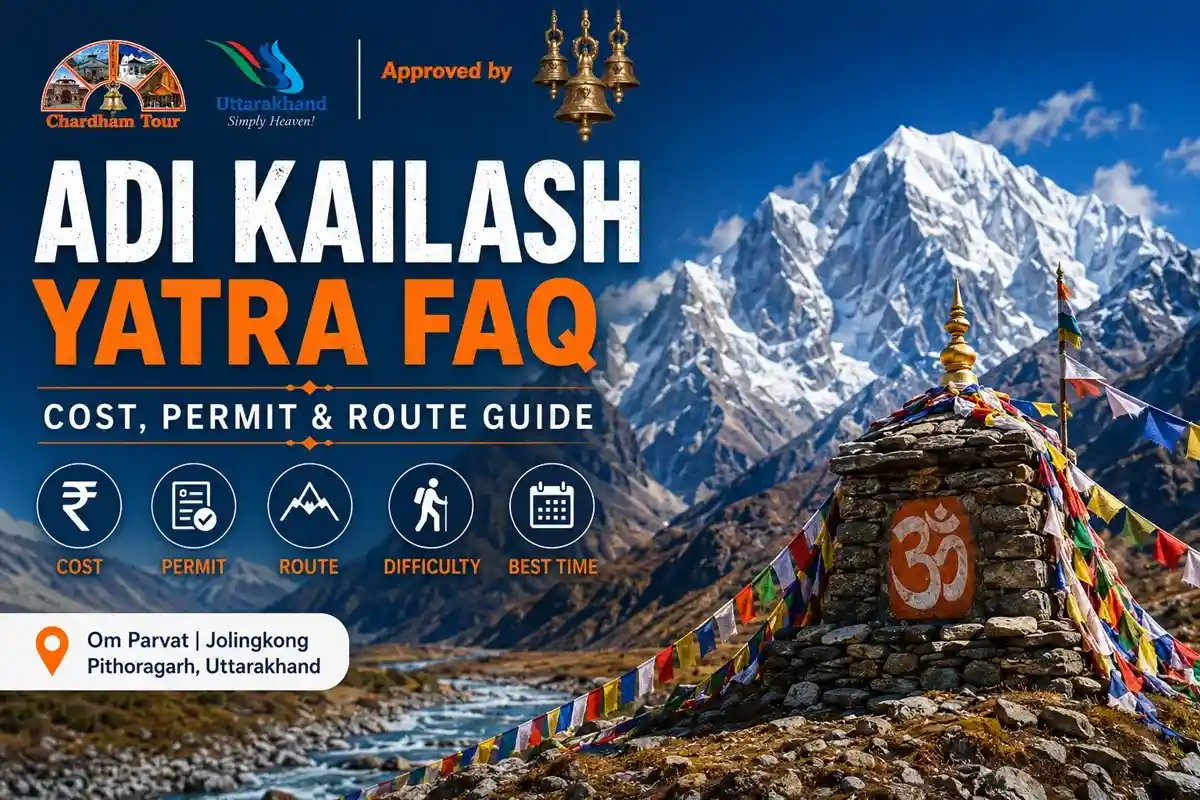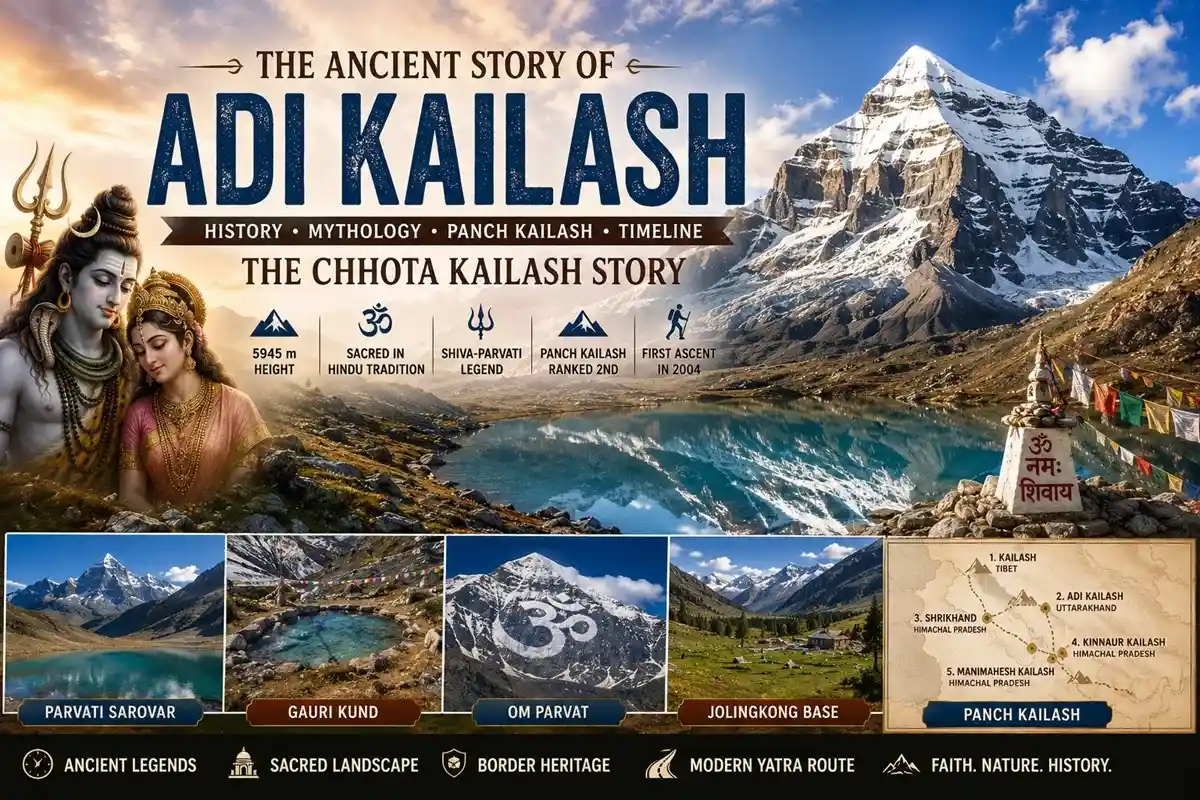
The history of Adi Kailash blends ancient Hindu belief with a much more recent modern story of border security and road-building. Tucked in Pithoragarh district, Uttarakhand, this Himalayan peak — also called Chhota Kailash — is treated by millions of devotees as one of Lord Shiva’s earthly homes. This guide separates what is widely believed from what is actually documented, so you get a clear, honest picture.
Quick Facts
| Detail | Information |
|---|---|
| Height | Approx. 5,945 metres (19,505 ft) |
| Other names | Chhota Kailash, Baba Kailash, Jonglingkong Peak |
| Location | Dharchula sub-division, Pithoragarh, Uttarakhand |
| Nearest base village | Gunji / Nabi, via Dharchula |
| Panch Kailash standing | Widely placed second, after Mount Kailash |
| Known for | Shiva-Parvati legend, Om Parvat nearby |
What Is Adi Kailash?
Adi Kailash sits in the Dharchula region, near the India–China border in Pithoragarh’s Vyas Valley. “Adi” means ancient or original, and the name reflects the belief that this was an early manifestation of Shiva’s presence on earth.
The mountain anchors a wider sacred landscape that includes Parvati Sarovar, Gauri Kund, and the nearby Om Parvat. Most first-time visitors don’t realise these three sites are treated as one continuous pilgrimage circuit, not separate stops.
- Also Reads on: Adi Kailash Yatra 2026 Planning Guide
Etymology: Where Does the Name Come From?
The word “Adi” translates to “first” or “original” in Sanskrit, and pilgrims traditionally use it to mark this peak as the earliest counterpart to Mount Kailash in Tibet. The regional name “Jonglingkong Peak” comes from the local Byansi dialect used in this border valley, and it’s still the name used on some older maps and government documents.
- Check out: Adi Kailash Yatra Route Map
Mythology Behind Adi Kailash
According to Hindu tradition, Lord Shiva and Goddess Parvati paused here on their journey from Kailash Mansarovar toward Triyuginarayan for their wedding. This belief is central to why the site is treated as sacred, even though it rests on oral and Puranic tradition rather than a single, universally cited scripture.
A few other legends are commonly told alongside this one:
- Local belief holds that Shiva performed his cosmic Tandava dance here and revealed his form to the sage Ashtavakra.
- Regional folklore connects the site to Ravana’s devotion to Shiva.
- Some traditions describe Parvati being tested here before her marriage.
Myth vs. History Note: These stories come from regional oral tradition and popular retellings, not from a single verified textual source. Treat them as devotional belief rather than settled historical fact.
Panch Kailash: Where Does Adi Kailash Stand?
Hindu tradition recognises five sacred Kailash peaks across the Himalayas, called the Panch Kailash. There’s no single official scripture ranking them, but most pilgrimage traditions and tour operators place Adi Kailash immediately after Mount Kailash.
| Position | Peak | Location |
|---|---|---|
| 1 | Kailash Mansarovar | Tibet |
| 2 (commonly cited) | Adi Kailash (Chhota Kailash) | Pithoragarh, Uttarakhand |
| 3 | Shrikhand Mahadev | Himachal Pradesh |
| 4 | Kinnaur Kailash | Himachal Pradesh |
| 5 | Manimahesh Kailash | Himachal Pradesh |
This standing is why Adi Kailash is often called the “Kailash of India” — the most significant Kailash peak that pilgrims can visit without leaving Indian territory.
Sacred Sites Around the Mountain
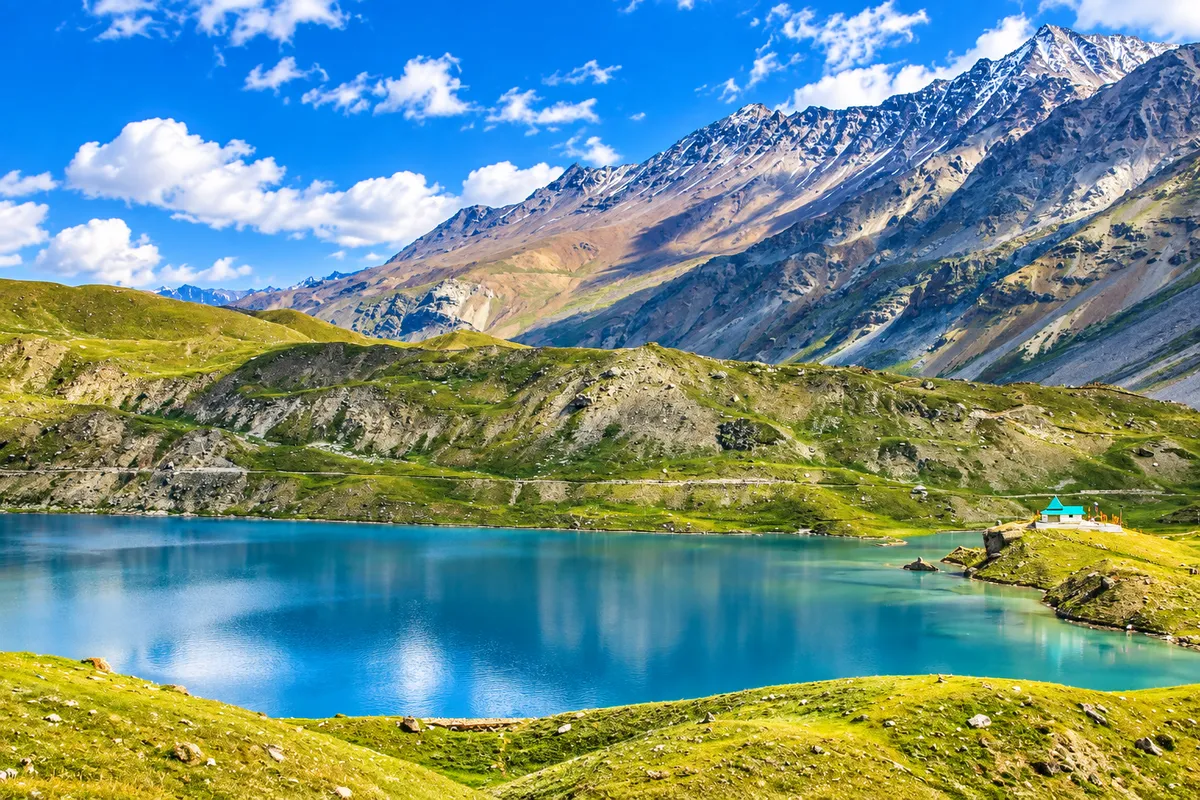
Parvati Sarovar sits near the mountain’s base and is considered a smaller mirror of Mansarovar Lake in Tibet.
Gauri Kund, named after Parvati (Gauri), is where local legend says she bathed to regain strength after her battle with the demon Jalandhar.
Om Parvat, near Nabhi Dhang, shows a natural snow pattern resembling the “ॐ” symbol. Several mountains are said to carry similar formations in folklore, but Om Parvat remains the best-known and most visited example.
From Trade Route to Border Zone
Long before it became a pilgrimage circuit, the Kali River valley near Adi Kailash served as a trade corridor between Kumaon and Tibet, used by merchants, shepherds, and wandering sages.
That changed after the 1962 Indo-China war, when the border area came under tight military control. The Indo-Tibetan Border Police (ITBP) and Kumaon Regiment secured and gradually mapped the terrain, keeping the region largely off-limits to civilians for years afterward.
The 2004 First Ascent
According to mountaineering records, a joint British-Scottish-American team completed the first recorded ascent of Adi Kailash in October 2004. The climbers reportedly stopped short of the true summit out of respect for the mountain’s sacred status — a detail that says as much about the site’s living religious importance as any legend does.
Local Communities: The Byansi and Rung Heritage
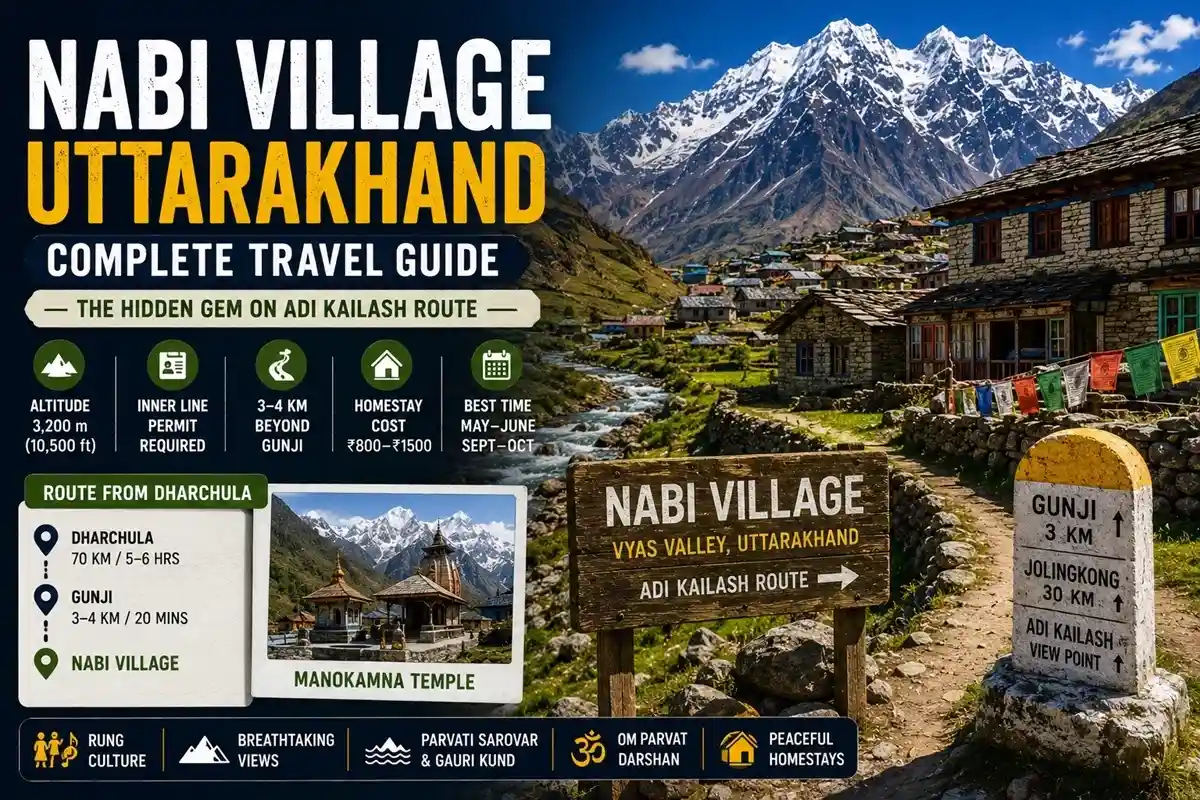
The valleys leading to Adi Kailash are home to the Byansi and Rung communities, whose Kumaoni-influenced culture and trans-Himalayan trading history shaped the region long before it became a formal pilgrimage route. Village names like Gunji and Nabi, and even the alternate peak name Jonglingkong, trace back to this local heritage rather than to Sanskrit scripture alone.
Modern Revival and Road Development
Interest in reopening the region to pilgrims grew from the 1980s onward. The Kumaon Mandal Vikas Nigam (KMVN), working with the Uttarakhand government, later organised structured tours, turning a once-restricted zone into a regulated yatra circuit.
Road development by the Border Roads Organisation (BRO) has sharply cut the trekking distance in recent years — pilgrims once walked close to 200 km; current itineraries typically involve a much shorter trek from the roadhead, though the exact distance varies by season and route condition.
Historical Timeline at a Glance
- Ancient period: Mythological association with Shiva and Parvati begins in oral and Puranic tradition.
- Pre-1962: Region functions as an active Indo-Tibetan trade corridor.
- 1962: Indo-China war closes routes; ITBP and Kumaon Regiment secure the border.
- 1980s onward: Gradual civilian access returns under government oversight.
- 2004: First recorded mountaineering ascent, as per expedition records.
- 2010s–2020s: BRO road-building shortens the trekking distance considerably.
- 2026: Region remains a regulated, permit-based pilgrimage and border zone.
Adi Kailash vs. Mount Kailash: Quick Comparison
| Feature | Adi Kailash | Mount Kailash |
|---|---|---|
| Location | Uttarakhand, India | Tibet |
| Height | ~5,945 m | ~6,638 m |
| Visa/Permit | Inner Line Permit (India) | Chinese visa + permits |
| Access | Largely motorable | Long trek/parikrama |
| Considered by pilgrims as | Nearest Indian alternative | The original abode |
FAQs
Q1. Why is Adi Kailash called Chhota Kailash?
Because it visually and spiritually resembles Mount Kailash in Tibet; the name reflects likeness, not lesser importance.
Q2. Is Adi Kailash mentioned in the Mahabharata?
There’s no clear, direct textual reference; its scriptural link is stronger in regional Puranic and oral tradition.
Q3. Who first climbed Adi Kailash?
A British-Scottish-American team, per mountaineering records, made the first recorded ascent in October 2004.
Q4. Why is Adi Kailash considered sacred?
Hindu tradition holds it as a resting place of Shiva and Parvati and, by some accounts, one of Shiva’s earliest abodes.
Q5. Where does Adi Kailash rank among the Panch Kailash?
It’s commonly placed second, right after Mount Kailash, though no single scripture formally ranks all five peaks.
Q6. What does the name “Adi Kailash” mean?
“Adi” means ancient or original, marking it as an early counterpart to the Kailash in Tibet.
Q7. What is Jonglingkong Peak?
It’s the local Byansi-language name for Adi Kailash, still used on some maps and older records.
Q8. What role did the 1962 war play in its history?
It closed border trade routes and led to years of restricted civilian access, controlled by the ITBP.
Q9. Is Adi Kailash older than Mount Kailash mythologically?
No fixed timeline exists; devotional tradition treats both as ancient, without a documented chronological order.
Q10. What is Om Parvat’s connection to Adi Kailash?
It’s a nearby peak with a natural snow pattern resembling “ॐ,” and is typically visited on the same yatra.
Q11. Who manages the Adi Kailash Yatra today?
The Kumaon Mandal Vikas Nigam (KMVN), with the Uttarakhand government, organises permits and tours.
Q12. Are the Ashtavakra and Ravana legends historically verified?
No — both come from regional oral tradition and should be treated as belief, not documented history.
Q13. Which communities live around Adi Kailash?
The Byansi and Rung communities, whose culture shaped the region long before organised pilgrimage began.
Q14. Is Adi Kailash an alternative to the Kailash Mansarovar Yatra?
Yes, many devotees who can’t travel to Tibet visit Adi Kailash instead, since it lies within Indian territory.
Q15. How has road access to Adi Kailash changed over time?
BRO-built roads have shortened what was once a near 200 km trek to a much shorter walk from the roadhead.
Q16. Is helicopter access available to Adi Kailash?
As of 2026, no — the area remains a restricted border zone, and pilgrims travel by road and short trek only.
Q17. What permit is required to visit Adi Kailash?
An Inner Line Permit, issued from Dharchula, is mandatory for Indian citizens due to its border location.
Suggested Tours