Adi Kailash Yatra, also known as Chhota Kailash or Baba Kailash, is a sacred high-altitude pilgrimage to the Adi Kailash peak (approximately 5,945 m) in Uttarakhand’s Pithoragarh district near the Indo-Tibet border. Revered as one of the Panch Kailash, it is believed to be an earthly abode of Lord Shiva and attracts pilgrims, trekkers, and nature lovers from across India.
Unlike the Kailash Mansarovar Yatra, Adi Kailash can be completed entirely within India without crossing into Tibet, making it more accessible while still offering an authentic Himalayan pilgrimage experience. However, the journey requires careful planning because of its remote border location, high altitude, limited travel season, and mandatory Inner Line Permit (ILP).
The yatra season generally runs from May to October (subject to weather and government notifications). Most pilgrims travel via Delhi – Kathgodam – Dharchula – Gunji – Jolingkong, where the final darshan of Adi Kailash and Parvati Sarovar takes place.
This step-by-step 2026 guide explains everything you need to plan your Adi Kailash Yatra, including eligibility, ILP registration, transport options, itinerary, accommodation, estimated budget, packing essentials, and important travel tips for a safe and comfortable pilgrimage.
Significance and Location
Adi Kailash is the pyramid-shaped sacred peak that closely mirrors Mount Kailash in Tibet in form and spiritual significance. It is one of the Panch Kailash in Hindu tradition, considered second in sanctity to Mount Kailash itself.
Located in the Upper Byans Valley northwest of Gunji village in Pithoragarh district, the peak sits close to the India-Nepal-Tibet trijunction — one of the most remote corners of the Indian Himalayas.
| Detail | Information |
| Peak Name | Adi Kailash (also: Chhota Kailash, Baba Kailash, Shiva Kailash) |
| Altitude | ~5,945 metres above sea level |
| Location | Pithoragarh District, Kumaon Himalayas, Uttarakhand |
| Nearest Base | Gunji (~3,200 m) | Jolingkong (~4,770 m) |
| Significance | One of Panch Kailash; earthly abode of Lord Shiva |
| Key Sites | Om Parvat, Parvati Sarovar, Gauri Kund, Kalapani, Patal Bhuvaneshwar |
| Season | May to October (verify current year dates at pithoragarh.nic.in) |
| Permit | Inner Line Permit (ILP) — mandatory | Portal: pass.pithoragarh.online |
| Managing Body | SDM Dharchula, Government of Uttarakhand |
| Coordinates (approx) | 30.22 N, 80.83 E |
Eligibility for Adi Kailash Yatra — Who Can Apply?
The Yatra is open to Indian citizens. Below are the standard eligibility criteria as of 2026 — note that these are subject to annual revision by the Uttarakhand District Administration and should be verified at the official portal before applying.
| Criterion | Standard Requirement (verify annually) |
| Nationality | Indian citizens only — ILP not issued to foreign nationals on this route (subject to government policy) |
| Age | Typically 9–70 years — check current year notification at pass.pithoragarh.online |
| Physical Fitness | Moderate fitness for 4–5 km high-altitude trek at ~4,770 m |
| Medical Certificate | MBBS fitness certificate mandatory for ILP application |
| Health Advisory | Persons with serious cardiac, respiratory or uncontrolled BP conditions must consult a specialist (not a general physician) |
Foreign Nationals: The standard ILP for the Adi Kailash route is generally not issued to foreign nationals due to its restricted border zone location. Foreign visitors should check current policy with the Uttarakhand Tourism Department or the nearest Indian embassy before planning.
Adi Kailash Yatra 2026 — Current Status and Updates
This section reflects the most current information available as of June 2026. Travel conditions in the Byans Valley change seasonally — always confirm status before departure.
| Update Category | 2026 Status / Information |
| Yatra Opening | Season opened approximately May 13, 2026 (verify current year at pithoragarh.nic.in — dates announced annually) |
| Yatra Closing | Expected late October 2026 — exact date announced by District Administration |
| ILP Registration | Open — apply at pass.pithoragarh.online; allow 2–5 working days for processing |
| Road Condition (Dharchula–Gunji) | BRO-maintained route; generally operational May–October. Monsoon (July–August) causes periodic closures due to landslides. Check latest status before departure. |
| Landslide Advisory | High-risk: July–August. Moderate-risk: June and September. Low-risk: May and October. |
| Mobile Network | BSNL: limited signal at Gunji. Jio/Airtel: unreliable beyond Dharchula. No internet beyond Dharchula. |
| Medical Advisory | Acclimatise 1 night in Dharchula and 1 night in Gunji minimum before Jolingkong trek. Carry Diamox (consult doctor). |
| Satellite Phone | Available to hire through registered tour operators in Dharchula — recommended for self-arranged groups. |
| UPI / Cash | No UPI/card payments beyond Dharchula. Cash only from Gunji onward. Carry Rs 15,000–20,000 minimum. |
Road Condition Check: The Dharchula to Gunji road is a BRO (Border Roads Organisation) maintained route through the restricted zone. Landslides during July–August can close this road without notice. Before travel, check the latest road condition updates via the SDM Dharchula office or the Uttarakhand Tourism helpline (1364).
Step 1 — How to Get the Inner Line Permit (ILP) for Adi Kailash Yatra
The ILP is the single most critical document. No pilgrim, vehicle, or group can enter the Byans Valley beyond Dharchula without it. ITBP (Indo-Tibetan Border Police) and civil checkpoints verify permits at every stage.
Documents Required
| Document | Details |
| Government Photo ID | Aadhaar / Voter ID / Passport / Driving Licence — original + 4 photocopies |
| Passport Photos | 2–3 recent colour photographs |
| MBBS Medical Certificate | From registered MBBS doctor confirming fitness for high-altitude travel |
| Police Verification | Issued within 15 days of application — from local police station |
| Notarised Affidavit | Rs 30 stamp paper — required by many operators and for group registrations |
Online Registration — Step by Step
- Visit pass.pithoragarh.online and create an account.
- Select ‘Adi Kailash Yatra’ as permit type.
- Fill personal and co-traveller details with proposed travel dates.
- Upload all required documents (clear scans).
- Pay the current permit fee online (check fee at portal — subject to annual revision).
- Download approved ILP. Print 5 copies minimum — one per ITBP / civil checkpoint.
Apply 3 Weeks Early: Processing takes 2–5 working days. Registration opens typically late February to early April before the May season. Never apply the week before travel — delays are common during peak season.
Offline Registration
Submit in person at SDM Dharchula office with all originals and copies. Processing: 1–2 working days. Tour operator packages typically handle all ILP paperwork — one of the key advantages of booking a package.
Step 2 — Best Time to Visit Adi Kailash
Short answer: May–June for clear views and full season access. September–October for fewer crowds and post-monsoon freshness. Avoid July–August due to monsoon road risks.
| Month | Weather at Gunji (3,200 m) | Suitability | On-Ground Reality |
| May | Cool (5–18 C), clear, residual snow | Excellent | Yatra opens; Om Parvat OM symbol visible; good road conditions; manageable crowds |
| June | Warm days (10–22 C), pleasant nights | Very Good | Peak season; book early; Om Parvat clearly visible; slight pre-monsoon humidity |
| July | Monsoon (10–18 C), rain heavy | Avoid | Landslide risk HIGH; road closures frequent; Yatra may suspend; not recommended |
| August | Heavy monsoon (10–18 C) | Avoid | Highest risk month; road frequently blocked; do not plan this month |
| September | Clearing (8–18 C), fresh | Very Good | Post-monsoon clarity; rivers lower; lush landscapes; fewer pilgrims — underrated month |
| October | Cool (2–15 C), crystal clear | Excellent | Best visibility; very few crowds; last window before closure — most experienced pilgrims prefer this |
| Nov–Apr | Sub-zero, heavy snow | Closed | Roads closed; Yatra not possible |
Step 3 — How to Reach Adi Kailash from Major Cities
All inter-city transport planning ends at Dharchula — the Yatra gateway town. Beyond Dharchula, only locally arranged 4×4 jeeps are permitted on the restricted Byans Valley road.
Distances to Dharchula
| City | Distance to Dharchula | Practical Route |
| Delhi | ~590 km | Overnight UTC bus (21–25 hrs) or train to Kathgodam + road (15–17 hrs total) |
| Lucknow | ~680 km | Train to Kathgodam (6–7 hrs) + road to Dharchula (8–9 hrs) |
| Mumbai | ~1,700 km via Delhi | Fly/train to Delhi — then Delhi route |
| Bangalore | ~2,800 km via Delhi | Fly to Delhi or Pantnagar — then road |
| Kolkata | ~2,215 km via Delhi | Train to Delhi or Kathgodam — then road |
| Hyderabad / Pune / Chennai | ~2,000–2,800 km | Fly to Delhi or Pantnagar — then road |
By Bus — Delhi to Dharchula
| Option | Departure | Duration | Fare (approx.) |
| UTC Bus via Tanakpur–Pithoragarh | 5:30 PM Anand Vihar ISBT | 21–25 hrs | Rs 1,100–1,130 |
| UTC Bus via Almora–Seraghat | 4:30 PM Anand Vihar ISBT | 20–24 hrs | Rs 1,050–1,100 |
| Private cab Delhi–Dharchula | Flexible | 14–16 hrs | Rs 8,000–12,000 (one way) |
Book UTC online at utconline.uk.gov.in — 2–3 weeks advance booking for peak season.
By Train
| Train | Terminus | Journey Time | Onward Connection |
| Ranikhet Express / Kathgodam Shatabdi | Kathgodam (Haldwani) | 7–9 hrs from Delhi | Bus/taxi to Pithoragarh (4–5 hrs), then Dharchula (3–4 hrs) |
| Tanakpur Express / Purnagiri Express | Tanakpur | 8–10 hrs from Delhi | Direct shared taxi to Dharchula via Champawat (5–6 hrs) |
By Air
Nearest: Pantnagar Airport (PGH), ~300–310 km from Dharchula. Delhi–Pantnagar flights: ~1–1.5 hours (IndiGo, Air India). From Pantnagar: taxi to Pithoragarh (5–6 hrs) + Dharchula (3 hrs). Total: 8–10 hours airport to Dharchula.
Naini Saini Airport, Pithoragarh (~90 km from Dharchula): limited scheduled flights — check current operational status before booking.
Adi Kailash by Helicopter — Premium Option
Chardham Tour offers Adi Kailash helicopter packages departing from Pithoragarh, covering Gunji, Nabhidhang (Om Parvat), and Parvati Sarovar in 4 days. This is the ideal option for senior citizens, pilgrims with limited time, or those who cannot manage the long jeep road.
| Package | Duration | Indicative Cost | Inclusions |
| Adi Kailash Helicopter Tour | 4 Days / 3 Nights | Rs 55,000–70,000/person (subject to season/operator) | Helicopter, stays, meals, guide, permit assistance |
| Adi Kailash + Om Parvat Helicopter | 4 Days / 3 Nights | Rs 58,500+/person (indicative) | Helicopter, Nabhidhang, Parvati Sarovar, all logistics |
Indicative Pricing: Helicopter fares are set by operators and may vary by season and availability. All costs above are indicative for 2026. Contact Chardham Tour for confirmed pricing and availability before booking.
- Suggested Tour: Adi Kailash Yatra & Om Parvat by Helicopter
Step 4 — Adi Kailash Yatra Route: Dharchula to Jolingkong
From Dharchula, the Yatra route passes through the Byans (Vyas) Valley — a restricted border corridor managed by the BRO and patrolled by ITBP. Only 4×4 vehicles with valid permits can travel this road.
| Segment | Distance | Mode | Time | On-Ground Notes |
| Dharchula to Gunji | ~50–55 km | 4×4 Jeep | 4–5 hrs | BRO road; 5 ILP checkpoints; narrow cliff sections; stunning valley views |
| Gunji to Jolingkong | ~20 km road + 4–5 km trek | Jeep + foot | 3–4 hrs | Jolingkong: Yatra trek base at 4,770 m; no vehicle beyond jeep drop point |
| Jolingkong to Parvati Sarovar | ~2–3 km one way | On foot | 1–1.5 hrs | Rocky trail at altitude; moderate; glacial lake at 4,501 m |
| Parvati Sarovar to Adi Kailash viewpoint | ~500 m extension | On foot | 30–45 min | Open ground; pyramid peak clearly visible on clear mornings |
| Gunji to Nabhidhang (Om Parvat) | ~20 km | 4×4 Jeep + walk | 2–3 hrs | Om Parvat OM symbol best viewed before 10 AM (clouds build after) |
| Gunji to Kalapani (optional) | ~15 km | 4×4 Jeep | 1–1.5 hrs | Kali Temple, Vyas Cave, Sheshnag Parvat views |
ITBP / Civil Checkpoints — ILP Verification Points
Print 5 copies of your ILP. Each checkpoint retains one. Digital copies are not accepted. Checkpoints also verify that all passengers match the names on the ILP — no additions or changes are permitted after issuance.
| Checkpoint | Location / Notes |
| Sobla | ~15 km from Dharchula — first ITBP verification |
| Sirkha | Mid-route |
| Budhi | Third checkpoint |
| Gala | Fourth checkpoint |
| Gunji | Final civil checkpoint — Yatra route begins here |
Step 5 — 8-Day Adi Kailash Yatra Itinerary from Delhi
| Day | Route and Activity | Mode | Overnight |
| Day 1 | Delhi to Kathgodam / Tanakpur | Train / bus (~8–10 hrs) | Kathgodam or Tanakpur |
| Day 2 | Kathgodam to Dharchula via Almora–Pithoragarh | Road (~8–9 hrs total) | Dharchula |
| Day 3 | Dharchula: ILP check, acclimatisation, Pithoragarh Fort visit (optional) | Rest and admin | Dharchula |
| Day 4 | Dharchula to Gunji via Byans Valley | 4×4 Jeep (~4–5 hrs) | Gunji homestay |
| Day 5 | Gunji to Jolingkong; Adi Kailash darshan; Parvati Sarovar parikrama | Jeep + 4–5 km trek | Gunji |
| Day 6 | Gunji to Nabhidhang (Om Parvat); Kalapani (Kali Temple, Vyas Cave) | 4×4 Jeep + short walks | Gunji or Nabhidhang |
| Day 7 | Return: Gunji to Dharchula; Patal Bhuvaneshwar (optional day trip) | Drive (~4–5 hrs) | Dharchula or Pithoragarh |
| Day 8 | Pithoragarh / Dharchula to Delhi | Train/bus (~10–12 hrs) | Home |
Extended 10–12 Day Option: Add Day 2 night in Almora for gentler ascent. Add a dedicated day for Patal Bhuvaneshwar from Pithoragarh. Extra days reduce altitude-related risk significantly and are recommended for first-timers.
Road vs Helicopter — Which Should You Choose?
| Factor | Road Yatra (8–12 days) | Helicopter (4 days) |
| Total Duration | 8–12 days from Delhi | 4 days from Pithoragarh |
| Physical Demand | Moderate — long jeep rides, 4–5 km trek at 4,770 m | Lower — short walk at high altitude only |
| Experience | Full immersive — villages, Byans Valley, checkpoints, local culture | Aerial views + darshan; less ground experience |
| Cost (per person) | Rs 20,000–60,000 (self/package) | Rs 55,000–70,000 (indicative) |
| Best For | Fit pilgrims, trekkers, budget travellers, first full Yatra experience | Senior citizens, time-constrained, mobility-limited pilgrims |
| Weather Risk | Higher — road closures possible in monsoon | Lower — helicopter flexible with weather windows |
| Acclimatisation | Natural — gradual ascent through Dharchula and Gunji | Required — arrive at altitude quickly; plan rest before trek |
Step 6 — Key Attractions on the Adi Kailash Route
1. Adi Kailash Peak (~5,945 m)
The sacred pyramid peak visible from Jolingkong and Parvati Sarovar. No climbing permitted — darshan is from the base area. Best viewed before 9 AM on clear days (clouds build by late morning). Its resemblance to Mount Kailash in Tibet is the source of both its name and its profound spiritual significance as Shiva’s earthly abode.
2. Om Parvat (~5,590 m) — The Natural OM Symbol
Viewed from Nabhidhang (~20 km from Gunji), the snow pattern on Om Parvat’s face forms the sacred OM (Aum) symbol. Most visible in May–June and September–October when snow coverage is optimal. Clouds build after 10 AM — arrive at the viewpoint early. No climbing permitted.
3. Parvati Sarovar / Parvati Kund (~4,501 m)
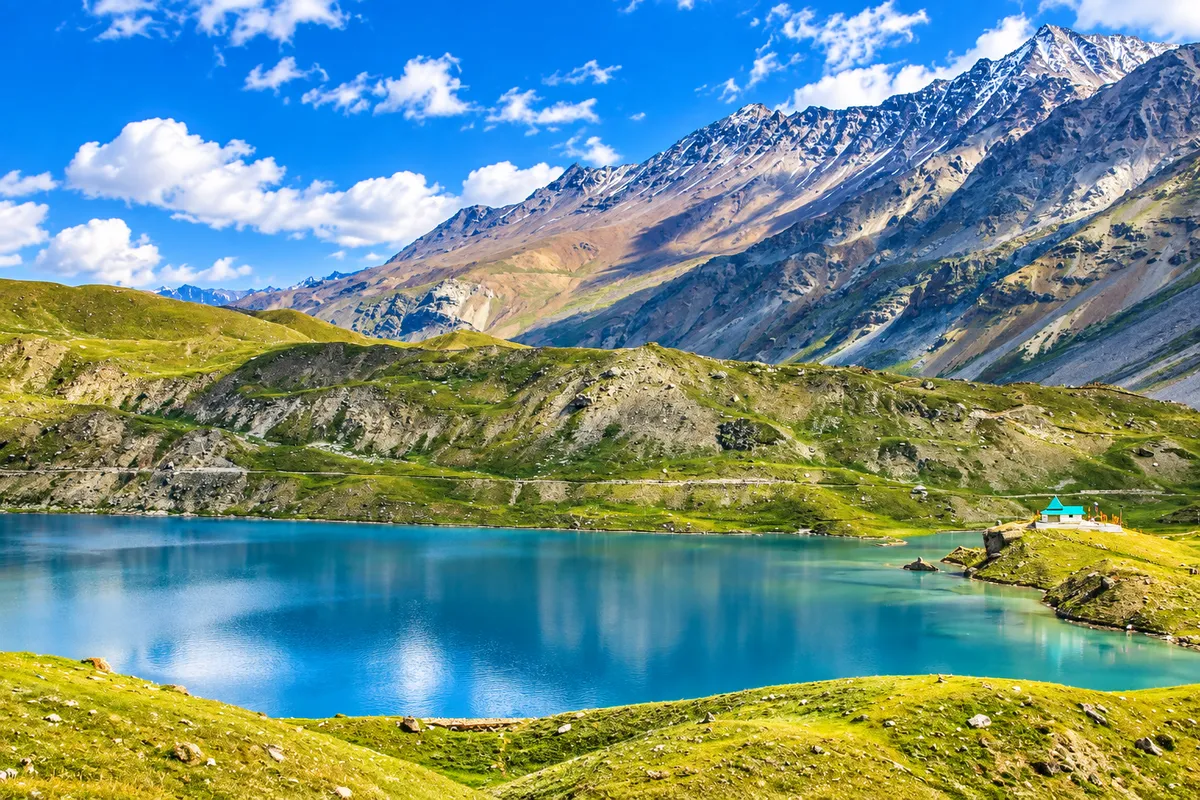
A glacial emerald lake ~2–3 km from Jolingkong where Goddess Parvati is believed to have bathed. Reflects the Adi Kailash peak on clear mornings. Pilgrims perform parikrama (circumambulation). A small Shiva-Parvati temple stands at the lakeside — this is the primary spiritual act of the Yatra for most devotees.
4. Gauri Kund (~4,572 m)
A sacred pond ~3–4 km from Parvati Sarovar at Adi Kailash base. Bathing is traditionally prohibited; site is for darshan only. Direct views of the Adi Kailash peak are visible from here on clear days.
5. Kalapani — Kali Temple and Vyas Cave (~15 km from Gunji)
Kalapani has historical and strategic significance as a contested India-China border region. Spiritually, the Kali temple (Goddess Kali) and the Vyas Cave (where Sage Vyas is said to have dictated the Mahabharata to Lord Ganesha) are its highlights. Views of Sheshnag Parvat from this area are outstanding.
6. Patal Bhuvaneshwar Cave Temple
A 160-metre-deep natural limestone cave ~2 hours from Pithoragarh. Natural formations resemble deities, including a natural Shivling, traditionally described as representations of the 33 Koti Devtas. A guide with a lamp leads visitors through the narrow passage. Best included as a dedicated day trip — do not rush it.
7. Pandav Parvat and Darma Valley
Five peaks near Gunji resembling the Pandava brothers overlook the ancient Darma Valley. Deep Mahabharata associations — local tradition holds the Pandavas passed through on their final Himalayan ascent. Beautiful panoramic views of the Byans Valley from near Gunji.
8. Kuti Village — Last Inhabited Frontier
Kuti village (~5 km from Jolingkong) is one of the last permanently inhabited villages on this route before the Tibet border. The village has traditional stone houses, and the landscape is stark and dramatic at altitude. A short walk from Jolingkong on clear days reveals views across the border range.
Step 7 — Accommodation on the Adi Kailash Route
Beyond Dharchula, accommodation is basic, limited, and must be pre-booked. No luxury options exist beyond the KMVN rest house in Dharchula.
| Location | Best Option | Type | Cost (per night) | Important Notes |
| Dharchula | KMVN Tourist Rest House, private hotels | Twin rooms, hot water | Rs 800–2,500 | Last reliable accommodation; book in advance for May–June |
| Pithoragarh | KMVN, private guesthouses | AC/non-AC rooms | Rs 700–2,000 | Last ATM, hospital, and well-stocked pharmacy |
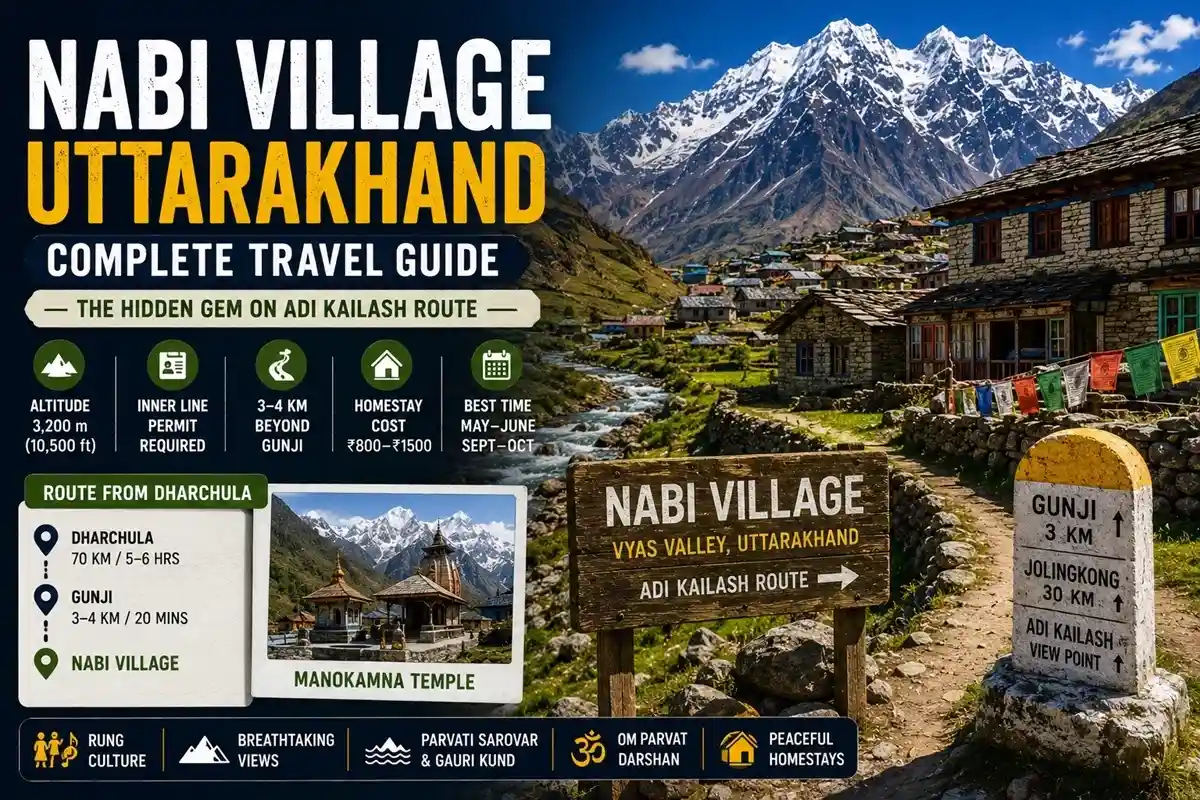
| Gunji | Village homestays, KMVN rest house | Multi-sharing, blankets, meals | Rs 400–800 (meals incl.) | Limited capacity; pre-book via operator; local Kumaoni meals |
| Nabhidhang | Basic homestays | Mattress, blankets, meals | Rs 400–600 (meals incl.) | Very basic; carry sleeping bag; no electricity |
| Jolingkong | Camp / basic shelter | Tents or basic room | Rs 300–600 | Minimalist; arrive light; stunning setting |
Book Early: Gunji has fewer than 20 beds available through homestays and rest houses combined. During May–June peak season, walk-in accommodation is essentially unavailable. Pre-book through a registered operator months in advance.
Step 8 — Adi Kailash Yatra Cost and Budget (2026)
| Expense | Budget (Self-arranged) | Comfortable / Package | Notes |
| Delhi–Dharchula transport | Rs 1,100–1,200 (UTC bus) | Rs 8,000–12,000 (cab) | UTC from Anand Vihar ISBT |
| Dharchula–Gunji (4×4 jeep) | Rs 2,000/person (shared) | Rs 6,000–8,000 (private) | Split across 4–6 co-passengers |
| ILP permit fee | Approx. Rs 200–600 (verify) | Same | Verify current fee at pass.pithoragarh.online |
| Accommodation (8 nights) | Rs 5,000–7,000 total | Rs 12,000–20,000 total | Homestays to KMVN range |
| Meals (per day) | Rs 300–500 | Rs 600–1,000 | No restaurants beyond Dharchula |
| Registered guide | Rs 800–1,200/day | Rs 1,500–2,000/day | Required beyond Gunji — policy subject to change |
| Pony/porter (optional) | Rs 500–800/day | Rs 1,000–1,500/day | For luggage or mobility on trek |
| Travel insurance | Rs 500–1,500 | Rs 2,000–4,000 | Strongly recommended; ensure it covers high-altitude helicopter |
| Total 8 days (per person) | ~Rs 20,000–30,000 | ~Rs 40,000–60,000 | Self vs package |
| Helicopter package total | N/A | Rs 55,000–70,000 (indicative) | Verify with Chardham Tour for current pricing |
What to Expect on the Jolingkong Trek
The trek is 4–5 km round trip — rated moderate in distance but demanding at altitude. Start early (before 7 AM) for the best Adi Kailash peak visibility and avoid afternoon cloud build-up.
| Section | Distance | Altitude | Conditions |
| Jolingkong to Parvati Sarovar | ~2–3 km one way | 4,770 m to 4,501 m | Rocky trail; well-defined; short descent then ascent |
| Parvati Sarovar to Adi Kailash viewpoint | ~500 m extension | ~4,550 m | Open ground; clear peak views on cloudless mornings |
| Jolingkong to Gauri Kund | ~3–4 km from Parvati Sarovar | ~4,572 m | Quieter trail; fewer pilgrims; outstanding close views of peak |
- Guide mandatory beyond Gunji — policy as per 2026 operations. Verify requirement and arrange via your operator or KMVN Gunji.
- Pony service available from Gunji for pilgrims with mobility needs.
- Altitude sickness (AMS) risk is real at 4,770 m — acclimatise in Gunji for one full night minimum before the trek.
Altitude Sickness (AMS) Guide for Adi Kailash Yatra
AMS is the most common medical issue on the Adi Kailash Yatra. At Jolingkong (4,770 m), the oxygen level is approximately 55% of sea-level density. Even physically fit pilgrims can be affected.
| AMS Symptom | Severity | Action |
| Mild headache, slight fatigue | Mild | Rest, hydrate, do not ascend further until symptoms improve |
| Persistent headache, nausea, dizziness | Moderate | Stop all physical activity; rest; take Diamox if prescribed; inform guide |
| Severe headache, vomiting, disorientation, loss of coordination | Severe / HACE/HAPE | Descend IMMEDIATELY — do not wait for morning; this is a medical emergency |
Prevention: Spend one night in Dharchula (2,000 m) and one full night in Gunji (3,200 m) before the Jolingkong trek. Drink 4–5 litres of water daily. Avoid alcohol. Take Diamox if prescribed by your doctor before travel.
Adi Kailash Yatra for Senior Citizens and Families
- Helicopter option: Eliminates the long Dharchula–Gunji jeep journey. Most practical for pilgrims above 60 or those with limited mobility. Contact Chardham Tour for helicopter package details.
- Pony service: Available from Gunji for the Jolingkong trek. Used widely by elderly pilgrims. Rates are set by local operators — verify at Gunji.
- Children: Standard ILP eligibility typically from age 9. Fit children aged 12 and above can generally manage the trek with preparation. Verify current age requirements at pass.pithoragarh.online.
- Medical clearance: Senior citizens and those with cardiovascular, respiratory, or BP conditions need clearance from a specialist (not just a GP). Bring all prescriptions and extra medication supply for 15+ days.
- Emergency: Nearest hospital is in Pithoragarh (~90 km from Dharchula). A basic ITBP medical post exists in the border area. Carry a comprehensive first aid kit. Satellite phones are hireable in Dharchula — recommended for groups without a registered operator.
Step 9 — Packing List for Adi Kailash Yatra
Clothing and Gear
| Category | Items |
| Base layer | 2 sets thermal inners — mandatory for sub-zero nights at Gunji and Jolingkong |
| Mid layer | Heavy fleece or woollen sweater; down jacket for 4,000 m+ sections |
| Outer layer | Windproof waterproof jacket; waterproof trekking trousers |
| Footwear | Ankle-support trekking boots (broken in before travel); 3–4 pairs warm woollen socks; camp sandals |
| Head and hands | Woollen cap/balaclava; warm gloves; UV-protective sunglasses (category 3+); wide sun hat |
| Trek gear | Trekking poles (strongly recommended at 4,770 m); 25–35L daypack; large duffel for base luggage |
Health, Documents and Electronics
- Diamox (consult your doctor before travel) — AMS prevention at altitude
- Personal first aid: bandages, antiseptic, blister pads, pain relief, antacids, ORS, anti-diarrhoeal
- Water purification tablets or UV filter bottle — no guaranteed clean water source beyond Dharchula
- Sunscreen SPF 50+ and lip balm — UV intensity is extreme at altitude
- Original government ID + 4 photocopies | Printed ILP: 5 copies | MBBS fitness certificate | Police verification
- Power bank (high capacity) — no reliable electricity beyond Dharchula
- Headlamp + spare batteries | Offline maps: download Maps.me or Google Maps before Dharchula
- Cash: minimum Rs 15,000–20,000 — no ATMs or UPI beyond Dharchula
- DSLR / Camera — permitted. Drone: Check current restrictions with SDM Dharchula before travel — use near border areas may be restricted.
Adi Kailash vs Kailash Mansarovar Yatra — Key Differences
| Factor | Adi Kailash (Chhota Kailash) | Kailash Mansarovar (Tibet) |
| Location | Pithoragarh, Uttarakhand (India) | Tibet Autonomous Region, China |
| Permits Required | ILP (Indian nationals only) | Chinese/Tibet travel permit + MEA India permit |
| Accessibility (2026) | Open — operational May–Oct 2026 | Suspended as of 2026 — MEA not operating Yatra currently |
| Altitude of Main Site | ~5,945 m (darshan from ~4,770 m) | Kailash: 6,638 m; Mansarovar: 4,590 m |
| Duration | 8–12 days (road); 4 days (helicopter) | 18–24+ days (road); shorter by helicopter |
| Physical Demand | Moderate — 4–5 km trek at 4,770 m | High — Parikrama (52 km) at 5,500–5,600 m |
| Cost (approx.) | Rs 20,000–70,000 | Rs 1,00,000–2,50,000+ when operational |
| Indian Citizens | ILP sufficient | MEA permit required — quota-based lottery |
2026 Status: Kailash Mansarovar Yatra via MEA (through China) remains suspended as of 2026. Adi Kailash (Chhota Kailash) is the most accessible Panch Kailash alternative within India. Pilgrims who wish to complete the Kailash darshan within India choose Adi Kailash Yatra.
Common Mistakes to Avoid on Adi Kailash Yatra
- Starting fitness training late — begin 6–8 weeks before departure. Daily walks, stair climbing with loaded backpack.
- Applying for ILP at the last minute — processing takes 2–5 working days. Apply minimum 3 weeks before travel.
- Printing only 1–2 ILP copies — 5 checkpoints retain one copy each. Print 5 minimum.
- Insufficient cash — no ATMs or UPI beyond Dharchula. Minimum Rs 15,000–20,000 in cash.
- Travelling July–August without checking road conditions — landslides frequently close the Dharchula–Gunji road.
- Skipping acclimatisation — at minimum, one night in Dharchula and one night in Gunji before Jolingkong.
- Assuming personal vehicles can go beyond Dharchula — the restricted road requires locally arranged 4×4 jeeps.
- No offline maps — download Maps.me or Google Maps area before leaving Dharchula.
- Overpacking — you carry everything on the trek. Every unnecessary kilogram costs you at 4,770 m altitude.
- Not informing family of daily plan — mobile connectivity disappears after Dharchula. Leave a day-by-day itinerary with a contact.
Practical Tips for the Adi Kailash Yatra
Fitness Preparation (Start 6–8 Weeks Early)
Daily 45–60 minute brisk walks building to 8–10 km. Stair climbing with a 10–12 kg weighted backpack. Yoga and pranayama (breathing exercises) for altitude adaptation. Do not begin the Yatra without at least 4–6 weeks of consistent physical training.
Food on the Route
Dharchula and Pithoragarh have restaurants with standard North Indian menus. Beyond Dharchula, only homestay meals are available — simple dal, rice, roti, and seasonal vegetables. Carry energy bars, dry fruits, and instant snacks for trek days when meals may be very early or unavailable on the trail.
Satellite Phone and Communication
No reliable mobile network beyond Dharchula. If travelling without a registered tour operator, hire a satellite phone in Dharchula — available from local equipment rental shops and some KMVN facilities. Save all emergency contacts on your phone and on paper before departing.
Frequently Asked Questions
Q1. What is Adi Kailash and why is it sacred?
Adi Kailash (Chhota Kailash) is a sacred peak at ~5,945 m in Pithoragarh, Uttarakhand, revered as Lord Shiva’s earthly abode and one of the Panch Kailash. Darshan is traditionally believed to cleanse past sins and grant divine blessings.
Q2. When does the Adi Kailash Yatra season open and close?
The season typically runs May to late October. Opening and closing dates are announced annually by the Pithoragarh District Administration — verify at pithoragarh.nic.in each year. In 2026, the season opened approximately May 13.
Q3. Is an Inner Line Permit mandatory? How do I get it?
Yes, the ILP is mandatory for all Indian citizens. Apply online at pass.pithoragarh.online with Aadhaar, MBBS fitness certificate, police verification, and photos. Print 5 copies minimum — one per ITBP/civil checkpoint.
Q4. How many days does the Adi Kailash Yatra take?
Minimum 8 days from Delhi and back. A 10–12 day itinerary is recommended for proper acclimatisation. Helicopter package: 4 days from Pithoragarh.
Q5. What is the total cost of the Adi Kailash Yatra?
Budget self-arranged: Rs 20,000–30,000 per person (8 days). Package tour: Rs 40,000–60,000. Helicopter package: Rs 55,000–70,000 (indicative — verify with Chardham Tour). Always carry Rs 15,000–20,000 cash minimum.
Q6. Is the Adi Kailash trek difficult?
The Jolingkong–Parvati Sarovar–Adi Kailash viewpoint trek is 4–5 km round trip, rated moderate in distance. The real challenge is altitude (4,770 m). Go slowly, stay hydrated, and acclimatise at Gunji for one full night before the trek.
Q7. Can senior citizens do the Adi Kailash Yatra?
Yes, with the right approach. The helicopter package eliminates the long jeep journey. Pony service is available from Gunji for the trek. Medical clearance from a specialist is essential for those above 60 or with any health conditions.
Q8. Can I use my personal vehicle beyond Dharchula?
No. The road to Gunji is a restricted military/border route. Personal vehicles are not permitted beyond Dharchula. Only locally arranged 4×4 jeeps with the appropriate route clearance can travel this road.
Q9. Is UPI or card payment available on the Adi Kailash route?
No reliable UPI or card payment infrastructure exists beyond Dharchula. Gunji, Nabhidhang, and Jolingkong are entirely cash-based. Carry Rs 15,000–20,000 minimum in cash before leaving Dharchula.
Q10. What mobile network works on this route?
BSNL has limited and intermittent signal at Gunji. Jio and Airtel are unreliable beyond Dharchula. There is effectively no internet beyond Dharchula. Download offline maps (Maps.me or Google Maps) and save all contacts before departure.
Q11. Is a guide mandatory for Adi Kailash Yatra?
A registered local guide is required for the section beyond Gunji as per 2026 operational policy. Verify the current requirement with the SDM Dharchula office or your tour operator. Arrange through your operator or the KMVN rest house in Gunji.
Q12. What is Om Parvat and is it part of the Yatra?
Om Parvat (~5,590 m) shows a natural OM symbol in snow on its face, visible from Nabhidhang (~20 km from Gunji). Most itineraries include a separate day trip to Nabhidhang for Om Parvat darshan. No climbing permitted.
Q13. How do I reach Dharchula from Delhi?
(1) UTC bus from Anand Vihar ISBT — Rs 1,100, 21–25 hrs. (2) Train to Kathgodam then road — ~15–17 hrs total. (3) Private cab — Rs 8,000–12,000, 14–16 hrs. (4) Fly to Pantnagar, then road — 8–10 hrs from airport.
Q14. Is Patal Bhuvaneshwar included in the Yatra?
Not on the main route, but typically visited as a day trip from Pithoragarh on the return. It is a 160-metre-deep limestone cave temple, 2 hours from Pithoragarh — one of India’s most remarkable cave sanctuaries.
Q15. Can foreigners do the Adi Kailash Yatra in 2026?
The standard ILP is generally not issued to foreign nationals due to the restricted border zone. Foreign visitors should check the latest policy with Uttarakhand Tourism or the nearest Indian consulate before planning.
Q16. When should I start fitness training?
Start 6–8 weeks before departure. Daily brisk walks building to 8–10 km. Stair climbing with a loaded 10–12 kg backpack. Yoga/pranayama for altitude breathing. Physical conditioning is the single most important non-document preparation.
Q17. Is food available on the route?
Dharchula has restaurants. Beyond that, only homestay meals — simple dal, rice, roti, vegetables. No restaurants or shops from Gunji onward. Carry energy bars, dry fruits, and snacks for trek days.
Q18. What is the Adi Kailash helicopter tour cost?
Chardham Tour’s helicopter packages are indicatively priced Rs 55,000–70,000 per person (4 days/3 nights, all inclusive). Exact pricing is subject to season and operator. Contact Chardham Tour for confirmed 2026 rates.
Q19. How is Adi Kailash different from Kailash Mansarovar Yatra?
Adi Kailash is in India (Pithoragarh, Uttarakhand) and accessible to Indian nationals with an ILP. Kailash Mansarovar is in Tibet and requires Chinese permits via MEA India — which remains suspended as of 2026. Adi Kailash is the most accessible Panch Kailash option currently available.
Q20. What emergency contacts should I save?
Police: 112 | Ambulance: 108 | SDRF: 1070 | Uttarakhand Tourist Helpline: 1364 | SDM Dharchula: 05961-222201 | Pithoragarh District: 05964-225520. Save all before departure — connectivity disappears beyond Dharchula.
Q21. Can diabetics or people with BP issues do the Yatra?
Consult a specialist before applying. Standard eligibility requires an MBBS fitness certificate. Controlled diabetics with good HbA1c levels and stable BP generally receive clearance — but high altitude affects glucose and BP management. Carry all medications plus 50% extra supply.
Q22. Is solo travel safe on the Adi Kailash route?
Solo travel is technically permitted with a valid ILP, but strongly discouraged beyond Gunji due to the remote terrain, lack of connectivity, and altitude risks. If travelling solo, hire a registered guide at Gunji, carry a satellite phone from Dharchula, and leave your itinerary with a contact.
Q23. Is drone photography permitted?
Drone use near the Indo-Tibet border area is subject to restrictions under Indian aviation and border security regulations. Check the current rules with SDM Dharchula and the DGCA before carrying a drone. Permit requirements for drone operation in restricted zones are strictly enforced.
Q24. Can I camp on the route?
Camping is possible at designated spots — primarily near Jolingkong and Nabhidhang with prior operator arrangements. Wild camping without a registered guide/operator is not advisable in the restricted zone. Carry your own sleeping gear regardless of accommodation type beyond Gunji.
Q25. What if my ILP application is rejected?
Applications can be rejected for incomplete documents, medical certificate issues, or administrative reasons. Contact the SDM Dharchula office directly (05961-222201) for the specific reason and rectification process. Tour operator packages include ILP processing support — another advantage of booking through a registered operator.
Final Thoughts: Plan the Adi Kailash Yatra Right
The Adi Kailash Yatra rewards those who plan carefully and tests those who underestimate it.
Apply for the ILP at least 3 weeks before travel. Train consistently for 6–8 weeks. Carry Rs 15,000–20,000 minimum in cash. Print 5 copies of every document. Build a buffer day for weather or road delays. And if managing logistics independently feels uncertain, book through a registered operator.
When you stand at Jolingkong at dawn and the Chhota Kailash rises above the Parvati Sarovar in the first Himalayan light — you will understand exactly why this Panch Kailash pilgrimage draws devotees back season after season.
Chardham Tour offers verified Adi Kailash Yatra packages (road and helicopter) for the 2026 season — covering permits, transport, accommodation, registered guides, and full logistics. Contact us at +91-7838908606 or visit chardhamtour.in to plan your Adi Kailash Yatra with experienced, trusted support.