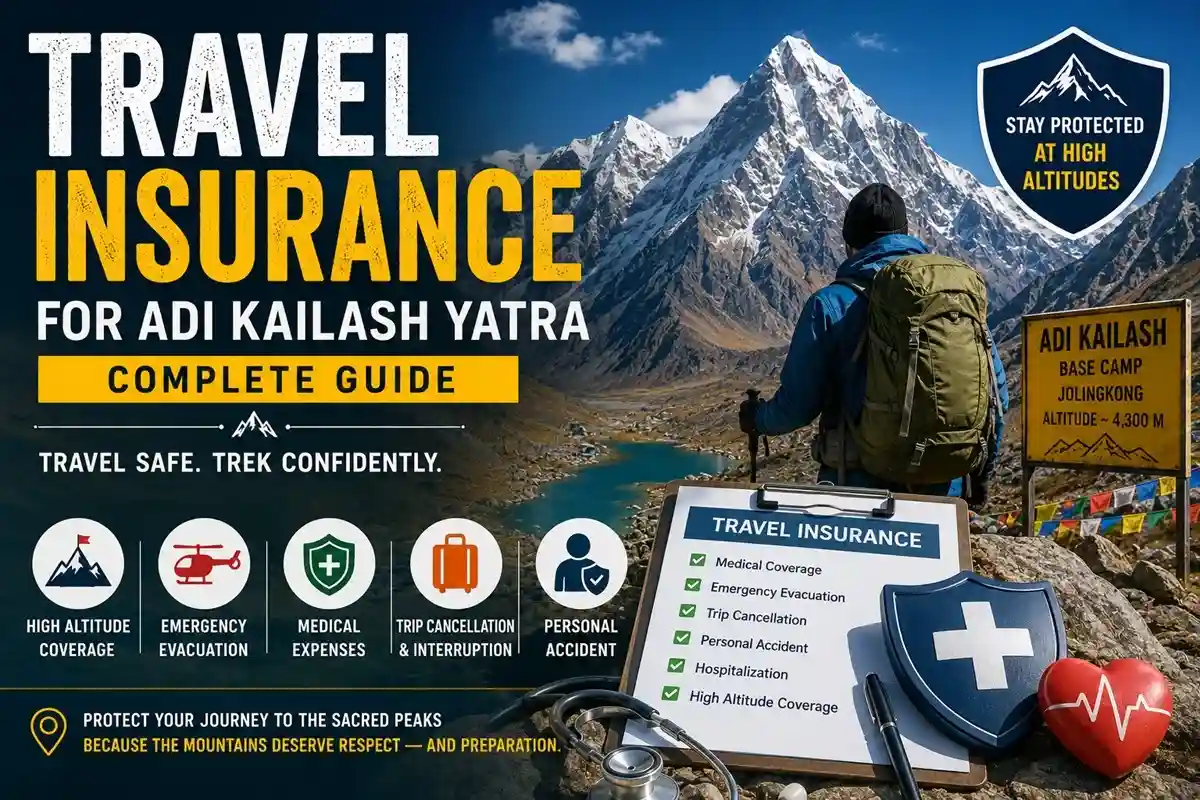
Travel insurance for Adi Kailash isn’t the same product you’d buy for a foreign holiday. Since the yatra stays entirely within India, look for a domestic high-altitude adventure or trek insurance policy — built for remote Himalayan terrain, not overseas trip cancellations. With darshan points near Jolingkong above 4,300 metres and optional treks pushing higher, this is exactly the route where a plain travel policy can quietly stop covering you.
This guide covers what to check, what claims typically involve, and how it connects to your ILP paperwork.
Quick Answer
For the Adi Kailash Yatra, look for a policy explicitly covering high-altitude trekking, medical evacuation, and hospitalisation — many standard travel policies exclude this by default. Since the route touches altitudes above 4,300 m, check that coverage extends to your highest planned point, includes helicopter evacuation, and doesn’t quietly exclude altitude sickness as a “pre-existing condition.”
Why Standard Travel Insurance Isn’t Enough
Regular travel insurance is built primarily for flights, baggage, and trip delays. Many general policies exclude “adventure” or “high-risk” activities by default, and altitude trekking above roughly 3,000–4,000 m commonly falls outside standard coverage — though this varies, so check the policy wording.
Adi Kailash sits well into that grey zone for most policies. The base camp at Jolingkong is around 4,300–4,400 m, and the peak rises to about 5,945 m. Most pilgrims don’t summit, but the optional trek toward Parvati Sarovar and Gauri Kund goes noticeably higher — sources cite figures from roughly 4,500 m upward, so confirm your policy’s ceiling covers it.
Why Insurance Matters on This Specific Route
- Altitude risk: AMS, and in rarer cases HAPE or HACE, become more likely above 3,500 m without proper acclimatisation.
- Remote terrain: Beyond Dharchula, medical facilities thin out fast.
- Evacuation is costly: Helicopter rescue costs vary by distance and aircraft availability, and can run into lakhs of rupees — out-of-pocket without insurance.
- Weather volatility: Sudden snowfall or landslides near Tawaghat can cause delays that trigger trip-interruption claims.
What an Adi Kailash Insurance Policy Should Cover
- Medical and hospitalisation expenses, including altitude-related illness — insurers often word this as “medical emergency” rather than literally “AMS covered,” so check the text
- Emergency medical evacuation, ideally including helicopter rescue
- Personal accident cover (death and disability)
- Trip cancellation/curtailment, useful given monsoon-related ILP delays
- Coverage for Om Parvat/Nabhidhang if it’s part of your itinerary
- Duration matching your full itinerary, Dharchula to Jolingkong and back
Many organised trek operators bundle a basic policy into their package, but the sum insured is often modest — check the actual coverage limits.
Altitude Coverage: The Detail Most Pilgrims Miss
Altitude limits are the most misunderstood part of adventure insurance. A policy that looks comprehensive on paper can still exclude your claim if your route crosses its stated altitude ceiling.
| Point on Route | Approx. Altitude | Insurance Relevance |
| Dharchula | ~940 m | Below any altitude threshold |
| Gunji | ~3,300–3,600 m | Many basic policies stop covering here |
| Jolingkong (base) | ~4,300–4,400 m | Requires a high-altitude-rated policy |
| Parvati Sarovar/Gauri Kund (optional) | ~4,500 m+ (sources vary) | Confirm this is explicitly included |
As a precaution, many pilgrims choose a policy covering up to 5,000–6,000 m — not a fixed rule, but a margin for the optional higher trek segments. Ambiguous route classifications (“trekking” vs “mountaineering”) sometimes create gaps at the exact altitude you’ll be at.
Insurance and Your ILP: How They Connect
The ILP process already requires a medical fitness certificate from an MBBS doctor. This is separate from insurance, but the two touch similar ground — insurers ask about existing health conditions too, and inconsistent disclosures across your paperwork can complicate a claim. Staying accurate and consistent across both is worth the extra ten minutes.
Typical Costs and Coverage Amounts
- Domestic high-altitude trek policies are generally inexpensive relative to the trip cost, but premiums vary by provider, age, duration, and sum insured.
- Example structures bundle hospitalisation, evacuation, and personal accident cover under a combined sum insured, commonly ₹1–5 lakh for domestic treks.
- Treat figures as indicative — get a current quote from an IRDAI-registered insurer before booking.
How to Choose the Right Policy
- Confirm the altitude ceiling covers your highest planned point.
- Check that helicopter evacuation is included, not just ground transport.
- Read the pre-existing condition clause carefully, especially for cardiac history.
- Confirm the policy accepts solo travellers if going without an operator.
- Verify claim documentation and the intimation window before you leave.
Buying Through an Operator vs Buying Directly
Many registered operators bundle a group policy into the package price — convenient, but the sum insured is often fixed and modest. Buying directly from an IRDAI-registered insurer usually gives more control over the sum insured and altitude ceiling. Ask to see the actual policy document, not just a confirmation that “insurance is included.”
Cashless vs Reimbursement Claims
Domestic adventure policies usually work one of two ways: cashless, where the insurer settles directly with a network hospital, or reimbursement, where you pay upfront and claim it back. Cashless hospitals are rare beyond Dharchula, so budget for paying first — confirm the model before you leave.
Filing a Claim: What to Do at the Time of an Incident
- Contact your insurer’s emergency helpline as soon as symptoms appear.
- Inform your trek leader or operator so evacuation logistics start in parallel.
- Keep every medical report, prescription, and bill from first treatment onward.
- Submit the claim intimation within your policy’s stated window.
- File final documentation, including the discharge summary if hospitalised.
Common Exclusions and Reasons Claims Get Rejected
- Pre-existing medical conditions not declared at purchase
- Trekking without a registered guide, where required
- Alcohol/drug-related incidents, or travel beyond the altitude/route stated in your policy
- Mismatched documents between your ILP medical form and the claim
- Delayed intimation beyond the policy’s stated window
- Missing original bills or discharge summaries
Senior Citizen Tips
Since parts of this route are now motorable, senior citizens increasingly attempt it — but altitude risk doesn’t scale down with age. Prioritise a higher medical sum insured, confirm there’s no restrictive age cap, and get the same fitness check recommended for the ILP.
Checklist Before Leaving Dharchula
- Policy document (physical + digital) with altitude ceiling confirmed
- Emergency helpline number saved offline
- Medical fitness certificate and health disclosures cross-checked for consistency
- Sum insured and claim model (cashless/reimbursement) noted
- Documents photographed as you go — reconstructing paperwork later is harder
Related reading: see our guides on the Dharchula ILP process, the Adi Kailash route, and Om Parvat darshan for the rest of your trip planning.
Frequently Asked Questions
Do I need travel insurance for Adi Kailash?
Not legally required, but strongly recommended given the altitude and terrain.
Does regular travel insurance cover Adi Kailash?
Many standard policies exclude high-altitude trekking above 3,000–4,000 m.
What altitude coverage do I need for Adi Kailash insurance?
Coverage matching your highest point; many prefer a margin to 5,000–6,000 m.
How much does helicopter evacuation cost near Adi Kailash?
Varies by distance and aircraft availability — ask your insurer directly.
Is AMS covered under Adi Kailash trek insurance?
Often yes, though insurers may word it “high-altitude illness” — check the text.
What is the best type of insurance for the Adi Kailash yatra?
A domestic high-altitude adventure policy with evacuation cover.
Can senior citizens get high-altitude insurance for this yatra?
Yes, though some policies cap the entry age — check first.
Does Adi Kailash travel insurance also cover the Om Parvat leg?
Only if the policy explicitly lists it.
Is insurance included in tour operator packages?
Sometimes, but coverage limits vary — verify the sum insured.
What documents do I need to buy Adi Kailash travel insurance?
Usually ID proof, age details, and trip dates; some need a health declaration.
Is it cashless or reimbursement for hospital treatment on this route?
Depends on the policy — cashless hospitals are rare beyond Dharchula.
Can I buy insurance after reaching Dharchula?
Best arranged before departure; last-minute options are limited.
Key Takeaways
- Many standard travel policies exclude this route — look for one explicitly covering high-altitude trekking.
- Confirm the altitude ceiling covers your highest planned point, not just the base camp altitude.
- Helicopter evacuation and altitude-illness coverage are the two features to verify first.
- Keep your ILP medical declaration and insurance health disclosure consistent.
Final Recommendation
For most pilgrims, the right approach is a domestic high-altitude adventure insurance policy bought a few days before departure, with clear altitude coverage, evacuation support, and honest health disclosures. It’s a small cost against a meaningful risk on a route this remote. Policy terms differ by insurer: this article is general information, not financial or insurance advice — read the actual policy wording and confirm current terms with an IRDAI-registered insurer before booking.
Suggested Tour: