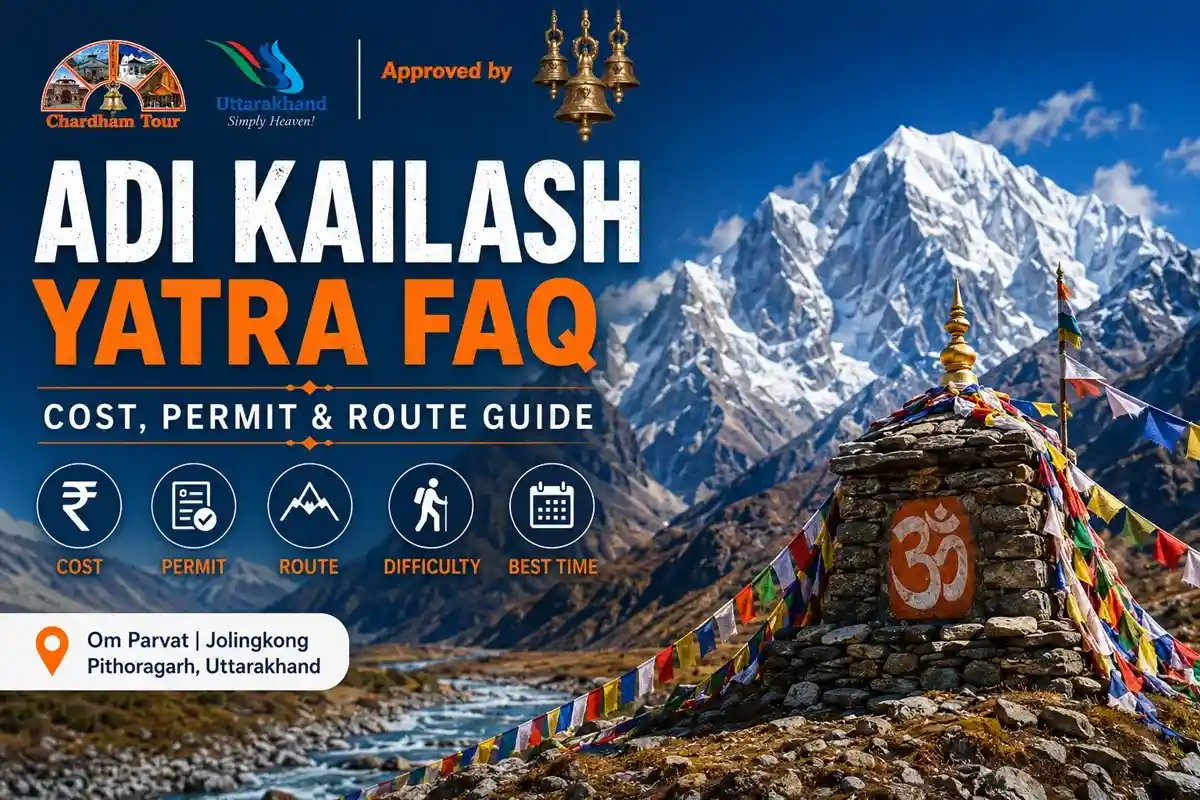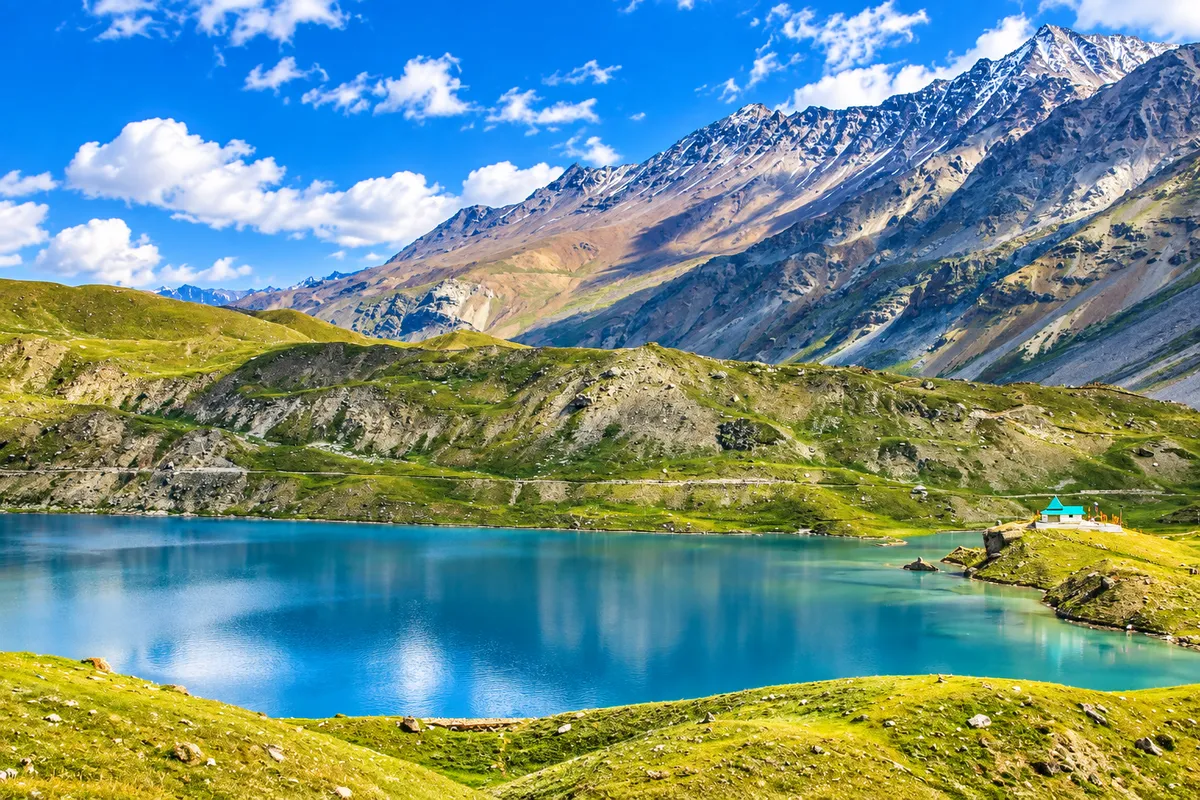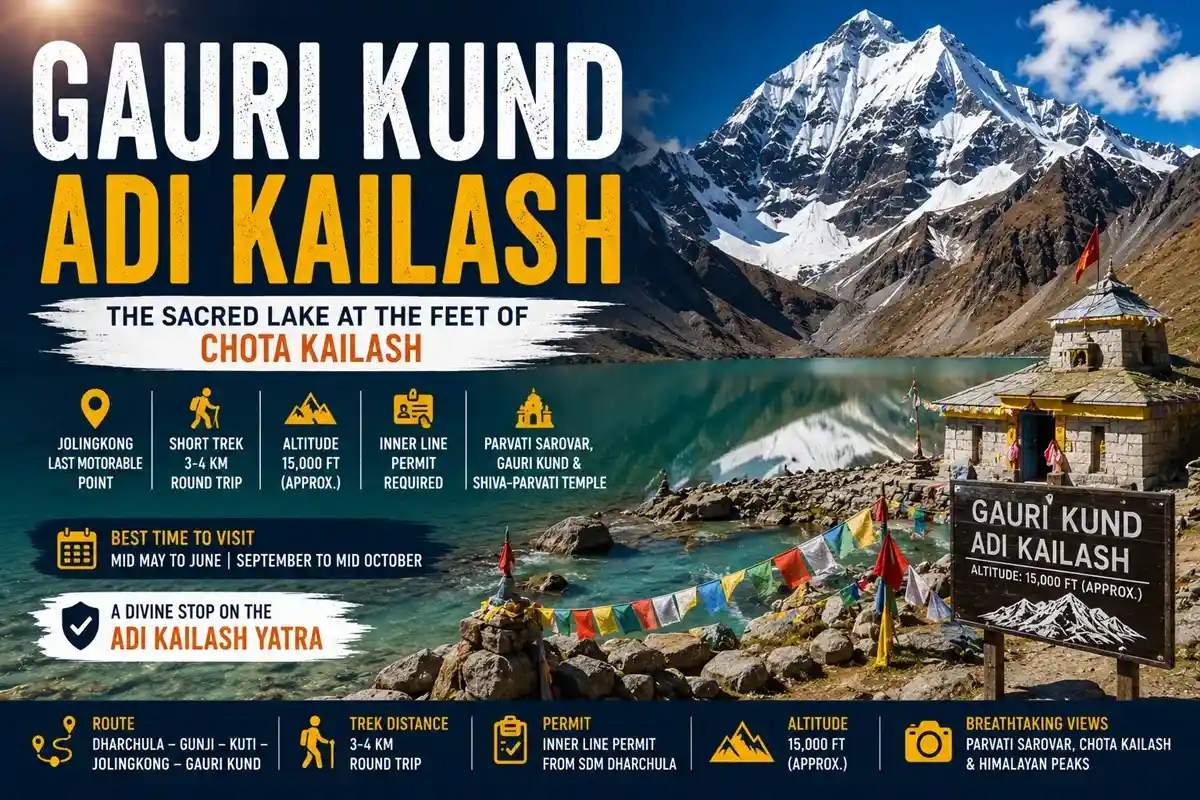
Gauri Kund Adi Kailash is a small, naturally formed glacial pool near Jolingkong in the Vyas Valley of Pithoragarh district, Uttarakhand — at approximately 4,500–4,600 metres (references vary), right beneath the face of Adi Kailash (Chhota Kailash).
For pilgrims, this is where darshan turns personal. Devotees regard the kund as Goddess Parvati’s bathing place, and many call the short walk to its edge the most moving stretch of the Adi Kailash Yatra.
Last updated: July 2026 | Cross-checked with Pithoragarh district and Uttarakhand Tourism sources.
Quick Answer
Gauri Kund is a sacred glacial pool near Jolingkong, the roadhead of the Adi Kailash Yatra in Pithoragarh (Uttarakhand). It sits at roughly 4,500–4,600 m, reached by a short walk from Jolingkong via Parvati Sarovar, needs an Inner Line Permit, and is best visited May–June and September–October.
Gauri Kund Adi Kailash vs Gaurikund Kedarnath: Don’t Confuse the Two
India has more than one sacred Gaurikund — mixing them up ruins itineraries. This one sits in the Byans (Vyas) Valley of the upper Kali River basin.
| Feature | Gauri Kund (Adi Kailash) | Gaurikund (Kedarnath) |
| District | Pithoragarh (Vyas Valley) | Rudraprayag |
| Role | Glacial pool near Jolingkong | Base town of the Kedarnath trek |
| Permit | Inner Line Permit required | No ILP needed |
| Access | Restricted border road | Regular Char Dham route |
This guide covers the Adi Kailash kund. A third exists near Mount Kailash in Tibet — a different place entirely.
Mythology & Significance
According to local Puranic tradition, this region is a second abode of Shiva and Parvati, and devotees hold that Gauri bathed in this glacial pool — hence the tradition of ritual sprinkling during darshan.
The customary sequence: sprinkle at the sacred kund, then darshan at Parvati Sarovar and the Shiva–Parvati temple. From the kund’s edge, Adi Kailash towers directly above — locals call it the peak’s closest darshan point.
Best Time to Visit Gauri Kund
The best time to visit Gauri Kund is May–June and September–October, when the Jolingkong road is open. Being a seasonal glacial pool, it may stay partly frozen early in the season; access depends on weather and snow conditions.
| Season | Months | Verdict |
| Pre-monsoon | May–June | Best window; pool may be part-frozen early on |
| Monsoon | July–August | Avoid; landslides and closures |
| Post-monsoon | Sept–Oct | Clear skies; cold mornings |
| Winter | Nov–April | Snowbound; route closed |
Early starts from Gunji or Nabi are the norm; weather deteriorates as the day progresses.
Gauri Kund Weather
Cold and windy even in season — temperatures may fall below freezing, particularly early in the season, and snow can arrive suddenly. UV is harsh at this altitude; sunglasses and sunscreen matter as much as woollens.
How to Reach Gauri Kund Adi Kailash
- Reach Kathgodam or Tanakpur — nearest railheads (~280–300 km from Dharchula); nearest airport Pantnagar.
- Drive to Dharchula — the last town with hotels, ATMs, and fuel; complete ILP formalities here.
- Dharchula to Gunji/Nabi (~70–80 km) — overnight acclimatisation halt.
- Gunji/Nabi to Kuti — roughly 19–20 km per the district route table; then Kuti to Jolingkong (~4,400–4,600 m, references vary) — roughly 14–15 km. The BRO road runs up to Jolingkong, subject to seasonal conditions.
- Jolingkong to Gauri Kund — the Gauri Kund Adi Kailash trek distance is short: ~1 km to Parvati Sarovar, then ~2 km further to the kund (itineraries vary), on rocky glacial terrain.
Distance Chart (Approximate — verify current road status)
| Stretch | Distance | Mode |
| Kathgodam → Dharchula | ~280–300 km | Road |
| Dharchula → Gunji/Nabi | ~70–80 km | Road |
| Gunji/Nabi → Kuti | ~19–20 km | Road |
| Kuti → Jolingkong | ~14–15 km | Road |
| Jolingkong → Parvati Sarovar | ~1 km | Short trek |
| Parvati Sarovar → Gauri Kund | ~2 km (itineraries vary) | Short trek |
Road status: The road has improved under the Border Roads Organisation, though landslides still occur — confirm conditions at Dharchula before departure.
Inner Line Permit for Gauri Kund
The kund lies in a restricted border zone, so an Inner Line Permit is mandatory. At the time of writing it is issued through the SDM office at Dharchula; registered operators routinely assist.
Commonly required: Aadhaar with copies, passport photos, and a high-altitude medical certificate. Entry rules for foreign nationals and OCI holders depend on current security regulations — verify before planning.
The Trek & Darshan Experience
From the Jolingkong roadhead, a short trail — partly improved in recent years — leads past Parvati Sarovar (~4,500 m) towards Adi Kailash’s base. The Shiva–Parvati temple (approximately 4,600 m, seasonal) stands just above the sarovar.
Nearby sights woven into legend include Bheem Ki Kheti (where, by local belief, Bheem grew wheat), Pandav Parvat, and Parvati Mukut. Keep the excursion unhurried — altitude, not distance, is the challenge.
Where to Stay
No accommodation exists at Gauri Kund itself. Jolingkong has only basic KMVN fibre huts/camps, so most yatris base at Gunji, Nabi, or Kuti homestays and day-trip. Indicative homestay cost: ₹1,000–1,500 per person per night with meals (approximate).
Altitude Sickness & Safety
At roughly 4,500–4,600 m, this glacial pool sits higher than most points on the yatra — acclimatize at Gunji or Nabi and keep the visit short. Watch for AMS symptoms (headache, nausea, breathlessness) and descend if they worsen; the nearest full hospital is at Dharchula.
The water is glacial cold — a quick ritual sprinkle is safer, as full immersion at this altitude can strain heart and breathing.
Sample Itinerary (5–6 Days)
- Day 1: Kathgodam → Dharchula.
- Day 2: Permits; drive to Gunji/Nabi.
- Day 3: Early drive via Kuti — the Byans Valley’s highest village — to Jolingkong; trek to Parvati Sarovar, Gauri Kund, and the temple; return.
- Day 4: Om Parvat darshan from Nabhidhang on the Lipulekh road.
- Day 5–6: Return via Dharchula, with a weather buffer day.
Check Posts, Facilities & Connectivity
Documents are verified at ITBP/army check posts — keep your permit accessible; drones are effectively prohibited. No shops, food stalls, or toilets exist at the kund — carry water and snacks. Mobile connectivity is extremely limited beyond Dharchula.
Budget Breakdown (Approximate, Per Person)
| Expense | Estimate |
| Kathgodam–Dharchula transport | ₹1,500–4,000 |
| Local vehicle in valley (shared) | ₹3,000–5,000 |
| Homestay + meals (per night) | ₹1,000–1,500 |
| Permit + documentation | ₹500–1,000 |
| Full packaged yatra (5–8 days) | ₹25,000–40,000 |
Packing List
Layered woollens, windproof jacket, sturdy trekking shoes, sunglasses, sunscreen, water, dry snacks, ORS, medicines, cash, document copies.
Senior Citizens & Age Limits
Many operators accept travellers roughly in the 5–80 age range, subject to health and current policy — confirm while booking. Seniors should carry a medical certificate, add an acclimatisation night, and keep the walk slow.
Common Mistakes to Avoid
- Confusing this kund with Gaurikund near Kedarnath.
- Skipping the acclimatisation night at Gunji/Nabi.
- Attempting a full dip without assessing fitness.
- Starting late and losing the clear-weather window.
- Planning travel in the July–August monsoon.
Responsible Tourism
Carry waste back, avoid plastic and soap in the sacred waters, follow army instructions, and support local homestays — tourism income sustains the valley’s Rung families.
Latest Updates (2026)
The BRO road now reaches Jolingkong — subject to seasonal conditions — reducing the old long treks to a short walk. Permits can occasionally be suspended for events or security reasons, so verify shortly before travel.
FAQs About Gauri Kund Adi Kailash
-
What is Gauri Kund Adi Kailash?
A sacred glacial pool near Jolingkong at Adi Kailash’s base, regarded by devotees as Goddess Parvati’s bathing place.
-
What is the Gauri Kund altitude?
Approximately 4,500–4,600 metres (references vary); acclimatize at Gunji or Nabi before visiting.
-
How far is Gauri Kund from Jolingkong?
About 1 km to Parvati Sarovar, then ~2 km further (itineraries vary) — combined in one excursion.
-
Is Gauri Kund the same as Gaurikund near Kedarnath?
No — Gaurikund (Rudraprayag) is the Kedarnath trek base; this kund lies in the restricted Vyas Valley, Pithoragarh.
-
Do I need a permit to visit Gauri Kund?
Yes — an Inner Line Permit issued at Dharchula, checked at army posts en route.
-
What is the best time to visit Gauri Kund?
May–June and September–October; the seasonal pool may stay part-frozen early on.
-
Can I bathe in Gauri Kund?
Ritual sprinkling is common; full immersion in glacial water at this altitude is risky — assess fitness first.
-
What is Parvati Sarovar?
A larger glacial lake near the kund that mirrors Adi Kailash; both are visited together.
-
Is there a temple at Gauri Kund?
A seasonal Shiva–Parvati temple (~4,600 m) stands near Parvati Sarovar, open only in yatra season.
-
How do I reach Gauri Kund Adi Kailash?
Kathgodam → Dharchula → Gunji/Nabi → Kuti → Jolingkong by road, then a short trek — permits at Dharchula.
-
Can foreigners visit?
Entry for foreigners and OCI holders depends on current security regulations — verify with the administration.
-
Is Gauri Kund safe for senior citizens?
The trek is short, but the altitude is serious — fitness, acclimatisation, and a slow pace are essential.
-
What is Bheem Ki Kheti?
A patch near the sarovar where, by local legend, Bheem of the Pandavas grew wheat.
-
Are food and toilets available at the kund?
No — facilities exist only at base villages like Gunji, Nabi, and Kuti; carry water and dry snacks.
-
Is mobile network available?
Connectivity is extremely limited beyond Dharchula; expect no signal at the kund.
-
How difficult is the Gauri Kund trek?
Short and gradual, but at 4,500+ m even easy terrain feels hard — pace matters more than fitness.
-
How is the Gauri Kund road condition?
Motorable in season but weather-dependent — landslides can close stretches; check at Dharchula.
-
Can the permit be suspended?
Occasionally, yes — ILPs have been paused for events or security reasons; verify shortly before travel.
Final Word: Should Gauri Kund Be on Your Itinerary?
If you’re doing the Adi Kailash Yatra, the honest answer is yes — Gauri Kund Adi Kailash is the journey’s spiritual core, a Gaurikund framed by the peak itself. It suits pilgrims seeking intimate darshan and slow travellers who value silence over spectacle.
Go in May–June or September–October, sort your ILP early at Dharchula, acclimatize, and keep the excursion unhurried. Do that, and — as many yatris say — those minutes at the water’s edge become the memory that outlasts the whole yatra.