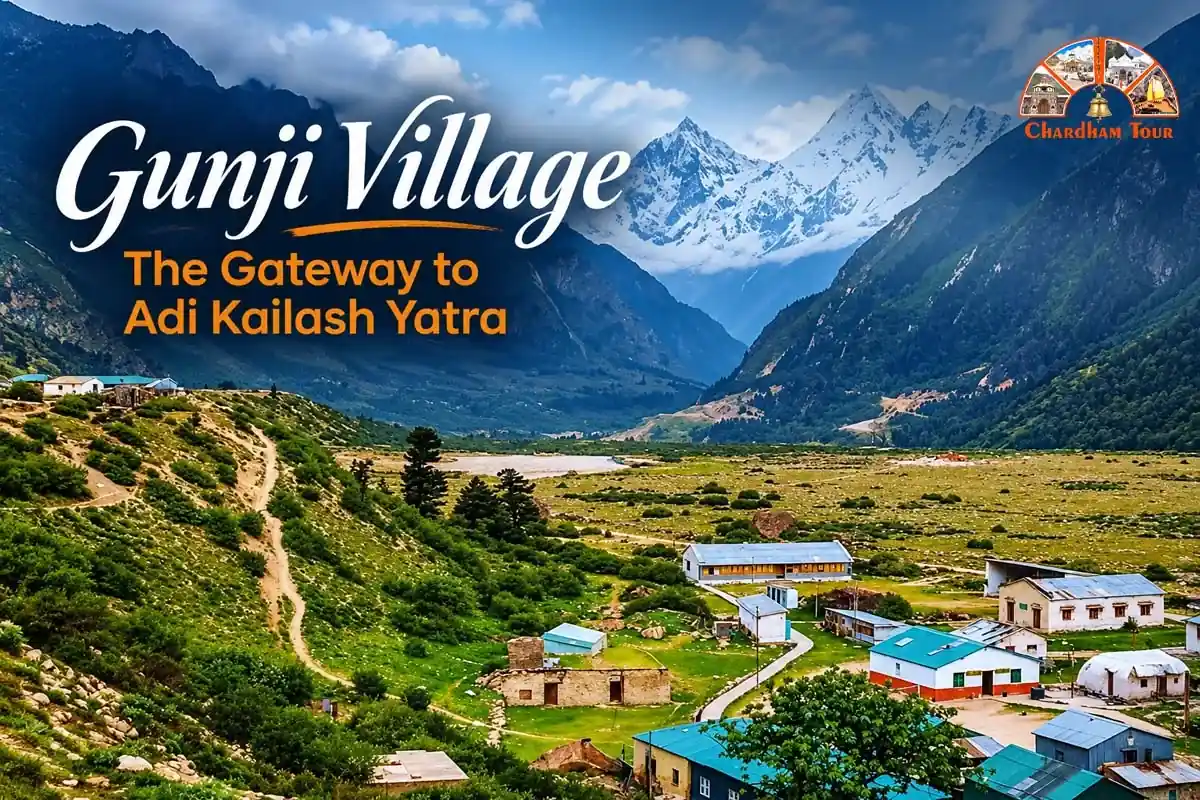
Gunji Village sits at an elevation of approximately 3,200 metres (about 10,500 feet) in the Byans Valley of Pithoragarh district, Uttarakhand. For anyone planning the Adi Kailash Yatra, this small Himalayan settlement works as a key route junction and an overnight halt for permit checks and altitude acclimatisation.
It isn’t the final village on this road — Kuti Village lies further ahead — but Gunji remains the last stop with organised lodging and medical support before the route splits toward Adi Kailash and Om Parvat.
Quick Answer: Gunji Village is a high-altitude settlement (~3,200 m) in the Byans Valley that serves as a route junction and acclimatisation halt on the way to Adi Kailash and Om Parvat. It’s reached from Dharchula by a regulated mountain road — confirm current permit, vehicle, and fee details with the district administration before travel.
Elevation at a Glance
| Location | Approx. Elevation |
| Gunji Village | 3,200 m / 10,500 ft |
| Jolingkong (Adi Kailash darshan area) | ~4,390–4,420 m / 14,400–14,500 ft |
| Nabhidhang (Om Parvat viewpoint) | ~4,300 m / 14,100 ft |
| Adi Kailash peak | 5,945 m / 19,505 ft |
These are three distinct points, not one location: Gunji is the halt, Jolingkong is the darshan area, and Adi Kailash is the peak beyond both.
Where Gunji Village Sits
Gunji lies near where the Kuthi Yankti and Kalapani rivers meet, close to the India–Nepal border region in the Kumaon Himalayas. It belongs to Rung (Byansi) territory, one of the four Bhotia communities here, and has served as a trans-Himalayan trade halt for generations.
Today it also functions as a security and permit checkpoint, with KMVN-run lodging nearby. It is not the final village on this route — Kuti Village sits further along the valley — but it remains the main stop before the road forks toward Jolingkong or Nabhidhang.
Best Time to Visit Gunji Village
The best time to visit Gunji Village is generally May to mid-June and mid-September to early October, when roads stay clearer and mountain visibility improves. July and August bring the monsoon, and this stretch has a history of landslides that can block the road without warning. Access is usually limited through winter due to snow — confirm current road status before planning.
Seasonal Snapshot
| Season | Months | Conditions |
| Peak season | May – mid-June | Clearer roads, cold mornings, higher footfall |
| Monsoon (avoid) | Mid-June – August | Landslide risk, possible road closures |
| Second window | Mid-September – early October | Crisp air, generally good visibility |
| Winter | November – April | Usually inaccessible; confirm locally |
How to Reach Gunji Village from Dharchula
The commonly used approach runs Dharchula → Tawaghat → Budhi/Bundi → Garbyang → Gunji Village. Vehicle movement beyond Dharchula is regulated; travellers typically use authorised local or tour-operator vehicles rather than private cars, so confirm current rules before your trip.
| Route Segment | Distance | Travel Time* |
| Kathgodam / Pantnagar → Pithoragarh | ~175–210 km | 5–7 hrs |
| Pithoragarh → Dharchula | ~90–96 km | 3–4 hrs |
| Dharchula → Gunji Village | ~65–90 km (mountain road) | 5–9 hrs |
| Gunji Village → Jolingkong (Adi Kailash) | ~30–40 km | 1.5–2.5 hrs |
| Gunji Village → Nabhidhang (Om Parvat) | ~18–25 km | 1.5–2 hrs |
*Distance and travel time vary with road, weather, and security conditions — confirm current figures with your operator.
Airport and Rail Connectivity
The nearest airport is Pantnagar, roughly 300 km from Dharchula; Naini Saini airstrip in Pithoragarh has very limited flights. The nearest railhead is Kathgodam, about 210 km from Pithoragarh. Most travellers fly or train into Kathgodam or Pantnagar, then continue overland via Pithoragarh.
Weather at Gunji Village — Indicative Conditions
Weather here shifts quickly, even within a single day — clear, cold mornings can turn cloudy by afternoon near monsoon. The figures below are indicative only and can vary with altitude, wind, and the local weather system.
| Month | Day Temp | Night Temp |
| May – June | ~10°C to 18°C | ~-2°C to 5°C |
| July – August | ~8°C to 15°C (rain likely) | ~2°C to 8°C |
| September – October | ~6°C to 14°C | ~-4°C to 3°C |
ILP for Gunji Village Adi Kailash Yatra
An Inner Line Permit is generally required for Indian citizens travelling to the Gunji sector, since this is a regulated border zone. Eligibility, age limits, medical criteria, and fees are set by the Pithoragarh district administration and can change between seasons — verify the latest notification before booking.
Documents Typically Needed
- Valid government ID (Aadhaar, Voter ID, or passport)
- Recent passport-size photographs
- Medical fitness certificate, where required
- Completed ILP application (via SDM Office, Dharchula, or your operator)
- Multiple photocopies of all documents
Physical verification at the SDM Office, Dharchula, is typically required even after online pre-registration, and permits are checked at multiple checkposts en route. Fees and processing time vary — confirm with the district administration or your operator.
Where to Stay in Gunji Village
Accommodation here is basic — KMVN rest houses and a handful of homestays, with tented camps arranged by some operators in peak months. Meals are simple, home-cooked Kumaoni fare such as dal, rice, roti, and sabzi rather than restaurant-style dining. Book ahead, since rooms fill quickly in the May–June and September windows.
Indicative Costs — Verify Before Booking
Prices vary by season, route, occupancy, and package inclusions, so treat these as a rough starting point, not a fixed quote.
| Expense Head | Approx. Range (per person) |
| Stay + meals (per night) | ₹1,500 – ₹2,500 |
| Shared vehicle, Dharchula–Gunji–Jolingkong | ₹4,000 – ₹6,000 |
| Multi-day package from Kathgodam | ₹18,000 – ₹32,000 |
| Helicopter-assisted option, where operational | ₹40,000 and above |
Carry ₹10,000–25,000 in cash for the trip — ATMs and digital payments become unreliable beyond Dharchula.
Travel Tips, Packing, and Safety
Network, ATM, and pharmacy access become limited beyond Dharchula, including at Gunji Village. Use filtered, boiled, or packaged water where available, and expect occasional power outages after dark.
Packing List
- Down jacket plus thermal innerwear (two sets)
- Sleeping bag rated to at least -10°C
- Headlamp with spare batteries
- Water purification tablets or a filter bottle
- Cash, ID proof, and multiple ILP photocopies
Senior Citizen and Family Tips
Senior travellers should get medical clearance and plan around mobility and altitude tolerance — a helicopter-assisted option may help, where operational. Families often prefer itineraries with built-in acclimatisation days over a rushed schedule.
Local Warnings
Accommodation fills quickly in peak season, so late bookings risk delays. Monsoon-season travel beyond Dharchula carries real landslide risk most years.
Responsible Travel and Local Culture
This is Rung (Byansi) homeland, and the valley ecosystem is fragile. Carry out all waste, dress modestly near temples, and ask before photographing residents or homes.
Emergency Preparedness
Basic medical help is coordinated through the security post at Gunji Village; anything beyond first aid takes time given the remote terrain. Carry trip insurance and any personal medication you need.
Key Takeaways
- Gunji Village sits at about 3,200 m in the Byans Valley — a route junction, not the final village on the road.
- Reaching it from Dharchula takes roughly 5–9 hours by regulated vehicle; confirm current rules first.
- An Inner Line Permit, ID proof, and often a medical certificate are required — verify fees with the district administration.
- Best window: May–mid-June and mid-September–early October; avoid the July–August monsoon.
- Network, ATMs, and pharmacies become unreliable beyond Dharchula, including here.
Frequently Asked Questions
-
What is the altitude of Gunji Village?
Approximately 3,200 metres (about 10,500 feet) in the Byans Valley, Pithoragarh district.
-
How far is Gunji Village from Dharchula?
Roughly 65–90 km by mountain road, about 5–9 hours depending on conditions.
-
What is the Gunji Village Adi Kailash distance?
Jolingkong, the Adi Kailash darshan area, is about 30–40 km from Gunji Village.
-
Is Gunji Village the last village before Adi Kailash?
No — Kuti Village lies further ahead, though Gunji is the main halt with lodging and permits.
-
What documents do I need for the ILP for Gunji Village Adi Kailash Yatra?
Valid ID, photographs, and often a medical certificate, submitted at the SDM Office, Dharchula.
-
What is the best time to visit Gunji Village?
May to mid-June and mid-September to early October generally offer the clearest roads.
-
Can I drive my own car to Gunji Village?
Vehicle access beyond Dharchula is regulated — confirm current rules before travel.
-
Is there mobile network or an ATM in Gunji Village?
Coverage and cash access are unreliable beyond Dharchula, including at Gunji Village.
-
What kind of accommodation is available in Gunji Village?
Basic KMVN rest houses and homestays, with simple Kumaoni meals.
-
How does Gunji Village connect to Om Parvat?
Nabhidhang, the Om Parvat viewpoint, is roughly 18–25 km from Gunji Village.
-
How high is Adi Kailash peak compared to Gunji Village?
Adi Kailash rises to about 5,945 m, well above Gunji Village’s 3,200 m elevation.
-
Is Gunji Village suitable for senior citizens?
Many seniors visit, but medical clearance and a realistic, unhurried itinerary matter most.
Final Word
Gunji Village works best when you treat it as what it is — a regulated high-altitude route junction, not a resort stop. Confirm permit, fee, and vehicle rules with the district administration, build in acclimatisation time, and book accommodation early for the May–June and September windows.
Whether you’re headed to Jolingkong for Adi Kailash or Nabhidhang for Om Parvat, this Byans Valley halt is where the practical part of the journey begins.