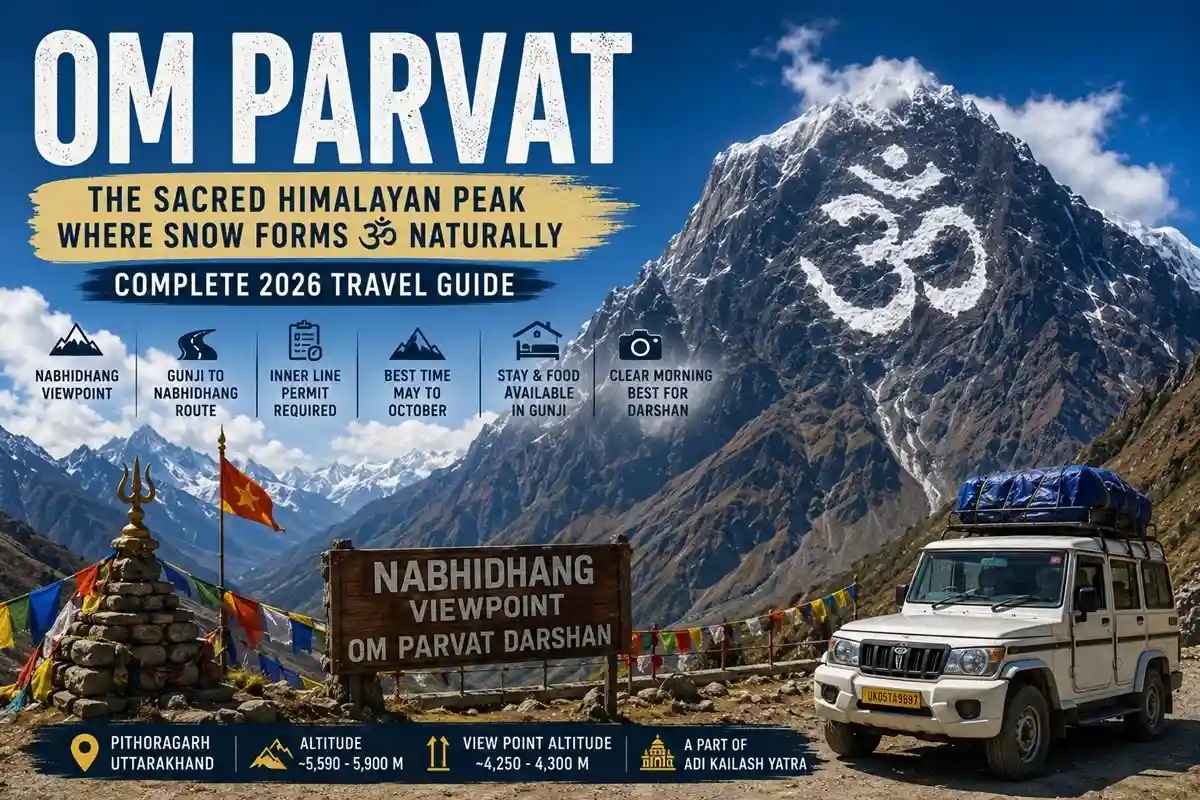
Om Parvat is one of the rarest sights in the Kumaon Himalaya — a peak in Pithoragarh, Uttarakhand, where snow settles naturally on dark rock in the shape of the sacred syllable ॐ. No carving, no human hand — just wind, snowfall, and geology repeating the snow formation every season.
The mountain stands near the Lipulekh Pass corridor on the Adi Kailash Yatra route, close to the India–Nepal–Tibet trijunction. No trekking is required — the darshan point at Nabhidhang is reachable by road, making this sacred peak accessible even to elderly devotees.
Quick Overview:
- Location: Nabhidhang, 20–25 km from Gunji.
- Elevation: Approx. 5,590–5,900 m.
- Best Time: May–October, early mornings.
- Highlight: Natural ॐ-shaped snow formation.
- Permit: Inner Line Permit (ILP) required.
Why the ॐ Mountain Is Sacred
In Hindu tradition, ॐ is the primordial sound of creation — so a sacred Himalayan peak displaying it naturally is deeply auspicious. Per local belief, this is where Lord Shiva revealed the secret of the universe to Goddess Parvati.
The peak sits in the Vyas Valley, named after Sage Ved Vyas. On the same road lie Ved Vyas Gufa — where, per local tradition, the sage composed parts of the Mahabharata — and the Kali temple at Kalapani, traditionally regarded as the origin of the Kali River. For many pilgrims, this peak and Adi Kailash together are the closest alternative to the Kailash Mansarovar Yatra, entirely within India.
How to Reach Om Parvat: Nabhidhang Route Details
Nearest railhead: Kathgodam/Tanakpur. Most reliable airport: Pantnagar (Pithoragarh’s airstrip has irregular connectivity). Travellers from South or West India should fly to Delhi first.
- Overnight Ranikhet Express or bus from Delhi to Kathgodam.
- Drive 10–12 hours to Dharchula via Almora and Pithoragarh.
- Complete ILP formalities at SDM Dharchula.
- Drive Dharchula → Tawaghat → Budhi → Gunji; acclimatise.
- Gunji is the fork: left branch to Jolingkong (Adi Kailash), right branch to Kalapani → Nabhidhang for the darshan.
- Only a 100–200 m walk is needed at the viewpoint itself.
Distance Chart (Approximate)
| Stretch | Distance | Mode |
| Delhi → Kathgodam | ~300 km | Train/bus |
| Kathgodam → Dharchula | ~292 km (via Pithoragarh) | Road, 10–12 hrs |
| Dharchula → Gunji | 80–95 km (varies by alignment) | Off-road 4×4 |
| Gunji → Kalapani | ~20 km | Off-road 4×4 |
| Kalapani → Nabhidhang | 2–5 km | Off-road 4×4 |
| Nabhidhang → viewpoint | 100–200 m | On foot |
The Dharchula–Gunji stretch is a rough, landslide-prone track maintained by the Border Roads Organisation (BRO). Vehicle rules beyond Dharchula are restricted — most pilgrims use registered 4×4s arranged through operators or KMVN; confirm current rules.
- Also Reads on: Adi Kailash Yatra 2026 Planning Guide
Best Time to See the ॐ Symbol
The best time is mid-May to June and September to mid-October, on clear mornings.
- May–June: Peak season; leftover snow makes the ॐ pattern bold and unmistakable.
- July–August: Avoid — monsoon landslides block roads and clouds hide the face for days.
- September–mid October: Crisp visibility; the symbol may look thinner after low snowfall.
Important: the pattern is seasonal. In August 2023, national media widely reported the snow briefly vanished from the face — a first in local memory — before fresh snowfall restored it. Plan for snow-plus-clear-sky conditions, not just open roads.
Weather at Nabhidhang
Expect cold days and sub-zero nights even in summer. Mornings are the most stable window — by afternoon clouds usually build up and hide the peak. That is why guides leave Gunji early; morning darshan is not a preference here, it is the strategy.
Permit Process: Adi Kailash Yatra Registration
The peak lies in a restricted Indo-Tibet border zone, so an Inner Line Permit (ILP) is mandatory.
- Issued at the SDM Office, Dharchula; some online pre-processing exists, but physical verification at Dharchula is still required
- Documents: Aadhaar or valid photo ID, passport photos, medical fitness certificate, recent police verification
- Cost: The government ILP fee is nominal; total paperwork (medical, photos, operator assistance) typically adds up to ₹1,500–2,500
- Eligibility: Permits are currently issued to Indian citizens only; foreigners, NRIs, and OCI holders are not permitted under present district guidelines. Age and fitness criteria also follow current administration rules.
- ITBP verifies permits at the Gunji checkpoint; the SDM office is closed on Sundays and national holidays
Most pilgrims combine this darshan with Adi Kailash on one permit, on separate days from a Gunji base.
Accommodation, Transport and Budget
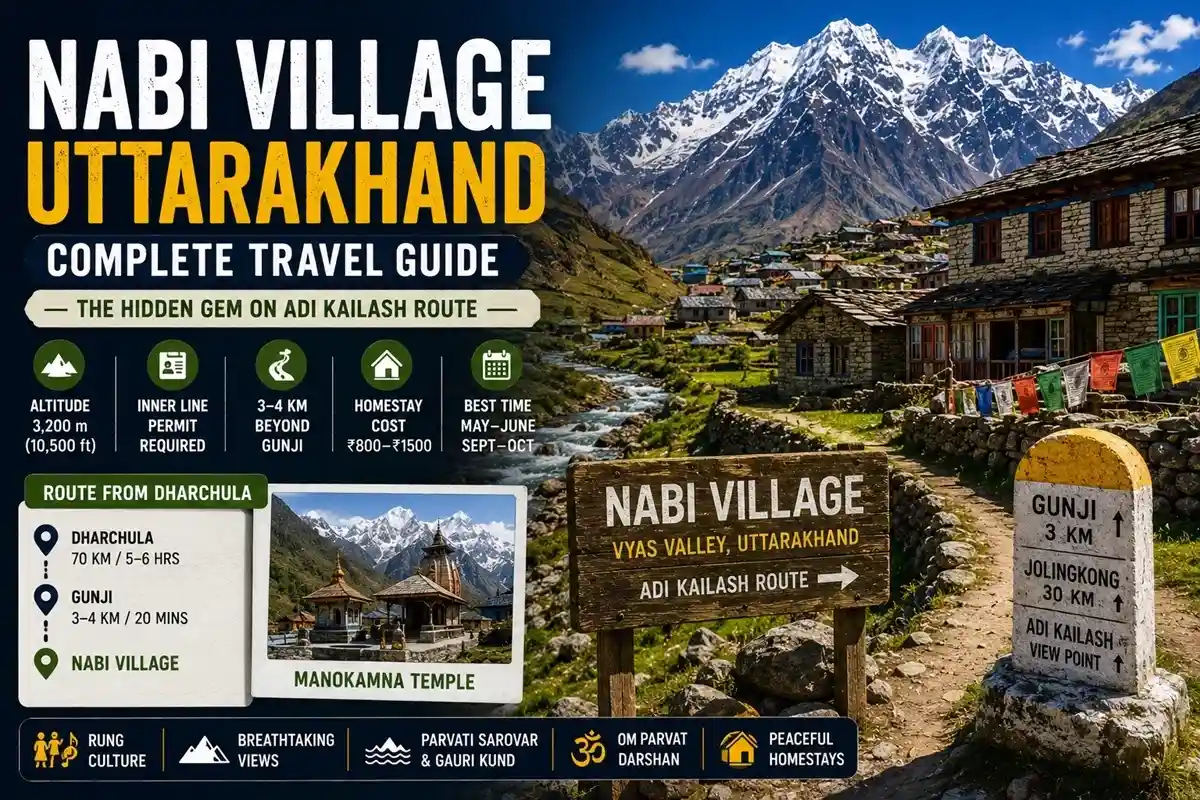
Stay in Dharchula hotels or the KMVN rest house (₹800–2,500/night), and in homestays or KMVN huts at Gunji, Nabi, or Kuti (₹500–1,500/night). Nabhidhang has only limited seasonal camps — most groups return to Gunji the same day.
Approximate per-person budget from Kathgodam (varies by operator): combined package ₹25,000–40,000 for 7–8 days, paperwork ₹1,500–2,500, plus a ₹3,000–5,000 weather buffer. Keep one spare day — cloud cover can wipe out a darshan morning entirely.
Health, Altitude Sickness and Emergency Support
Nabhidhang sits above 4,000 m, where oxygen is far thinner than the plains. Watch for AMS symptoms — headache, nausea, dizziness, breathlessness at rest — and descend immediately if they worsen.
The nearest hospitals are at Dharchula and Pithoragarh; beyond Gunji only basic ITBP/army first aid exists, with evacuation by road or helicopter. Acclimatise at Gunji, hydrate constantly, and ask your doctor about Diamox.
Connectivity, Fuel and Facilities
- Network: Connectivity is limited and changes every season — patchy at Gunji, near-blackout beyond. Never rely on it for emergencies.
- Fuel & cash: Last reliable petrol pump and ATMs are at Dharchula.
- Electricity: Limited beyond Gunji; carry a power bank.
- Food/water: Simple vegetarian meals at homestays; carry dry fruits and a 2-litre bottle.
- Photography: Sunrise to ~10 AM light is best; never photograph army/ITBP posts, and drones need prior permission in this border zone.
Packing List
Layered woollens, down jacket, thermals, waterproof shoes, sunglasses, SPF 50 sunscreen, gloves, cap, medicines, ORS, dry fruits, power bank, binoculars or a zoom lens, cash, and three photocopies of your ILP in a ziplock bag.
Senior Citizens and Family Tips
This is the most senior-friendly darshan in the region — the viewpoint is motorable, with barely 100–200 m of walking. Even so, anyone with uncontrolled BP, cardiac, or respiratory issues needs honest medical clearance, plus two acclimatisation nights at Gunji. Carry your ILP always — it is checked at multiple posts.
Sample Itinerary from Delhi (7–8 Days)
- Day 1: Delhi → Kathgodam (overnight train/bus)
- Day 2: Kathgodam → Dharchula; permit paperwork
- Day 3: Dharchula → Gunji; acclimatise
- Day 4: Gunji → Jolingkong → Adi Kailash darshan
- Day 5: Gunji → Kalapani → Nabhidhang darshan
- Day 6–7: Return via Dharchula and Kathgodam
- Keep Day 8 spare for weather.
Om Parvat vs Adi Kailash: What Is the Difference?
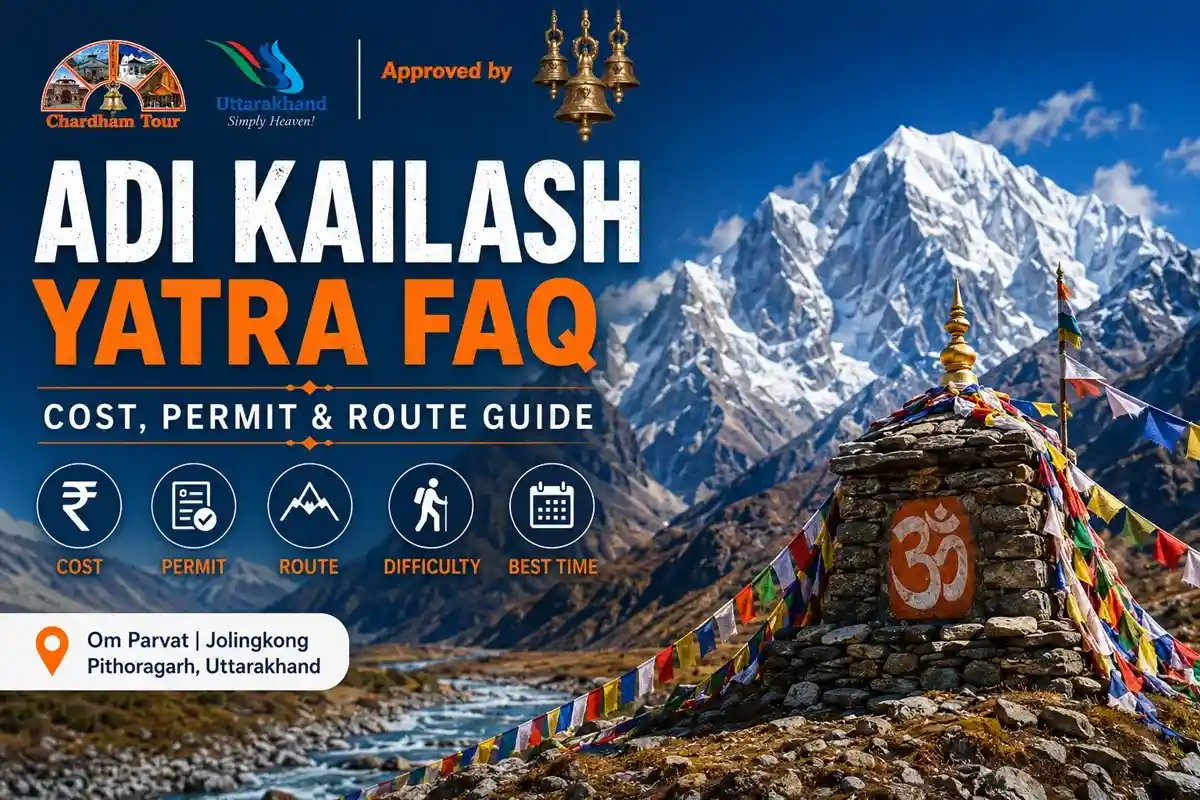
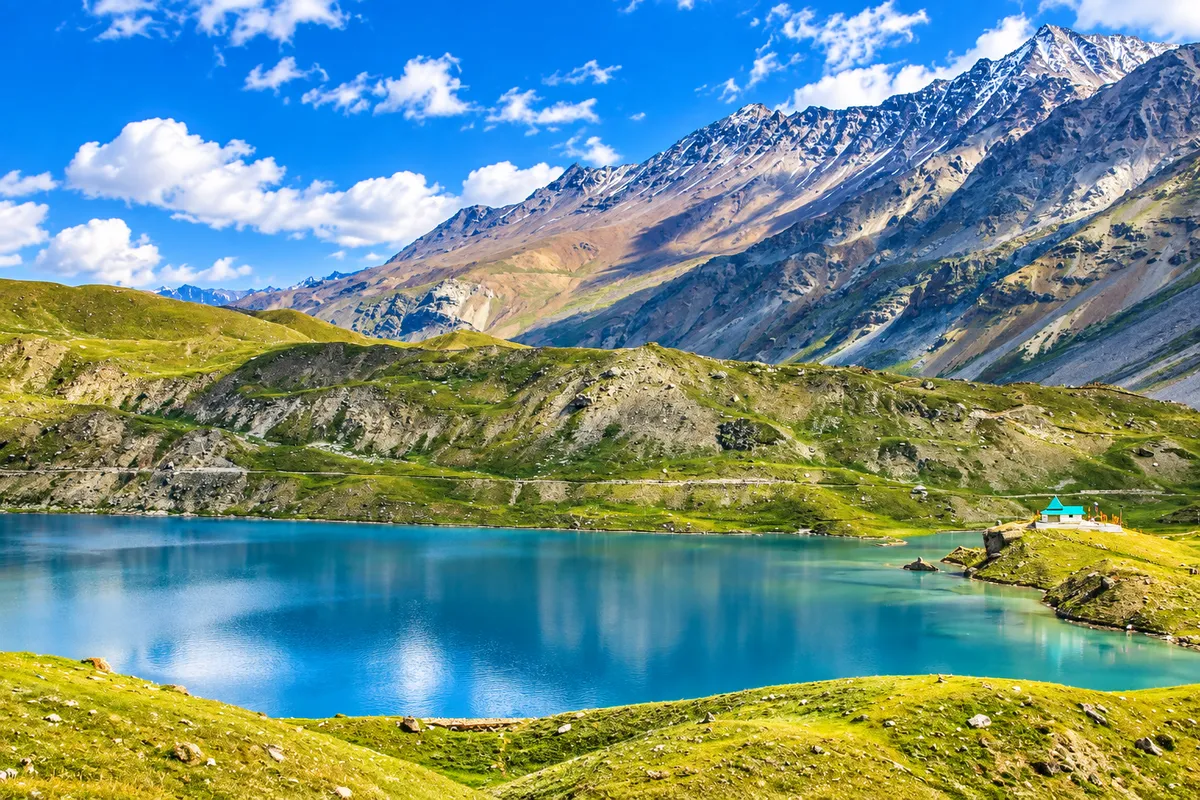
Adi Kailash (Chota Kailash) is revered as Shiva’s abode, reached via Jolingkong with a short walk to Parvati Sarovar and Gauri Kund. The ॐ peak needs no walking at all — its darshan happens from the roadside viewpoint at Nabhidhang. Most pilgrims do both from a Gunji base on separate mornings.
Mount Kailash Darshan from Old Lipulekh
Since late 2023, the Uttarakhand administration and KMVN have promoted distant Mount Kailash (Tibet) darshan from the Old Lipulekh peak area near this route — permission-dependent, not a permanent activity. Ask your operator if it is running this season.
Latest Updates 2026
- Local operators report the 2026 season opened in early May after BRO snow clearance — verify against the official district notification before booking.
- BRO continues to improve the Dharchula–Lipulekh corridor, shortening what was once a multi-day trek.
- Operators report smoother permit pre-processing, though final verification remains at Dharchula — confirm current rules with the district administration.
Planning the circuit? See our guides on Gauri Kund Adi Kailash, the Adi Kailash Yatra route, Kalapani and Ved Vyas Gufa, Gunji village stay, and the Inner Line Permit process.
FAQs
Q-1: Where is Om Parvat located?
In Pithoragarh district, Uttarakhand, near the Lipulekh Pass corridor close to the India–Nepal–Tibet trijunction.
Q-2: What is the altitude of Om Parvat and Nabhidhang?
The peak is approximately 5,590–5,900 m depending on the source; Nabhidhang sits at roughly 4,250–4,300 m.
Q-3: Is trekking required to see Om Parvat?
No — Nabhidhang is motorable from Gunji, with only a 100–200 m walk at the viewpoint.
Q-4: What is the best time to see the ॐ symbol?
Clear mornings from mid-May to June and September to mid-October.
Q-5: Why does the ॐ symbol appear, and is it always visible?
Snow settles naturally in ridges on the dark rock face — no carving involved — but it can fade in low-snow periods or hide behind afternoon cloud.
Q-6: Do I need a permit, and can foreigners visit?
An Inner Line Permit from SDM Dharchula is mandatory, and it is issued to Indian citizens only.
Q-7: How far is Nabhidhang from Gunji?
Roughly 20–25 km by off-road 4×4, via the Kali temple at Kalapani.
Q-8: Can Om Parvat and Adi Kailash be done together?
Yes — most itineraries cover both on separate days from a Gunji base within one permit.
Q-9: Is it suitable for senior citizens, and where do pilgrims stay?
Yes — the most accessible darshan in the region; stay in homestays or KMVN huts at Gunji, Nabi, or Kuti.
Q-10: How much does the trip cost?
Approximately ₹28,000–45,000 per person from Kathgodam (varies by operator), plus a weather buffer.
Q-11: How do I reach Om Parvat from Delhi?
Train or bus to Kathgodam, then road to Dharchula and Gunji — about 7–8 days round trip.
Q-12: What is the weather like in June and September?
Cold days and sub-zero nights in both; June has bolder snow, September has crisper visibility.
Q-13: Is altitude sickness a risk at Nabhidhang?
Yes — above 4,000 m AMS is real, so acclimatise at Gunji and descend if symptoms worsen.
Q-14: Is photography allowed at the viewpoint?
Yes, sunrise to about 10 AM gives the best light — but never photograph army/ITBP posts, and drones need permission.
Final Word
Om Parvat is that rare pilgrimage where nature does the preaching — a mountain writing ॐ in snow, year after year, at the edge of three nations. Best option: a 7–8 day circuit from Kathgodam in June or September, with darshan on a clear morning from Nabhidhang. Most important advice: sort the ILP and medical certificate first, leave Gunji early, keep a spare day for clouds. Ideal travellers: devotees, seniors who cannot trek, photographers, and Kailash Mansarovar seekers — this sacred Om mountain rewards them all.