
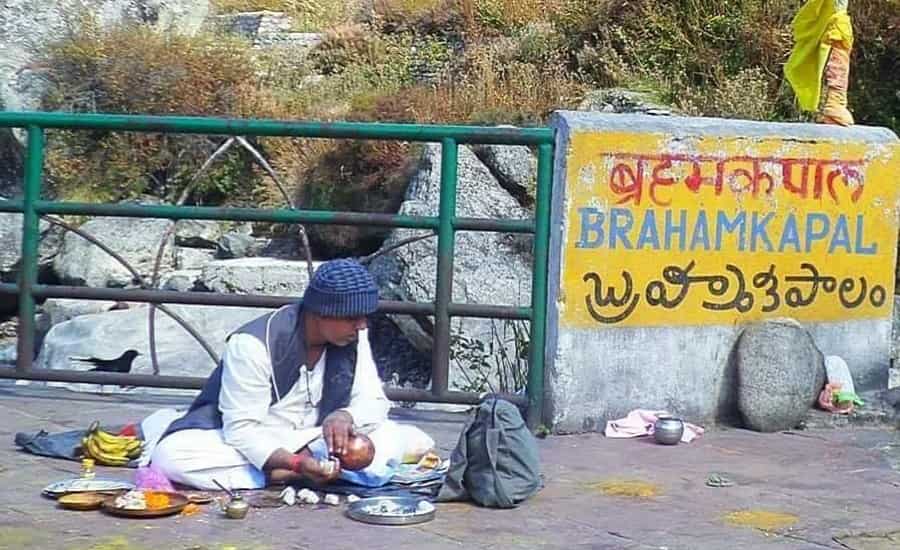
Brahma Kapal is a sacred flat rock platform (ghaat) on the left bank of the Alaknanda River within Badrinath Dham, Chamoli district, Uttarakhand, at approximately 3,100 metres above sea level.
It is one of the most revered Pind Daan sites in Hindu tradition — traditionally believed, according to Puranic scripture, to offer many times greater spiritual merit for ancestral rites than other sacred sites including Gaya (Bihar).
According to the Shiva Purana and Skanda Purana, this is the site where Lord Shiva was finally liberated from Brahmahatya (the gravest sin of slaying a Brahmin). Pilgrims perform Shradh, Pind Daan, and asthi visarjan here to seek moksha for their ancestors.
Where is Brahma Kapal Located?
Brahma Kapal is on the left bank of the Alaknanda River, approximately 200 metres from the main Badrinath Temple — a short walk along the riverbank through the temple complex.
It is not a separate enclosed temple but a wide natural stone platform (ghaat) at the river’s edge, sacred due to its role in Lord Shiva’s liberation from Brahmahatya. The Tapt Kund (ritual hot spring) and the main temple are both within a few minutes’ walk.
| Detail | Information |
| Location | Left bank, Alaknanda River, Badrinath Dham |
| Distance from Badrinath Temple | ~200 metres (2–3 minute walk) |
| Altitude | ~3,100 metres above sea level |
| District | Chamoli, Uttarakhand |
| Managing Authority | Badrinath-Kedarnath Temple Committee (BKTC) |
| Open Season | Late April/May to November (Badrinath Kapat season) |
| Closed Season | Mid-November to late April — Badrinath inaccessible in winter |
| River | Alaknanda — one of the major tributaries forming the Ganges |
| Coordinates (approx.) | 30.7433 N, 79.4928 E |
How to Reach Brahma Kapal from Badrinath Temple
From the Badrinath Temple entrance, walk left (north) along the Alaknanda riverbank path. The Brahma Kapal ghaat is clearly visible approximately 200 metres down the path. The route is flat and paved — accessible for most pilgrims.
From the bus stand or main market of Badrinath town, the walk is approximately 5–8 minutes. There are no vehicles required for this short distance.
Visitor Access and Practical Information
| Facility | Status at Brahma Kapal (2026) |
| Entry Fee | No entry fee. The ghaat is freely accessible during Kapat open season. |
| Parking | Parking available in Badrinath town (~200 m–400 m from the ghaat). No vehicle access directly to ghaat. |
| Washrooms | Basic facilities available near the Badrinath Temple complex. None directly at the ghaat. |
| Wheelchair Access | The route from the temple is relatively flat and paved, but the ghaat platform itself has uneven natural stone surfaces. Assistance recommended for elderly/mobility-impaired pilgrims. |
| Mobile Network | BSNL has the most reliable coverage in Badrinath. Jio and Airtel have limited signal. Do not rely on internet for navigation — download offline maps. |
| ATM | SBI ATM available near Badrinath Temple/market area. Carry adequate cash from Rishikesh or Haridwar as ATMs can run out in peak season. |
| Medical Help | Basic first aid at Badrinath. District hospital is in Chamoli (~90 km). For serious altitude-related emergencies: Army Base Hospital is the nearest facility. |
| Photography | Permitted in general areas. Avoid photographing ongoing rituals without permission — the ghaat is an active sacred space. |
| Best Time of Day | Early morning 6–9 AM recommended for quieter access and full priest availability. Afternoons (11 AM–2 PM) can be crowded during peak May–June season. |
The Complete Mythology of Brahma Kapal — Verified from Puranic Sources
The story behind Brahma Kapal is documented in the Shiva Purana and Skanda Purana. Below is the correct and complete account — with key corrections from inaccurate versions commonly found online.
The Five-Headed Brahma and the Sin of Brahmahatya
According to the Shiva Purana, Lord Brahma originally possessed five heads. In certain Puranic accounts, Brahma developed great arrogance, believing himself equal to or greater than Lord Shiva.
In some Puranic traditions, Brahma also acted with transgression toward Saraswati (referred to in some texts as Shatarupa) — though this detail is narrated differently across Puranic sources.
Correction: The original article on this page stated Brahma ‘approached his daughter Prithvi.’ Prithvi (the Earth goddess) has no role in this narrative. The correct name from Puranic sources is Saraswati or Shatarupa, depending on the tradition.
Enraged by Brahma’s arrogance and transgression, Lord Shiva severed Brahma’s fifth head. With four heads remaining, Brahma is depicted as we know him today in all traditional imagery.
The Brahmahatya Curse — The Skull That Would Not Leave
When Lord Shiva severed Brahma’s head, the skull (Kapala) attached itself to Shiva’s palm and could not be removed. This was divine punishment for Brahmahatya — the sin of slaying a Brahmin. Brahma, as the first and supreme Brahmin, made this the gravest possible form of this sin.
Lord Shiva then took the form of a wandering mendicant (Bhikshatana), roaming the three worlds for twelve years, carrying Brahma’s skull as a begging bowl. Wherever he sought alms, the food in the bowl burst into flames — the curse preventing him from receiving nourishment or liberation.
Correction: The original article stated Brahma’s head ‘got stuck in Shiva’s Trishul.’ The primary Puranic account (Shiva Purana) states it attached to Shiva’s palm/hand — forming a kapala (skull-bowl). This detail is central to the Kapalika tradition of Shaivism and was missing from the original content.
Liberation at Brahma Kapal
After twelve years of wandering and penance, Lord Shiva arrived at the banks of the Alaknanda River at what is now Brahma Kapal in Badrinath. Here, the skull finally fell from his palm and separated. The Brahmahatya was lifted. Lord Shiva was freed.
This spot — where Brahma’s Kapala fell — became Brahma Kapal: literally ‘the skull of Brahma.’ It is considered among the most powerful sites for releasing souls from karmic bondage, particularly Pitru Rin (ancestral debt).
The Pandavas at Brahma Kapal
After the Kurukshetra war, the Pandava brothers bore the sin of Gotra Hatya (killing kinsmen) and of slaying Brahmin-warriors including Dronacharya’s lineage. As instructed by Lord Krishna, they journeyed to Badrinath and performed Shradh and Pind Daan at Brahma Kapal for the souls of those killed in battle.
Correction: The original article described the Pandavas as having committed ‘Brahma Hatya.’ More accurately, their primary sin was Gotra Hatya (killing of kinsmen) combined with the killing of Brahmin warriors in battle — these are categorically different sins in Hindu tradition.
Mythological Significance: Connection to Creation
Some later Puranic traditions interpret Brahma Kapal’s significance as cosmic in scope — suggesting the liberation of Brahma’s skull here represented a point where even a primordial creator’s transgression was dissolved, allowing the universe’s karmic cycle to continue without an unresolved sin at its foundation.
Spiritual Significance of Brahma Kapal
Brahma Kapal is classified as a Mahatirtha in Puranic literature — a place of supreme pilgrimage significance. Its sanctity rests on three pillars:
- Pitru Moksha: Pind Daan here is traditionally believed to grant ancestral liberation across multiple generations, according to the Puranic tradition associated with this site.
- Brahmahatya Mukti Precedent: The site where even the gravest sin in Hindu scripture was lifted from Lord Shiva — establishing a sacred precedent for karmic liberation.
- Comparative Merit: According to Puranic tradition, the spiritual merit of Pind Daan at Brahma Kapal is traditionally described as far exceeding that of the same ritual at Gaya — Hinduism’s most established Pind Daan centre.
Scriptural Sources: The significance of Brahma Kapal is documented in: (1) Shiva Purana — Kotirudra Samhita, (2) Skanda Purana — Badari Mahatmya section, and (3) regional Badrinath Mahatmya texts. It is described in Puranic literature, not in the four Vedas.
How to Perform Pind Daan at Brahma Kapal — Step-by-Step Guide
Pind Daan involves offering rice-sesame balls (pindas) with water to the souls of departed ancestors. The ritual is conducted by a registered hereditary purohit and takes 1–2 hours for a standard ceremony.
Step 1 — Register with a Purohit (Priest)
Hereditary purohits registered with the BKTC (Badrinath-Kedarnath Temple Committee) are present at the Brahma Kapal ghaat throughout the open season. Many of these priests maintain family bahis (ancestral registers) with records of pilgrims’ family lines spanning generations.
Note: Not every purohit maintains family bahis — this is specific to hereditary panda families. You can approach any registered purohit for a first visit and establish a family connection for future visits.
Step 2 — Items Required
| Ritual Item | Purpose |
| Cooked rice or rice flour | Primary material for forming pindas (rice balls) |
| Black sesame seeds (til) | Mixed into pindas; essential for ancestral rites |
| Kusha grass | Sacred grass used in ritual setup and offerings |
| Sacred thread (janeyu) | Worn by the male participant during the ritual |
| Flowers, tulsi leaves | Offered alongside the pindas to ancestors |
| Alaknanda River water | Used for tarpan (water offering) throughout the ritual |
| Ashes/relics for asthi visarjan | Only if performing ashes immersion; bring in a sealed container |
Step 3 — Ritual Procedure
- Take a ritual bath (snan) in the Tapt Kund hot spring near the temple before proceeding to Brahma Kapal.
- Reach the Brahma Kapal ghaat and approach a registered purohit. Provide your gotra, the names of departed ancestors, and your own details.
- The purohit performs the Sankalpa — a formal declaration of the ritual’s purpose, your family lineage, and the souls for whom the Pind Daan is offered.
- Pindas (rice-sesame balls) are shaped and offered alongside water tarpan, with mantras recited for each ancestor separately.
- The pindas are immersed in the Alaknanda River as the final offering to the ancestors.
- If performing asthi visarjan, this follows immediately after Pind Daan in the same river.
- The purohit concludes with blessings and may record your details in the family bahi.
Duration and Cost
Standard Pind Daan: 1–2 hours. Extended Shradh with full mantra recitation takes longer.
Cost is mutually agreed with the purohit — no fixed government rate exists. It varies by ritual scope, number of ancestors included, and the priest. Cash is recommended as connectivity at the ghaat can make digital transactions unreliable even where UPI is accepted.
Best Time: Arrive early morning (6–9 AM recommended). The ghaat is quieter, priests are fully available, and weather is most stable. This is a recommendation, not a mandatory timing.
Can Daughters Perform Pind Daan at Brahma Kapal?
Yes. Daughters can perform all ancestral rites — Pind Daan, Shradh, and asthi visarjan — at Brahma Kapal. There is no gender restriction at this site.
Multiple purohits at Brahma Kapal confirm this in practice. The scriptural principle is that any child — son or daughter — holds the right to perform ancestral rites. Some priests cite the concept that ‘Putra’ in classical Sanskrit applies to offspring of both genders in the context of filial duty.
Widows, unmarried women, and women of all ages have performed these rituals here. If you encounter any priest who denies this right, seek another registered purohit — the scriptural tradition supports daughters’ participation in ancestral rites.
Asthi Visarjan at Brahma Kapal
Brahma Kapal is one of the most sacred sites in Uttarakhand for asthi visarjan — the immersion of a deceased person’s ashes and bone fragments in the river.
The practice is traditionally believed to help release the soul from earthly attachment and support its journey toward liberation. Bring ashes in a sealed, clean container. Your purohit will perform the immersion with the appropriate mantras, managing the process safely given the river current.
Season Only: Asthi visarjan at Brahma Kapal is only possible during the Badrinath open season — late April/May to mid-November. The site is inaccessible in winter.
When is Brahma Kapal Open? — Season and Timings 2026
| Period | Status | Notes |
| Late April to June | Open — Peak Season | Badrinath Kapat opens; maximum pilgrims; all purohits present |
| July to August | Open — Monsoon | Accessible but weather risky; some road disruptions possible |
| September to October | Open — Ideal Season | Best months; clear weather, fewer crowds, full ritual access |
| November (till Kapat closing) | Open — Last Window | Kapat closes mid-November; last opportunity for the year |
| Mid-November to late April | Closed | Badrinath inaccessible in winter; Brahma Kapal Pind Daan not possible |
The Badrinath Kapat opening date for 2026 is announced on Basant Panchami each year by the Rawat family (temple’s hereditary priests). Always verify the confirmed date through the official BKTC website or a reliable news source before planning your trip.
Registration Required: All Badrinath Dham visitors require Chardham Yatra biometric registration. Verify the latest registration requirements at registrationandtouristcare.uk.gov.in before travel — rules are reviewed annually.
Brahma Kapal vs Gaya — Which Should You Choose for Pind Daan?
| Factor | Brahma Kapal (Badrinath) | Gaya (Bihar) |
| Puranic Tradition | Site of Lord Shiva’s liberation from Brahmahatya; documented in Shiva Purana and Skanda Purana | Where Lord Vishnu’s footprint (Vishnupad) resides; documented in Garuda Purana, Vayu Purana |
| Traditional Merit | Puranic tradition describes exceptional merit for ancestral rites here | The established standard benchmark for Pind Daan in Hindu tradition |
| Altitude / Access | ~3,100 m; open only May–November; requires Chardham Yatra planning | Year-round accessible; easier for elderly and mobility-impaired pilgrims |
| Ritual Options | Pind Daan, Shradh, asthi visarjan in Alaknanda River | Multiple ghats, extended ritual options, many priests |
| Best Suited For | Pilgrims combining with Chardham Yatra; Lord Shiva devotees | Standalone pitru rites; those unable to do high-altitude travel |
The traditional merit comparison is a Puranic belief, not a measurable quantity. Both sites are deeply valid for ancestral rites. The right choice depends on your travel capacity, the tradition of your family, and whether you are already visiting Badrinath.
Things to Avoid During Pind Daan at Brahma Kapal
- Do not perform the ritual without a registered BKTC purohit — self-conducted rites without a qualified priest are not traditionally valid and may lead to ritual errors.
- Do not wear leather footwear on the ghaat platform — remove shoes before stepping onto the sacred stone.
- Do not skip the pre-ritual Tapt Kund bath — this ritual purification is considered part of the rite, not optional.
- Do not photograph other pilgrims’ rituals without explicit permission — this is an active sacred space, not a photography site.
- Do not rush the ritual — attempting to complete Pind Daan in under 30 minutes is not appropriate. Plan 1–2 hours minimum.
- Do not arrive without your ancestors’ names and family gotra — the sankalpa requires this information and cannot proceed without it.
- Do not rely on digital payments alone — connectivity at the ghaat can be unreliable. Carry adequate cash.
Nearby Sites to Visit with Brahma Kapal
| Site | Distance | Significance |
| Badrinath Temple | ~200 m | Primary Chardham shrine; Lord Vishnu as Badrinarayan |
| Tapt Kund | ~100 m | Sacred hot spring; ritual bath before Pind Daan |
| Narad Kund | ~300 m | Where Narad Muni meditated; cool water spring |
| Mana Village | ~3 km | Last Indian village; Vyas Cave, Bheem Pul, Saraswati River |
| Vasudhara Falls | ~5 km | Himalayan waterfall; sacred in Vaishnava tradition |
| Charanpaduka | ~2 km | Rock with Lord Vishnu’s footprint impression |
| Satopanth Lake | ~24 km trek | Sacred triangular lake; associated with the Trimurti |
Practical Tips
- Carry cash — purohit fees and ritual materials. Cash is recommended because network connectivity for digital payments can be unreliable at the ghaat even where UPI is technically accepted.
- Verify Chardham Yatra registration — required for all Badrinath Dham visitors. Check the latest rules at registrationandtouristcare.uk.gov.in before travel, as requirements are reviewed annually.
- Dress traditionally — modest, religious attire is expected. Remove footwear before the ghaat platform.
- Carry ancestors’ names and gotra — written on paper before travel. Inform your purohit if you do not know your gotra.
- For asthi visarjan — bring ashes in a sealed container. Your purohit manages the immersion safely.
- Acclimatise first — Brahma Kapal is at ~3,100 m. Rest for one day in Badrinath or Joshimath before attempting rituals if coming from the plains. AMS (altitude sickness) affects concentration.
- Arrive early morning (6–9 AM) — quieter, better priest availability, more stable weather.
- Keep emergency numbers saved — Police: 112 | Ambulance: 108 | SDRF Disaster: 1070.
Frequently Asked Questions
Q1. What is Brahma Kapal and why is it sacred?
Brahma Kapal is the sacred ghaat in Badrinath Dham where, according to the Shiva Purana and Skanda Purana, Lord Shiva was liberated from Brahmahatya after twelve years of wandering. It is one of the most revered ancestral rites sites in Hindu tradition — performing Pind Daan here is believed to offer exceptional merit for the liberation of ancestors.
Q2. When is Brahma Kapal open in 2026?
Brahma Kapal is accessible only during the Badrinath Kapat open season — approximately late April/May to mid-November. The exact 2026 Kapat opening date is announced on Basant Panchami (January/February). Verify the confirmed date via the BKTC website or official news before planning.
Q3. How to perform Pind Daan at Brahma Kapal?
Take a ritual bath at Tapt Kund, then proceed to the ghaat and approach a registered purohit. The priest performs sankalpa, pinda preparation and offering with rice-sesame and tarpan (water offering), with mantras for each ancestor. The ritual takes 1–2 hours.
Q4. What is the cost of Pind Daan at Brahma Kapal?
No fixed government rate exists. Costs are agreed with the purohit and typically range from Rs 500 to Rs 5,000 or more depending on ritual scope and number of ancestors. Carry cash — connectivity for digital payments can be unreliable at the ghaat.
Q5. Can Pind Daan be done online or by proxy at Brahma Kapal?
The BKTC does not currently advertise an official online or proxy Pind Daan service for Brahma Kapal. Some private operators claim to offer this — these are not officially recognised by the temple committee. Personal presence or sending a trusted family member is the established and authentic approach.
Q6. Is Brahma Kapal better than Gaya for Pind Daan?
Puranic tradition holds Brahma Kapal in very high regard for ancestral rites. Gaya is the established gold standard, accessible year-round with extensive ritual facilities. If you are already visiting Badrinath, Brahma Kapal is the ideal choice. For a standalone pitru rites trip, Gaya may be more practical for most pilgrims.
Q7. Can I perform asthi visarjan at Brahma Kapal?
Yes. Asthi visarjan in the Alaknanda River at Brahma Kapal is a common and sacred practice. Bring ashes in a sealed container. Your purohit will conduct the immersion with appropriate mantras. It is performed only during the open season (May–November).
Q8. Why did Lord Shiva cut off Brahma’s head?
According to the Shiva Purana, Brahma developed extreme arrogance and transgression. Lord Shiva severed Brahma’s fifth head in response. Brahma originally had five heads — all traditional depictions show him with four heads after this event. The severed skull attached to Shiva’s palm, beginning the Brahmahatya curse.
Q9. Is the Brahma Kapal story in the Vedas or Puranas?
The specific narrative is in the Puranas — primarily the Shiva Purana (Kotirudra Samhita) and Skanda Purana (Badari Mahatmya section). The four Vedas do not contain specific pilgrimage site narratives. Puranic literature is the scriptural authority for Brahma Kapal’s significance.
Q10. Can Pind Daan be done in winter at Brahma Kapal?
No. Brahma Kapal is inaccessible from mid-November to late April when Badrinath Dham is closed for winter. Pind Daan at Brahma Kapal cannot be performed outside the open season.
Q11. How far is Brahma Kapal from Badrinath Temple?
Approximately 200 metres — a 2–3 minute flat walk along the Alaknanda riverbank from the temple entrance. No vehicle required. The path is accessible for most pilgrims including elderly, though the ghaat surface has some uneven stone.
Q12. What documents and details should I carry?
Carry: (1) names of all departed ancestors for whom Pind Daan is sought, (2) your family gotra (lineage name), (3) your Aadhaar or government ID, (4) Chardham Yatra registration proof. If you do not know your gotra, inform the purohit — a general gotra can be used.
Q13. Is Chardham Yatra registration required for Brahma Kapal?
Yes. All Badrinath Dham visitors require Chardham Yatra biometric registration. This applies to those coming specifically for Brahma Kapal rituals as well. Verify the latest requirements at registrationandtouristcare.uk.gov.in before travel — rules may be updated.
Q14. Can women who are widowed or unmarried perform the rituals?
Yes. Widows, unmarried women, and women in all life circumstances can perform Pind Daan and Shradh at Brahma Kapal. There are no restrictions based on marital status. If you encounter resistance from any individual priest, seek another registered purohit.
Q15. What is the best time of day to visit?
Early morning — 6 to 9 AM — is recommended for quieter access, better priest availability, and more stable weather. This is a practical recommendation based on crowd patterns and weather at Badrinath, not a ritual requirement.
Q16. Can foreigners visit Brahma Kapal?
Foreign nationals can visit Badrinath and Brahma Kapal. However, the area near the Tibet border (including Mana Village, 3 km away) requires an Inner Line Permit for some nationalities. Check current permit requirements with the Uttarakhand government or your nearest Indian consulate before travel.
Q17. What should I avoid during the Pind Daan ritual?
Do not wear leather on the ghaat. Do not skip the pre-ritual Tapt Kund bath. Do not rush the ceremony. Do not photograph other pilgrims’ rituals without permission. Do not arrive without ancestors’ names and your gotra. Allow 1–2 hours minimum for the ritual.
- Want to perform Pind Daan at Brahma Kapal? Book a Badrinath Yatra Package
20 thoughts on “Brahma Kapal…Lord Shiva’s Freedom from Sin of Brahma’s Killing”



It’s a beautiful place, I visited n did Pindpradhan for our ancestors who died here, very happy to learn they all would have attended moksha peacefully.
Do they allow daughter to perform the rituals
Certainly, daughters can perform pinddan and shradha and all other rituals. In Atarveda its clearly mentioned that Putra also denotes Daughter.
होली के बाद चैत्र मास प्रारंभ मे पितृमोझ के लिए पिंड दान कर सकते है क्या
Pls send priest contact number
Verygood story will you give Head priests contact no
Hari Sati Brahmkapal Mahatirth Purohit- 95*****10
Pandit ji aap ka contact number mil saka hai kya and Bramha Kapal ke liye bhi contact number
Please share your contact no
941****886
sir
may I know any online services provided for those tho cannot personally visit this place to offer parental rituals and whether it can be done on their behalf in absentia and if so pleae provide me full details for which act of kindness i shall be ever grateful to you sir
regards
and respects
Plsend stand stpry oq Badri nathji and Shri Badrinath ji
Can I do pind daan and asthi visarjan InFebruary or do I have to wait till the badri kapat opens.
Please help me with the query
In badri vishu bhagwan upper body part is there and in haridwar feets of vishnu bhagwan. So u can pray on both places
The idol of Lord Badarinathji is made of black stone- Shaligram seated in padmashan posture .
Its not possible to offer pindas during the winter months wef form Nov 15 until May each year.
1. Should i do seperate shraddhafor my Father, Both elder and Younger Brother, each day or do Father along with other ancestors.
2. Should i do same as above at Gaya also or not Required.
3. Pl provide phone number of purohit
Should i do seperate shraddhafor my Father, Both elder and Younger Brother, each day or do Father along with other ancestors.
2. Should i do same as above at Gaya also or not Required.
3. Pl provide phone number of purohit
Bhai ji namaskar, I need the contact number of a priest at brahmkapal for pind Daan. I will be there in May. I can do booking and get an idea about cost as well.
kya mujhe brahamkapaal mai pinddaan ke liye kisi registered pujaari ji ka number mil jayegaa jisse mai is kaarya ke baare mai jaankaari le saktaa hooin