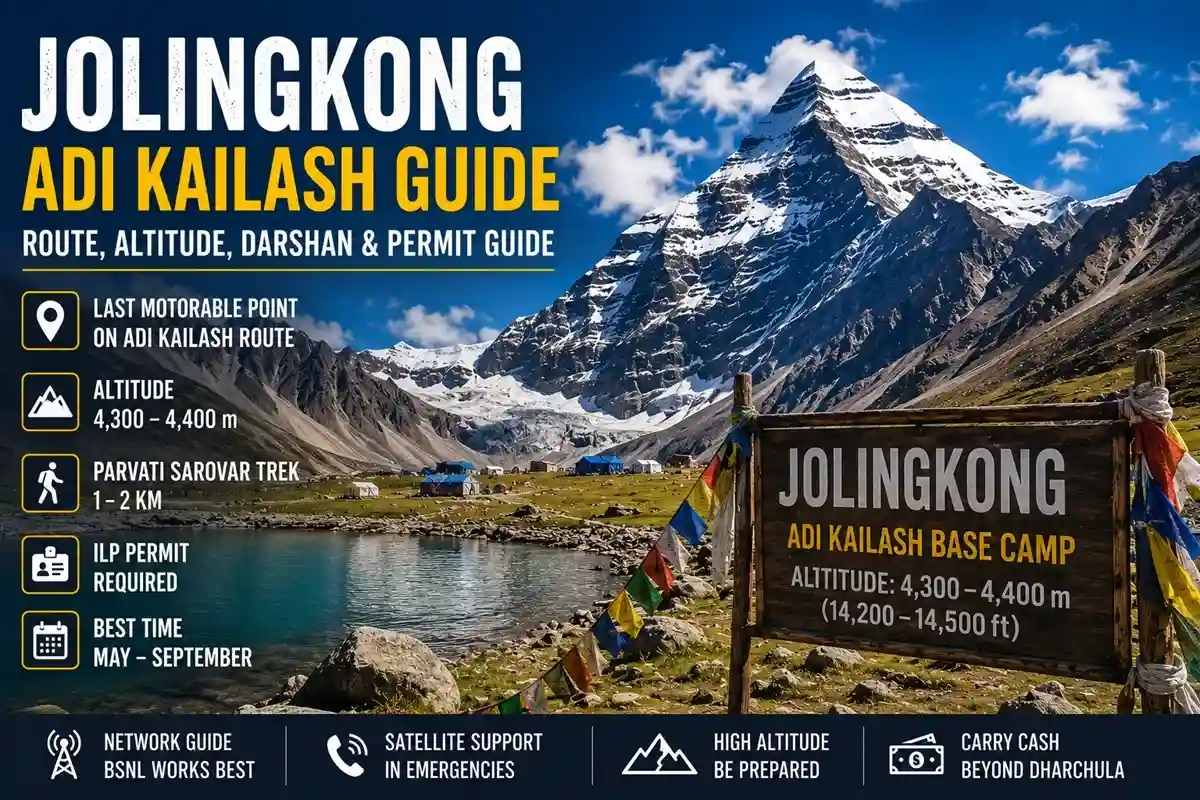
Jolingkong is generally regarded as the last motorable point on the Jolingkong Adi Kailash route — a high-altitude meadow in Pithoragarh district where pilgrims get their first full view of Adi Kailash and stand beside the sacred Parvati Sarovar. It’s not a town or village, but a remote campsite in the Kuthi Yankti Valley, close to the India–Tibet border. For most pilgrims, this is the emotional high point of the yatra — everything before it is travel, and everything here is arrival.
Facts
- Location: Jolingkong, Pithoragarh district
- Altitude: 4,300–4,400 m (14,200–14,500 ft)
- Distance: 30–35 km from Gunji via Kuti village
- Trek: 1–2 km to Parvati Sarovar; 2–3 km further to Gauri Kund
- Highlights: Seasonal Shiva-Parvati Temple with Adi Kailash directly ahead
What Is Jolingkong (Also Spelled Jyolingkong)?
Jolingkong, sometimes written as Jyolingkong, is the vehicle drop-off point and base camp for Adi Kailash darshan. Vehicles cannot go much further — the final stretch to the sacred sites is on foot or by hired mule. It’s not infrastructure that makes it special; there’s barely any. It’s the setting — a wide alpine meadow with Adi Kailash’s pyramid-shaped face filling the sky, and the glacial Parvati Sarovar resting below it. Most pilgrims arrive early morning from Gunji, since cloud cover usually builds up by late morning and can hide the peak.
Jolingkong Altitude vs Other Points on the Route
| Location | Approx. Elevation |
| Gunji | ~3,200 m (10,500 ft) |
| Kuti village | ~3,900 m (12,800 ft) |
| Jolingkong (Adi Kailash base camp) | ~4,300–4,400 m (14,200–14,500 ft) |
| Parvati Sarovar | ~4,500–4,600 m (approx.) |
| Adi Kailash Peak | 5,945 m (19,505 ft) |
How to Reach Jolingkong From Dharchula
The route runs through remote, restricted terrain, following the Kali River and the Kuthi Yankti Valley along the international border.
Route: Delhi → Kathgodam/Pithoragarh → Dharchula → Gunji → Kuti → Jolingkong
| Segment | Approx. Distance | Road Type |
| Dharchula to Gunji | ~80–90 km | BRO mountain road |
| Gunji to Kuti village | ~18–20 km | Narrow, partly unpaved |
| Kuti to Jolingkong | ~17 km | Rugged, 4×4 needed |
| Jolingkong to Parvati Sarovar | ~1–2 km | Foot trail |
| Jolingkong to Gauri Kund | ~2–3 km further | Steeper foot trail |
Nearest airport: Pantnagar. Nearest railhead: Kathgodam. Road conditions near Kuti are the least predictable stretch — narrow, gravelly, and landslide-prone after rain. A Bolero or Scorpio-type 4×4 is recommended over a sedan.
Parvati Sarovar, Gauri Kund, and the Temple
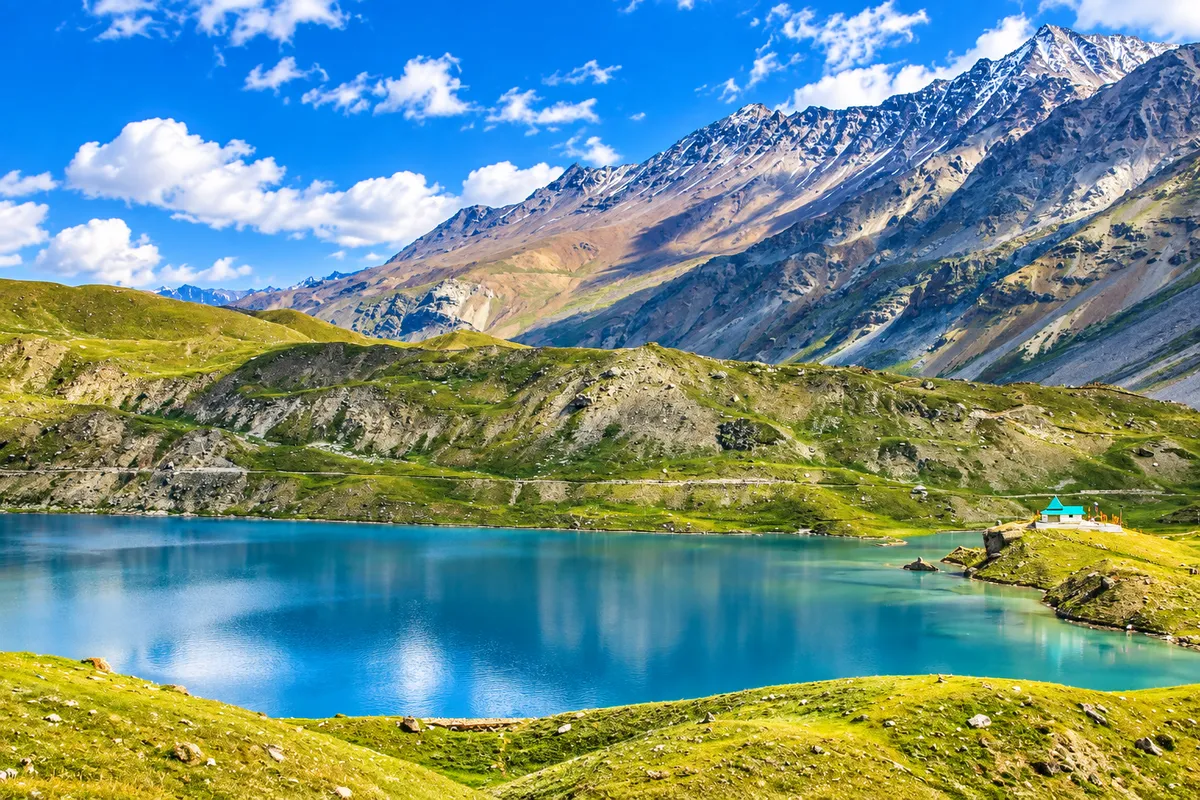
Parvati Sarovar is the glacial lake closest to Jolingkong, roughly a 1–2 km walk away, though some sources use “Jolingkong Lake” for this same system. It’s regarded as one of the most sacred lakes in the Kumaon Himalayas for its direct link to Adi Kailash. Many devotees take a ritual dip here; bathing at Gauri Kund is not permitted, out of respect for its sanctity.
A short uphill walk brings you to a Shiva-Parvati temple, open only during the yatra season (roughly June to September). Gauri Kund lies a further 2–3 km ahead and slightly higher — the tougher of the two walks, so pilgrims with limited stamina often skip it.
Many regard Jolingkong as spiritually equivalent to Mount Kailash for those unable to undertake the Tibet yatra — part of why it draws devoted pilgrims despite the terrain.
Weather at Jolingkong
Weather here swings sharply between day and night, even in peak season:
- May–June: Stable pre-monsoon, generally the clearest window, 10–15°C days with near-freezing nights
- July–August: Monsoon season — frequent clouds, showers, and landslide risk, though occasional clear spells happen
- September: Usually the most reliable post-monsoon window, crisp skies and thinner crowds
Morning darshan is better in any month, since Jolingkong’s clear-weather window typically closes by 11 AM to noon.
Registration and Permit Process for Jolingkong
Jolingkong falls inside a restricted border zone, and an Inner Line Permit (ILP) is mandatory beyond Dharchula, issued only to Indian citizens. The current process needs physical verification at the SDM office, Dharchula, rather than a fully online application.
Documents typically required: valid ID (Aadhaar/passport/voter ID), a passport photo, a medical fitness certificate from a registered practitioner, and a filled permit form. Processing can take a few hours depending on ITBP clearance. Age eligibility varies by operator — confirm with yours rather than assuming a fixed age limit. See our dedicated Adi Kailash Yatra permit guide for the full checklist.
Altitude and Health Precautions
Jolingkong’s altitude puts every visitor at real risk of Acute Mountain Sickness (AMS), and in rare cases HAPE or HACE. This is not a place to push through discomfort.
Many first-time pilgrims treat the Gunji-to-Jolingkong day like routine sightseeing, when it’s actually the highest, most demanding point of the yatra.
- Spend at least one full night in Gunji before attempting Jolingkong
- Avoid alcohol and heavy meals the night before
- Diamox is sometimes used preventively, only after consulting a physician
- Descend if you notice breathlessness at rest, confusion, or a headache that doesn’t ease
Accommodation and Transport
There’s no hotel infrastructure at Jolingkong itself — pilgrims stay in Gunji and travel here for the day. Gunji offers basic KMVN guesthouse rooms and local homestays on twin/triple-sharing, with simple bedding, shared bathrooms, and hot water sometimes charged extra.
A private 4×4 (Dharchula–Gunji–Jolingkong) is the standard transport choice, usually included in yatra packages. At Jolingkong, mules and porters are hired on the spot. Helicopter charters from Pithoragarh exist through some operators, though seats are limited and availability depends on weather and government clearance.
Senior Citizens and Families
Senior citizens should ask operators about the helicopter-assisted circuit, since it cuts down high-altitude driving days. Those on the road route should factor in mule support. Families usually build in an extra acclimatization day at Gunji rather than rushing straight to Jolingkong.
What to Pack for Jolingkong
- Heavy-duty thermal layers (nights drop close to freezing even in July)
- Windproof, waterproof jacket and trekking shoes with good grip
- A trekking pole for the Gauri Kund stretch
- Sunscreen, UV sunglasses, and a basic medical kit including Diamox if prescribed
Budget Breakdown
A realistic cost for the Jolingkong/Adi Kailash leg, once already in Dharchula, runs roughly ₹2,500–4,000/day for transport, accommodation, food, and guidance. Budget separately ₹1,500–2,500 for mule hire, plus travel insurance with high-altitude evacuation cover — non-negotiable above 4,000 m. Temple offerings are personal choice with no fixed figure. Book early during peak season, when Gunji stays and permit slots fill up fast.
- Suggested Tour: Adi Kailash and Om Parvat Yatra from Delhi 2026
FAQs
Is Jolingkong the same as Adi Kailash?
No — it’s the base camp from where pilgrims trek toward Adi Kailash.
How high is Jolingkong?
Roughly 4,300–4,400 m (14,200–14,500 ft).
Can vehicles go beyond Jolingkong?
Vehicles normally stop here; the rest is on foot or by mule.
What is the Gunji to Jolingkong distance?
Approximately 30–35 km via Kuti village, 3–4 hours’ drive.
Do foreign nationals need a permit for Jolingkong?
Foreign nationals aren’t permitted here — only Indian citizens with a valid ILP.
Is Jolingkong safe for senior citizens?
Needs caution due to altitude; ask about helicopter options and acclimatize at Gunji first.
What is the Parvati Sarovar trek distance from Jolingkong?
Roughly 1–2 km, taking 45 minutes to over an hour at altitude.
Is Gauri Kund harder to reach than Parvati Sarovar?
Yes, a further 2–3 km and higher, so it’s often skipped if breathless.
What documents are needed for the Jolingkong permit?
Valid ID, a passport photo, a medical fitness certificate, and a filled permit form.
Is mobile network available at Jolingkong?
Extremely limited to non-existent — inform family before losing signal at Gunji.
Can children, diabetics, or heart patients visit Jolingkong?
Only with prior medical clearance — altitude adds real strain, and very young children aren’t advised.
Are drones or overnight camping allowed at Jolingkong?
No drones without special clearance; camping isn’t standard, most pilgrims day-trip from Gunji.
Is bathing allowed at Parvati Sarovar and Gauri Kund?
A ritual dip is common at Parvati Sarovar; bathing at Gauri Kund is discouraged.
Final Word
Jolingkong isn’t a stopover — it’s the emotional peak of the Adi Kailash Yatra, where a demanding mountain journey turns into a quiet, personal moment beside Parvati Sarovar. It rewards travellers who respect the altitude, complete ILP paperwork early, and acclimatize at Gunji. For fit pilgrims, families with time to spare, and seniors using helicopter support, Jyolingkong remains one of the most powerful, least commercialised pilgrimage stops in the Indian Himalayas.