Dialects of Kumaoni
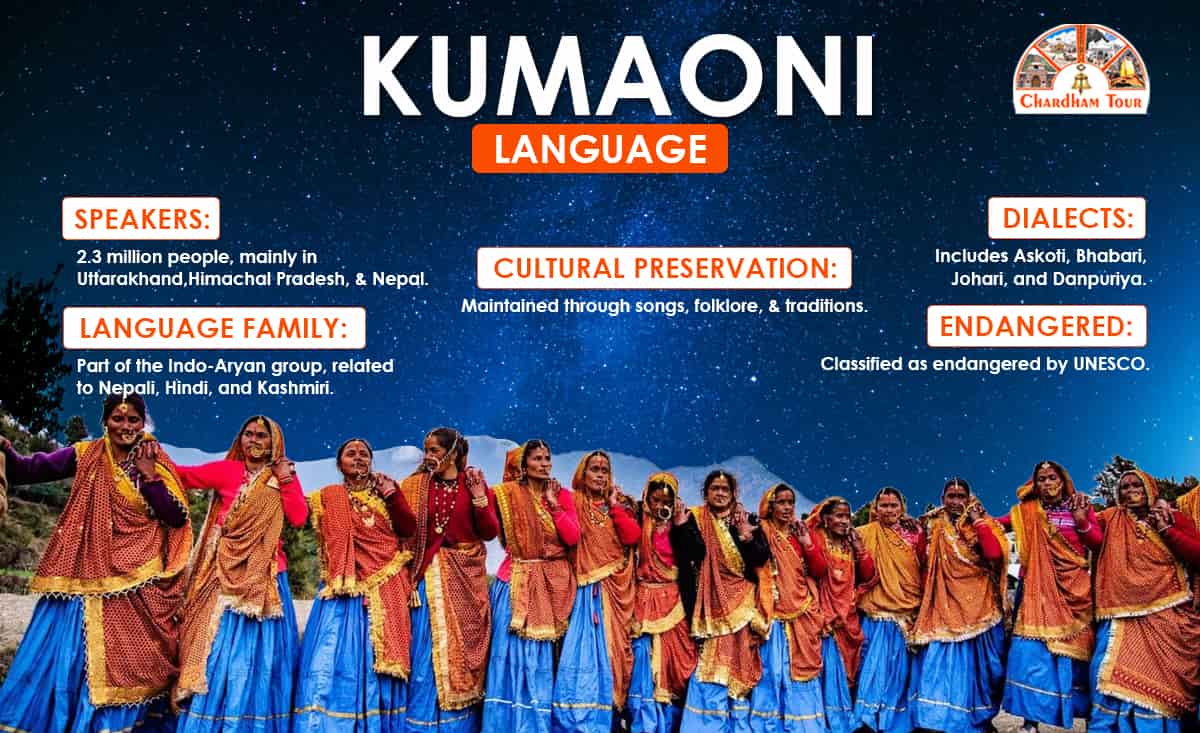
George Grierson’s Linguistic Survey of India recorded close to a dozen Kumaoni dialects over a century ago, and most of the same divisions are still in use by linguists today, though the exact list shifts a little from one source to the next:
- Central Kumaoni — Almora and northern Nainital
- Johari — Munsiyari and the Johar valley
- Askoti — Askot
- Bhabhri — Haldwani, Ramnagar
- Danpuriya — Danpur, Bageshwar, Kapkot
- Gangoli — Berinag, Gangolihat
- Khasparjiya — around Almora town
- Kumaiyya — Champawat
- Pachhai — Ranikhet, Dwarahat
- Phaldakotiya — Phaldakot
- Rau-Chaubhainsi — Nainital
- Sirali / Soryali — Didihat and the Sor valley, Pithoragarh
These share grammar and core vocabulary, but the accent shift is real. Someone from Munsiyari and someone from Champawat can usually place each other’s home valley within a few sentences.
History of the Kumaoni Language
Kumaon is thought to trace back to “Kumu,” an old name for the area around Champawat, once the seat of the Chand dynasty. As Chand territory grew, the whole region took the Kumaon name, and the language spoken there followed suit. A second explanation ties the name to “Kurmanchal” — the mountain of Kurma, Vishnu’s tortoise incarnation. Both versions appear in historical writing on the region, and neither has fully displaced the other.
Linguistically, Kumaoni sits in the Central Pahari branch of Indo-Aryan. Uttarakhand government language material traces its development back to Shauraseni Apabhramsha, the same broad stream that fed into Rajasthani. Centuries of contact with Khasa, Kol, and Kirat communities in the hills — plus later borrowing from Sanskrit and Hindi — shaped the vocabulary further. The Chand-era revenue records of King Baj Bahadur Chand, dated to the 17th century, are among the oldest well-documented written sources for the language. Older inscriptions from the region exist too, but their dating is still debated, so it’s fairer to call the 17th-century records a solid historical milestone rather than the absolute starting point.
Kumaoni Grammar and Script
Kumaoni’s grammar tracks closely with Garhwali, and shares broader ground with Hindi, Gujarati, and Rajasthani. One specific detail worth knowing: the verb “to be” builds off the root ach, a feature Kumaoni shares with certain Rajasthani constructions. Where Kumaoni and Garhwali grammar pull apart, linguists usually point to the influence of Khasa, an extinct language once spoken by the region’s earliest known inhabitants.
Kumaoni is written in Devanagari today — the same script used for Hindi and Sanskrit. Before that, parts of the region used scripts related to the Takri family, once common across the western Himalayas. That older script isn’t in everyday use anymore. Whatever gets published in Kumaoni now — books, newspapers, social posts — runs in Devanagari.
Where Kumaoni Stands Today
UNESCO’s Atlas of the World’s Languages in Danger classifies Kumaoni as vulnerable. In UNESCO’s own framework, that specific category means most children in the community still grow up speaking it, but its use outside the home is shrinking — pushed out by Hindi in schools, government offices, and increasingly in the cities where Kumaoni families move for work. Kumaoni has more speakers than several languages that already sit in the Eighth Schedule of the Constitution. It still isn’t in the Schedule itself. Activists and state legislators have pushed for its inclusion for years, without movement so far.
What actually happened at the state level in 2010 is more specific than it usually gets described: the Uttarakhand government set up the Uttarakhand Bhasha Sansthan that year, tasked with research, standardisation, and preservation work for the state’s regional languages, Kumaoni included. That’s not the same as making Kumaoni an official language of the state — Hindi still runs Uttarakhand’s official business, with Sanskrit as the second official language. The Bhasha Sansthan’s more recent work includes digitising Kumaoni and Garhwali folk literature and building a linguistic map of the state. Some government schools in Kumaon now open assembly with a few lines in Kumaoni alongside Hindi. Local bodies such as the Kumaon Sahitya Sabha keep backing Kumaoni writers and cultural events on the ground.
Kumaoni Holi
Nowhere does Kumaoni show up louder than in its Holi season, and this is the part of the culture most visitors actually encounter. It isn’t a single day — the singing starts around Basant Panchami and runs for weeks, across three distinct forms:
- Baithki Holi — men gather seated, in temples or homes, singing classical raga-based songs. Sometimes called Nirvan ki Holi.
- Khari Holi — standing, dancing, dhol and hurka driving the rhythm. Louder and faster than Baithki.
- Mahila Holi — women’s Holi songs, built around devotion, family, and stories from Krishna’s life.
Local tradition ties the roots of this back to the Chand court at Champawat, where classical music brought in from the plains mixed with existing Kumaoni singing styles. Travel through Kumaon between January and March, and you’ll hear this before you read a single word of Kumaoni anywhere.
Kumaoni in Literature
Kumaoni’s own literary tradition runs through names like Lok Ratna Pant “Gumani,” Krishna Pandey, and Shiv Dutt Sati — writers who worked directly in the language — alongside a long oral tradition of folk songs and ballads such as Malushahi-Rajula.
A separate group belongs to writers of Kumaoni background who built their careers mainly in Hindi: Sumitra Nandan Pant, Shailesh Matiyani, Mrinal Pande. Their work carries Kumaoni sensibility in places, but calling them Kumaoni-language writers overstates it — worth knowing the distinction if you’re citing either group.
Difference Between Kumaoni and Garhwali
Outsiders lump Kumaoni and Garhwali together constantly, and it mildly irritates people from either region. The two share a family tree — both Central Pahari, both Indo-Aryan — but the gap shows up fast once you’re actually listening: accent, everyday vocabulary, and how shared-root words get pronounced. Beyond that broad description, the honest answer is that the differences run word by word and phrase by phrase, which makes them better explored with someone who actually speaks both languages than flattened into one tidy comparison.
In Short
Kumaoni carries a few centuries of Kumaon’s history in it — Chand-era records, a script that’s mostly disappeared, Holi ragas still sung every spring. It hasn’t made it into the Eighth Schedule, and there’s no sign that it will soon. But with over two million speakers counted in the last census, and active preservation work underway at the state level, it isn’t fading quietly either. Travelling through Almora, Nainital, or Pithoragarh and catching a Holi gathering in season — or picking up a handful of Kumaoni words — tells you more about the region than most itineraries manage.
FAQs
How many people speak Kumaoni today?
The 2011 Census counted 2,081,057 Kumaoni speakers across India. Over 1.98 million of them live within the Kumaon division of Uttarakhand itself. No newer official count has been published since.
Is Kumaoni a language or a dialect?
Linguists treat Kumaoni as a distinct Indo-Aryan language in the Central Pahari group, not a dialect of Hindi — though it holds no official constitutional status.
Is Kumaoni an endangered language?
UNESCO’s Atlas of the World’s Languages in Danger lists it as vulnerable, meaning most children in the community still learn it, but daily use outside the home is shrinking.
What script is Kumaoni written in?
Devanagari, same as Hindi and Sanskrit. Parts of the region used Takri-related scripts before that, but they’ve fallen out of everyday use.
Is Kumaoni included in the Eighth Schedule of the Constitution?
No. Kumaoni and Garhwali have both been proposed for inclusion, but neither has made it in. The Uttarakhand government did set up the Uttarakhand Bhasha Sansthan in 2010 to research and preserve the state’s regional languages — that’s a preservation body, not official recognition.
What is the difference between Kumaoni and Garhwali?
Both are Central Pahari languages with a shared Indo-Aryan root, but they differ in accent, everyday vocabulary, and pronunciation. The gap is real enough that locals from either region notice it instantly.
What are the main dialects of Kumaoni?
Commonly cited varieties include Central Kumaoni, Johari, Askoti, Bhabhri, Danpuriya, Gangoli, Khasparjiya, Kumaiyya, Pachhai, Phaldakotiya, Rau-Chaubhainsi, and Sirali/Soryali. The exact grouping varies by source.
What is Kumaoni Holi?
A weeks-long musical Holi tradition unique to Kumaon, performed in three forms — Baithki Holi (seated, classical), Khari Holi (standing, energetic), and Mahila Holi (women’s songs) — starting around Basant Panchami.
Which language family does Kumaoni belong to?
Indo-Aryan, Central Pahari branch, closest to Garhwali.
Who wrote in Kumaoni, and who’s just from Kumaon?
Lok Ratna Pant “Gumani,” Krishna Pandey, and Shiv Dutt Sati wrote directly in Kumaoni. Sumitra Nandan Pant, Shailesh Matiyani, and Mrinal Pande are of Kumaoni background but are known mainly for their Hindi writing.
Where is Kumaoni spoken outside India?
In Nepal’s Sudurpashchim Province, where related speech varieties are also referred to by local names that differ from region to region.
Can Kumaoni speakers understand Garhwali, or the other way round?
Partially. Shared Indo-Aryan roots and Central Pahari grammar give some mutual intelligibility, but vocabulary and pronunciation differ enough that full fluency in one doesn’t carry over automatically.

Related Posts

Sayanachatti to Yamunotri Guide

Dharchula: Gateway to Adi Kailash, Om Parvat & Kailash Mansarovar