Every second caller on our desk asks: “Adi Kailash aur Kailash Mansarovar mein farak kya hai?” Fair question — both names sound alike and both honour Lord Shiva. Adi Kailash vs Kailash Mansarovar are two very different journeys: one a short trip inside India, the other a longer pilgrimage into Tibet, also called Kailash Parikrama.
Quick Answer:
- Adi Kailash: 7–9 days in Uttarakhand; only an Inner Line Permit required.
Kailash Mansarovar: 15–24 days in Tibet; requires Chinese permits/MEA selection and is much more expensive.
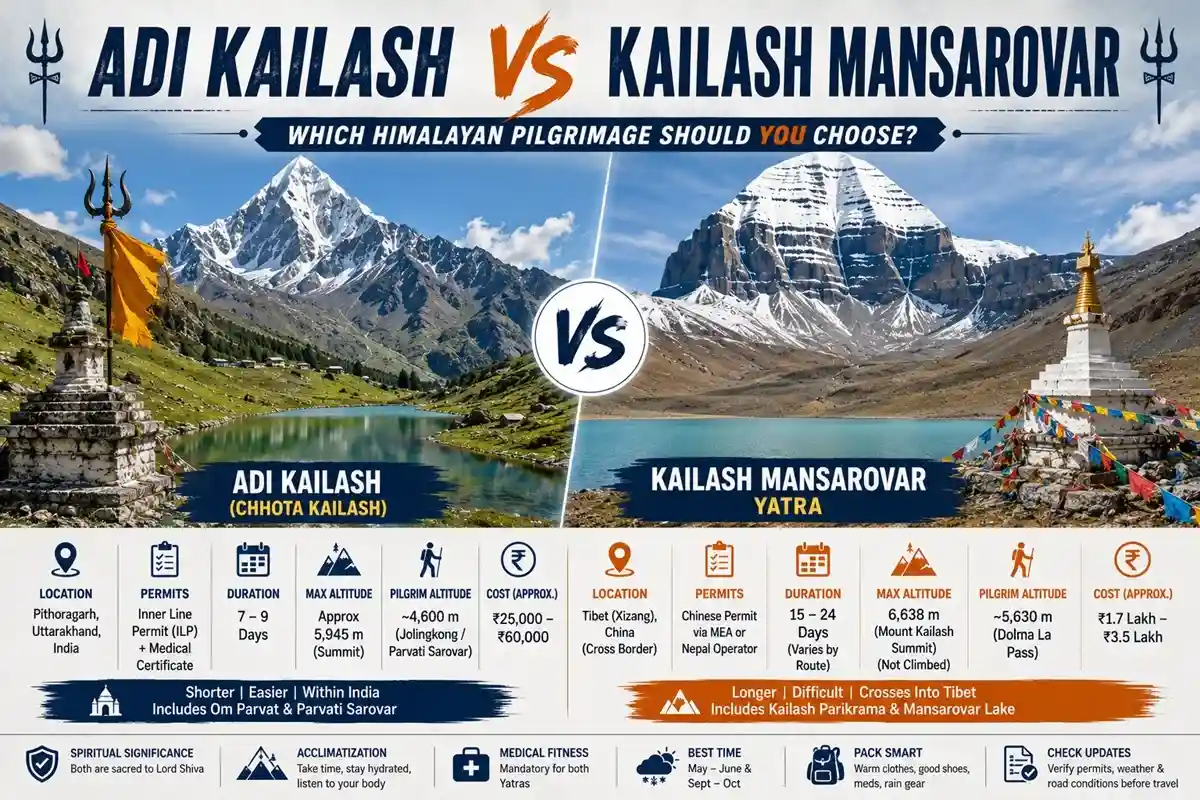
Adi Kailash vs Kailash Mansarovar: Key Differences at a Glance
| Factor | Adi Kailash (Chhota Kailash) | Kailash Mansarovar Yatra |
| Location | Pithoragarh, Uttarakhand | Tibet (Xizang), China |
| Documents | ILP + medical certificate | Chinese permit via MEA or Nepal operator |
| Duration | 7-9 days | 15-24 days, varies by route |
| Cost (indicative) | ₹25,000-₹60,000 | ₹1.7 lakh-₹3.5 lakh |
| Peak height | Approx 5,945 m | 6,638 m (not climbed) |
| Pilgrim altitude reached | ~4,600 m (Jolingkong/Parvati Sarovar) | ~5,630 m (Dolma La pass) |
| Difficulty | Easy to Moderate | High |
What Is Adi Kailash
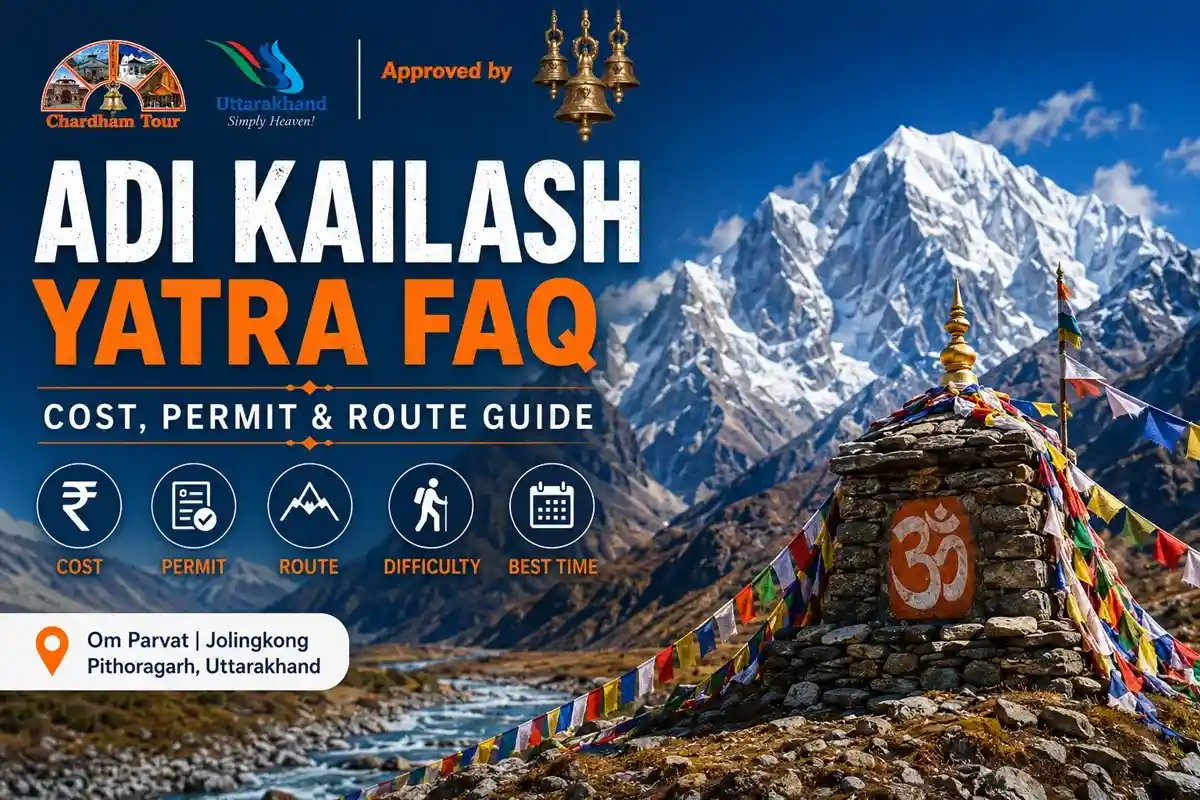
Adi Kailash, also called Chhota Kailash or Baba Kailash, is one of the Panch Kailash and holds its own religious significance, not just a smaller substitute for Mount Kailash. It sits near Kuti village in Dharchula, entirely inside India — no border crossing needed. Most pilgrims combine it with Om Parvat darshan and Parvati Sarovar at its base.
What Is Kailash Mansarovar Yatra
This is the original pilgrimage to Mount Kailash and Lake Mansarovar inside Tibet, near Purang (Taklakot). After a five-year pause, it resumed for the 2026 season under bilateral India-China agreements, with batches travelling via Lipulekh and Nathu La passes, coordinated by the MEA and the Chinese government. The Kailash Parikrama on foot, crossing the high Dolma La pass, is the toughest and most spiritually significant part.
Peak Height vs Pilgrim Altitude — Don’t Confuse the Two
This is where many guides go wrong. Adi Kailash’s summit stands around 5,945 m, but pilgrims never climb it — the real destination, Jolingkong/Parvati Sarovar, sits at roughly 4,600 m. Lake Mansarovar itself is around 4,590 m, while Dolma La pass climbs to about 5,630 m, the highest point most Mansarovar pilgrims reach.
Route and Distance Chart
| Leg | Adi Kailash | Kailash Mansarovar |
| Delhi–Kathgodam | ~280 km | ~280 km |
| Kathgodam–Dharchula | ~300 km, 10-12 hr | ~300 km, 10-12 hr |
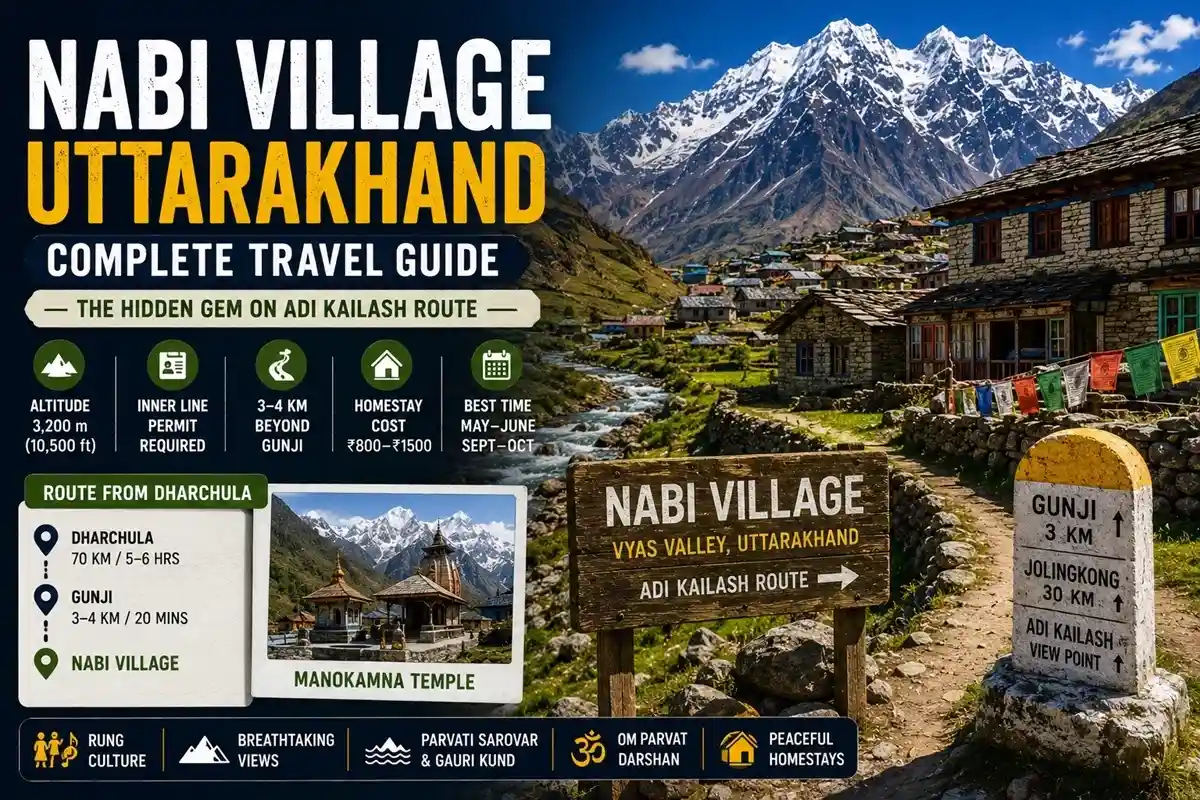
| Dharchula–base | ~100-130 km via Gunji, Nabi, Jolingkong (4×4 only) | Lipulekh Pass–Taklakot, or Nathu La (Sikkim), or Nepal route |
| Total from Delhi | ~620 km one way | Varies by route |
Road conditions near Gunji stay unpredictable in monsoon — local drivers recommend a buffer day at Dharchula.
Weather Information
Adi Kailash sees pleasant days (10-15°C) and near-freezing nights in May-June and September-October. Kailash Mansarovar’s Tibetan plateau stays colder and drier — highs rarely cross 15°C, nights near the lake drop below freezing even in summer. Both regions turn risky in July-August monsoon.
Latest 2026 Season Updates
Treat these as indicative, not fixed:
- MEA has organised roughly 20 batches of 50 pilgrims for Mansarovar 2026 via Lipulekh and Nathu La; numbers are confirmed annually.
- Pithoragarh district has repeatedly suspended fresh ILP issuance this monsoon, along with pausing the Adi Kailash Yatra, due to landslide risk.
- Online pre-registration is typically available on the Uttarakhand tourist portal when functional — confirm with SDM Dharchula before travel.
Permits, Registration and Documents
Adi Kailash needs an ILP from SDM Dharchula plus a medical fitness certificate with basic pulse and BP checks. Indian citizens don’t need a passport.
Kailash Mansarovar selection runs through a computerised MEA process, with route preference (Lipulekh, Nathu La, or both) chosen at registration. Nepal-route operators handle Chinese visa and Tibet permit paperwork separately.
Cost Breakdown (Indicative)
Standard Adi Kailash packages cost approximately ₹25,000-₹60,000, covering ILP, transport, stay and meals. Helicopter packages cost roughly ₹70,000-₹1.35 lakh. Kailash Mansarovar costs about ₹1.7 lakh-₹3.5 lakh, inclusive of visa, permit, transport and lodging. Pricing varies by operator and season.
Check out:
Hotel and Accommodation Details
Adi Kailash pilgrims typically stay in KMVN guesthouses (like the Gunji facility), Nabi homestays, or basic dharamshalas — dormitory-style at the budget end. On the Mansarovar side, the Tibet Tourism Bureau arranges guesthouses near Taklakot, with tented camps during parikrama.
Transport Options
Adi Kailash is reached by shared jeep, tempo traveller or private 4×4 from Dharchula, plus a seasonal helicopter option from Pithoragarh, weather permitting. Kailash Mansarovar transport is group-wise inside Tibet — fixed convoy timings pilgrims cannot alter individually.
Packing List
- Heavy woollens, thermal layers, windproof jacket (needed even in June)
- Sturdy trekking shoes, sunglasses, sunscreen, lip balm
- Personal medicines, Diamox (only on doctor’s advice), ORS
- Torch, power bank, cash (ATMs stop past Dharchula)
- Copies of ILP, ID proof, medical certificate
Difficulty, Altitude Sickness and Senior Citizen Tips
Adi Kailash is now largely vehicle-based, with trekking limited to roughly 2-5 km near Nabhidang and Jolingkong. Most fit seniors above 55 manage it after a basic check. Kailash Mansarovar is tougher — Dolma La above 5,600 m and long walks make it unsuitable for heart, lung or joint issues.
AMS (Acute Mountain Sickness) is a real risk above 3,500 m on both routes — watch for headache, nausea or breathlessness, and descend if symptoms worsen.
Best Time to Visit
May-June and mid-September to October suit both yatras — roads are clearer and weather stays stable. Avoid July-August, when landslides shut the Dharchula-Gunji stretch most often and ILP issuance can pause.
Local Warnings and Safety Tips
- Mobile network and ATM access disappear past Dharchula — carry cash.
- Don’t skip acclimatisation; AMS is the most common reason pilgrims turn back.
- Keep ILP, ID and medical certificate copies handy at ITBP/BRO checkpoints.
- BRO maintains roads near Gunji; clearance depends on weather.
Which One Should You Choose
It comes down to time, budget and body. Choose Adi Kailash for a week-long trip, moderate budget, and a genuine Himalayan pilgrimage without the visa process. Choose Kailash Mansarovar if the original Mount Kailash darshan matters spiritually and you can commit three weeks and a bigger budget.
Booking early is recommended for Mansarovar since MEA slots fill fast. Families usually choose Adi Kailash first, as a taster before Mansarovar.
Key Takeaways
- Adi Kailash = shorter, cheaper, fully within India, ILP only, vehicle-based.
- Kailash Mansarovar = the original Tibet pilgrimage, costlier, tougher, needs Chinese permit.
- Pilgrims don’t climb either peak — Adi Kailash viewed from ~4,600 m; Dolma La tops out near 5,630 m.
- Adi Kailash ILP has faced repeated monsoon-linked suspensions — verify status before travel.
- Best months for both: May-June and September-October.
Conclusion
At the end of the day, Adi Kailash vs Kailash Mansarovar isn’t a competition — it’s about matching the yatra to your time, budget and body. Adi Kailash offers an accessible Shiva Kailash pilgrimage within India; Kailash Mansarovar remains the once-in-a-lifetime darshan for the longer Tibet journey. Whichever Kailash Yatra you pick, book early and travel in the May-June or September-October window.
FAQs
- Is Adi Kailash the same as Kailash Mansarovar?
No — Adi Kailash is in Uttarakhand, India; Kailash Mansarovar is in Tibet, China. - What is the difference between Adi Kailash and Kailash Mansarovar?
Adi Kailash needs only an ILP and 7-9 days; Kailash Mansarovar needs a Chinese permit and 15-24 days. - Which Kailash Yatra is easier, Adi Kailash or Kailash Mansarovar?
Adi Kailash is easier — mostly vehicle-based. Kailash Mansarovar involves long walks above 5,000 m. - Do I need a passport for Adi Kailash Yatra?
No, Indian citizens only need an Inner Line Permit and a medical certificate. - Is Kailash Mansarovar Yatra open in 2026?
Yes, it resumed for 2026 after a five-year gap, via Lipulekh and Nathu La passes. - What is the Adi Kailash Yatra cost in 2026?
Roughly ₹25,000-₹60,000 for standard packages; ₹70,000-₹1.35 lakh by helicopter. - Adi Kailash helicopter vs road — which is better?
Helicopter saves time and suits seniors; road travel is cheaper and shows more of the route. - Can senior citizens do the Adi Kailash Yatra?
Yes, most fit seniors manage it well with a basic medical check. - Is the Adi Kailash Yatra currently open?
Depends on the season — monsoon often brings temporary ILP suspensions, so confirm with SDM Dharchula. - Can foreigners visit Adi Kailash?
Foreign nationals need special permission beyond the standard ILP, since it’s a restricted border zone. - What is the best time for Adi Kailash and Kailash Mansarovar yatra?
May-June and mid-September to October, when roads are clearer and landslide risk is lowest. - Can I do both Adi Kailash and Kailash Mansarovar in one trip?
Not practically — separate permits and routes mean most pilgrims plan them as two trips.