Badrinath Dham sits amid the Nar and Narayan mountain ranges, and its challenging geography is exactly why a bit of planning goes a long way. This guide walks through what you actually need to know — dates, weather, how to get there, where to stay, and what to eat — with the numbers cross-checked rather than copied from wherever they first appeared online.
About Badrinath — Abode of Lord Vishnu
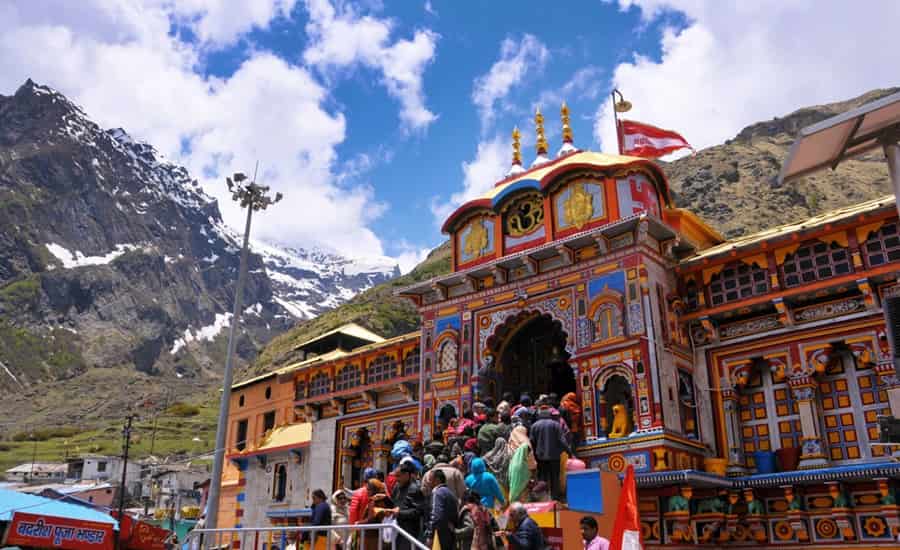
Nestled in the Chamoli district of Uttarakhand, between the Nar and Narayan mountain ranges, Badrinath Dham (also called Badri Vishal) is one of the holiest Hindu pilgrimage sites and one of the four Char Dhams. The town sits at an elevation of roughly 3,100–3,133 m (sources vary slightly on the exact figure), on the banks of the Alaknanda River.

Quick Facts: Badrinath Yatra 2026
| Detail | Information |
|---|---|
| Location | Chamoli District, Uttarakhand |
| Presiding Deity | Lord Vishnu (Badri Narayan) |
| Elevation | ~3,100–3,133 m |
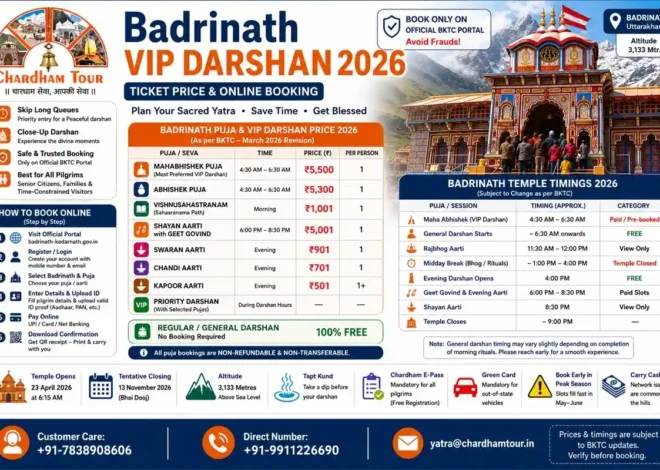
| Opening Date 2026 | 23 April 2026, ~6:15 AM (confirmed by BKTC on Basant Panchami) |
| Closing Date 2026 | Tentatively ~13 November 2026, confirmed on Vijayadashami |
| Best Months to Visit | Mid-May to mid-June, mid-September to late October |
| Season Length | Roughly 6 months; closed the rest of the year for snow |
Important Things to Know Before Planning Badrinath Yatra 2026
- Registration is mandatory as per the current Uttarakhand Government advisory. A free Char Dham e-pass via registrationandtouristcare.uk.gov.in is required before travelling — this is separate from any hotel or transport booking, and rules have shifted before, so check the portal for the current process rather than assuming this stays fixed indefinitely.
- The temple is only open ~6 months a year. Outside the April–November window, the road is snowbound and the deity’s worship shifts to the Narsimha Temple in Joshimath.
- Exact dates shift every year. They’re calculated on the Hindu Panchang and announced on Basant Panchami (opening) and Vijayadashami (closing) — don’t assume last year’s dates apply.
Weather and Best Time to Visit
Badrinath’s weather swings hard across the season, so timing matters as much as anything else in your planning.
- Summer (May–June): Pleasant and the most crowded window — good for sightseeing and darshan, but book accommodation early.
- Winter (December–March): The road is inaccessible due to heavy snowfall; the temple itself is closed during this period.
- Monsoon (July–September): Heavy rainfall brings a real risk of landslides, flooding, and road closures. Most guides, including this one, recommend avoiding this window unless necessary.
- Post-monsoon (September–October): Thinner crowds, generally good weather, and a nice window to actually take in the surroundings rather than just queue for darshan.
Note that the temple typically stays open into mid-November even though the most pleasant weather window is narrower (May–June and September–October) — a November visit is possible, but expect cold mornings.
How to Reach Badrinath Dham
- By Road: Well-connected from Haridwar and Rishikesh, with regular buses. The road trip typically takes 10–12 hours, sometimes stretching to 14 in peak-season traffic.
- By Rail: Rishikesh and Haridwar are the nearest railway stations; from there, continue by bus, cab, or taxi.
- By Air: Jolly Grant Airport in Dehradun is the nearest commercial airport — Badrinath has no commercial airport of its own, though helicopter access is available separately (see below).
For full distances, route maps, and the Joshimath gate system, see our complete How to Reach Badrinath guide.
Helicopter Service for Badrinath Yatra
If you want to save time and skip the long mountain drive, helicopter travel is an option — but it works differently here than at Kedarnath. Kedarnath has a subsidised government shuttle service (booked via IRCTC’s official heliyatra.irctc.co.in portal, flying from Phata, Sersi, or Guptkashi). Badrinath does not have an equivalent shuttle system. Helicopter access to Badrinath is generally arranged through private charter packages, typically flying from Sahastradhara helipad in Dehradun to the Badrinath helipad (about 1 km from the temple). Book these through a registered tour operator, and always confirm your Char Dham e-pass registration is in place first, since it’s required regardless of how you travel.
Route for Badrinath Dham
Here’s the shape of the journey:
- Most pilgrims start from Haridwar or Rishikesh, the twin gateways to the Char Dham region.
- En route, you’ll pass through Devprayag, Rudraprayag, Karnaprayag, Nandprayag, and Joshimath — the last major town before Badrinath.
- From Joshimath, the final ~45 km stretch to Badrinath runs through a narrow, regulated one-way section of road — budget extra time for this leg, especially in peak season.
Things to Do In and Around Badrinath
- Badrinath Temple: The main draw — attend darshan and, if you can, one of the aartis.
- Tapt Kund: A hot-water spring right by the temple; many pilgrims bathe here before darshan.
- Mana Village: About 3–4 km away, often called India’s last village before the Tibet border — home to Vyas Gufa and Bheem Pul.
- Vasudhara Falls: A scenic waterfall about 6 km trek from Mana Village (roughly 2–3 hours one way), dropping from a height of approximately 122 m (400 ft). No food or water stalls en route, so carry your own.
- Hemkund Sahib: A revered Sikh shrine — but note this isn’t a casual add-on to a Badrinath trip. It’s reached via roughly a 19 km trek from Govindghat (13 km to Ghangaria, then a steep 6 km climb to the shrine), and typically needs its own dedicated day or two, usually with an overnight stop at Ghangaria. Govindghat itself sits on the route between Joshimath and Badrinath. Only plan this in if you’re building it into your itinerary deliberately.
Best Places to Stay in Badrinath
- New Hotel Snow Crest: Spacious rooms, 24-hour front desk, free Wi-Fi — good for basic comfort near the temple.
- Hotel Sarovar Portico: About 300 m from the temple, with rooms offering Himalayan views and help arranging temple darshan.
- Badri Vishal Guest House: Centrally located in Badrinath town, with friendly staff and basic facilities.
- Hotel Panchvati Inn: Clean rooms near the town’s key spots, with all basic facilities covered.
Facility details like Wi-Fi and specific amenities can change season to season — confirm directly with the hotel or check the site’s live Badrinath Hotels listing before booking. May–June is usually the busiest period, so earlier booking is generally advisable.
What to Eat in Badrinath
Food options in Badrinath are vegetarian, in keeping with the town’s spiritual character. Most dishes here are part of broader Garhwali and Kumaoni regional cuisine rather than being unique to Badrinath specifically.
- Phanu: A wholesome lentil soup made from lentils soaked overnight.
- Aloo Ke Gutke: A Kumaoni-style potato dish tossed in local Himalayan herbs and spices.
- Kafuli: A thick, spiced gravy made from spinach or fenugreek leaves, served with rice.
- Temple Prasad: Typically khichdi (rice and lentils), offered after darshan — sacred rather than a “dish to try,” but part of the experience nonetheless.
Travel Tips
- Dress modestly out of respect for the sacred setting.
- Pack warm clothing regardless of when you visit — temperatures drop fast at this altitude, even outside winter.
- Carry your own food and water for the road; eating options are limited along stretches of the route.
- Avoid littering or damaging the surroundings — this is an ecologically sensitive Himalayan zone.
- Register for your Char Dham e-pass well before you travel, not after you’ve already reached Haridwar.
Common Mistakes to Avoid
- Assuming last year’s opening/closing dates apply. They’re recalculated annually on the Hindu Panchang.
- Booking Badrinath helicopter tickets on the Kedarnath IRCTC shuttle portal. That system doesn’t cover Badrinath — go through a registered operator instead.
- Treating Hemkund Sahib as a quick side trip. It needs its own trek and time; don’t squeeze it in as an afterthought.
- Skipping e-pass registration until arrival. Slots get tight in May–June — register early.
Final Words
Planning a Badrinath Yatra comes down to a few things that actually matter: knowing the real opening and closing dates for the year you’re travelling, respecting the seasonal weather windows, and not conflating Badrinath’s travel logistics with Kedarnath’s (especially around helicopter booking). Get those right, and the rest — where to stay, what to eat, what to see nearby — is the enjoyable part of the planning.
FAQs
Q1. When does Badrinath Temple open in 2026?
23 April 2026, at approximately 6:15 AM, as confirmed by BKTC on Basant Panchami.
Q2. When does Badrinath Temple close in 2026?
Tentatively around 13 November 2026 — the official date is confirmed on Vijayadashami, closer to the date.
Q3. Can I book a Badrinath helicopter ticket on the same IRCTC portal as Kedarnath?
No. heliyatra.irctc.co.in is the official Kedarnath shuttle booking portal. Badrinath helicopter travel is generally arranged through private charter operators, not this government shuttle system.
Q4. Is Hemkund Sahib close to Badrinath?
Not directly — it’s reached via a roughly 19 km trek from Govindghat (13 km to Ghangaria, then 6 km up to the shrine). Plan it as a separate leg of your trip, not a quick add-on.
Q5. What is the best time to visit Badrinath?
Mid-May to mid-June, or mid-September to late October, for the best combination of weather and manageable crowds.
Q6. Is registration mandatory for Badrinath Yatra?
Yes — a free Char Dham e-pass via registrationandtouristcare.uk.gov.in is mandatory for every pilgrim, regardless of travel mode.