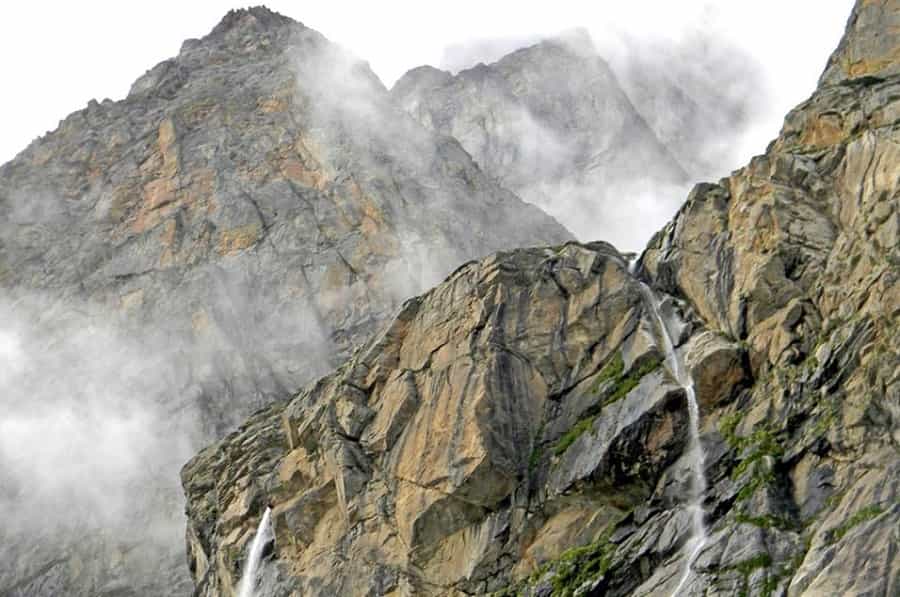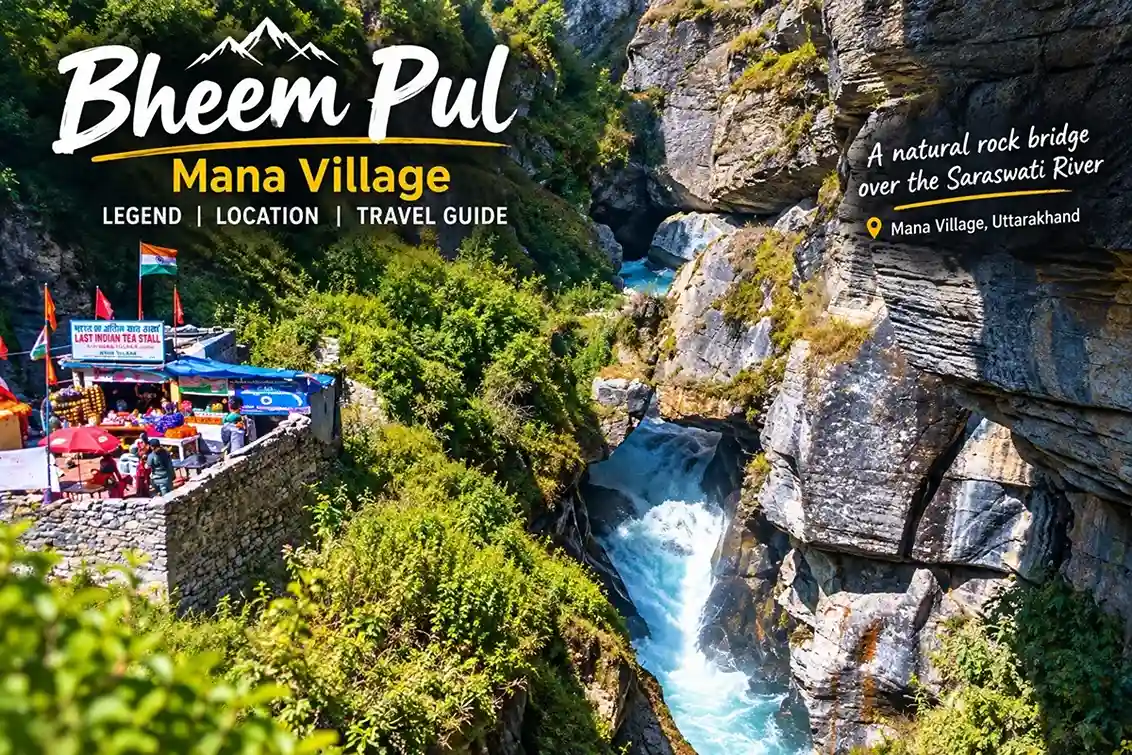
A large natural rock spans the Saraswati River in Mana Village, just past Badrinath. It’s known locally as Bheem Pul, and Incredible India’s own description calls it a natural rock bridge over the Saraswati — the physical fact is straightforward even though the story behind it isn’t something anyone can verify.
Quick Answer: Bheem Pul is a natural rock bridge over the Saraswati River in Mana Village, about 3 km from Badrinath Temple in Chamoli district. Local Hindu tradition holds that Bhima placed the rock so Draupadi could cross the river during the Pandavas’ final journey toward the Himalayas — that’s the legend, not a documented historical event. Access follows Badrinath’s pilgrimage season, and BKTC recommends May, June, September, and October as the best months to visit.
The Legend Behind the Name
According to local Mahabharata tradition, the five Pandava brothers and Draupadi were making their final journey through the Himalayas when they reached the Saraswati at Mana. The brothers crossed without trouble, but Draupadi couldn’t manage it. Bhima, the story goes, threw a massive boulder across the river so she could cross. That’s the legend attached to the rock pilgrims now visit — worth stating plainly as legend rather than history, since that’s exactly how Incredible India frames it too.
Mana carries other layered mythology beyond this one story. Local tradition also places Ved Vyasa’s composition of the Mahabharata nearby, dictated to Lord Ganesha — a separate tale tied to Vyas Cave in the same village.
Where Bheem Pul Is Located
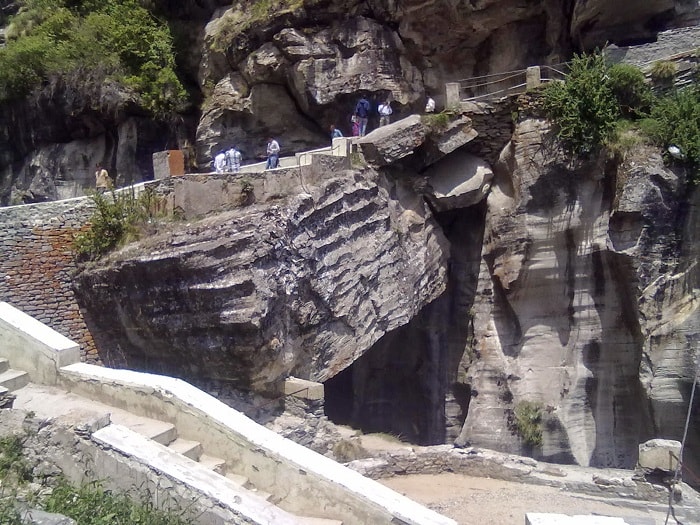
Bheem Pul sits inside Mana Village, roughly 3 km from Badrinath Temple — a figure BKTC states directly, alongside a travel time of about 30 minutes. The walking route from Badrinath runs via NH-7 (the highway once numbered NH-58), passing Vyas Gufa before reaching the boulder at the village’s far end. The Saraswati rushes under the rock with real force before eventually joining the Alaknanda downstream; the Chamoli district administration places that confluence roughly 9 km downstream from Mana.
There’s a well-known tea stall near the site that’s promoted locally as the “last Indian tea stall” — a popular photo stop, though treat that as tourism branding rather than a literal geographic claim.
Places to Visit Near Bheem Pul
Mana Village: Commonly described as India’s last village near the Indo-Tibetan border, though it’s also promoted in some government tourism messaging as a “first village.” It sits at roughly 3,219 metres — that’s Mana’s altitude, not a separate elevation for Bheem Pul itself, which is a distinction worth getting right if you’re comparing figures across sites.
Brahma Kapal: Commonly listed at around 2 km from Badrinath on the banks of the Alaknanda, though official listings vary slightly by reference point. This is the site associated with ancestral rites (Shradh) at Badrinath.
Vyas Cave and Ganesh Gufa: Another major attraction in Mana Village, typically visited alongside Bheem Pul rather than as a separate trip. Some accounts describe Vyas Gufa and a nearby Ganesh Gufa as two distinct caves; others treat them as one site. Local tradition places Ved Vyasa’s dictation of the Mahabharata to Lord Ganesha here.
Alaknanda’s source: The Alaknanda originates from the Bhagirath Kharak and Satopanth glacier system near Badrinath — not the Gaumukh Glacier, which is a separate glacier near Gangotri feeding an entirely different river.
Best Time to Visit Bheem Pul
BKTC lists May, June, September, and October as the best months for Bheem Pul specifically, and Uttarakhand Tourism gives the same window for Mana. Weather and road conditions in the Himalayas can still shift quickly even within these months, so treat this as a strong recommendation rather than a guarantee. July and August bring heavier monsoon rainfall and a real risk of landslides on the route — check current road conditions before travelling rather than assuming the route is clear. Access to Mana and Bheem Pul is generally tied to Badrinath’s pilgrimage season, and winter snowfall can make the route difficult or unavailable — check locally rather than assuming a fixed closing date.
How to Reach Bheem Pul
- By Air: Jolly Grant Airport, Dehradun, is the nearest airport. BKTC’s own listings put this anywhere from 290 to 300 km depending on the destination point used, so treat any single number you see elsewhere with some caution.
- By Rail: Rishikesh is the nearest major railhead. BKTC lists it at around 274 km from Badrinath — a lower figure than some general travel sites suggest, so this is worth checking against your specific route.
- By Road: Buses run from ISBT Kashmiri Gate, Delhi, to Haridwar and Rishikesh; from there, connect by bus or taxi to Badrinath via NH-7. Mana Village is about 3 km beyond Badrinath, reachable by local taxi or on foot.
Safety Tips
- The Saraswati is a fast-flowing mountain river — stay well back from the edge and don’t attempt to enter the water.
- Stone paths around Mana Village are uneven; proper footwear matters more here than at most stops on the Badrinath circuit.
- Altitude here is above 3,200 metres, so visitors with mobility concerns should build in extra time.
- Carry warm layers even in summer, since temperatures drop fast after sunset.
FAQs About Bheem Pul
What is Bheem Pul famous for?
A natural rock bridge over the Saraswati River, tied to a local legend that Bhima placed it so Draupadi could cross during the Pandavas’ journey to the Himalayas.
Where is Bheem Pul located?
In Mana Village, Chamoli district, about 3 km from Badrinath Temple.
What is the altitude of Bheem Pul?
Mana Village, where Bheem Pul is located, sits at roughly 3,219 metres. Official sources give this as Mana’s elevation rather than a separate figure for the bridge itself.
Did Bhima actually build Bheem Pul?
That’s local tradition, not a documented historical event. The rock’s origin is natural; the Bhima connection is legend passed down through local and Mahabharata-linked storytelling.
Is Bheem Pul open all year?
No. Access generally follows Badrinath’s pilgrimage season, and winter snowfall can make the route difficult or unavailable — check current conditions before travelling.
What river flows under Bheem Pul?
The Saraswati River, which joins the Alaknanda downstream — the Chamoli district administration places that confluence about 9 km downstream from Mana.
What other places should I visit near Bheem Pul?
Vyas Cave, Ganesh Gufa, Brahma Kapal, and Mana Village itself are all commonly visited together.
Where do pilgrims perform ancestral rites near Badrinath?
At Brahma Kapal, on the banks of the Alaknanda near Badrinath.
What is the best time to visit Bheem Pul?
May, June, September, and October, per BKTC’s own recommendation — though mountain weather can still change quickly within that window.
How do I reach Mana Village from Delhi?
Travel to Rishikesh or Haridwar by road, rail, or flight to Jolly Grant Airport, then continue by road via Devprayag, Rudraprayag, and Joshimath to Badrinath, followed by a short local ride to Mana.
Final Word
Bheem Pul is a single rock over a river, but it sits inside one of the most story-dense stretches of the Badrinath circuit, a short walk from Vyas Cave and a short ride from Brahma Kapal. Keep the legend and the geography separate in your head — the bridge is real, the Bhima story is tradition — and plan around Badrinath’s open season rather than a fixed calendar date. If you’re visiting Badrinath as part of a Char Dham Yatra, Bheem Pul and Mana Village make an easy add-on stop; our Char Dham Yatra packages cover route planning and transport for this stretch.

Related Posts
Sayanachatti to Yamunotri Guide
Dharchula: Gateway to Adi Kailash, Om Parvat & Kailash Mansarovar