Last Updated on December 26, 2025
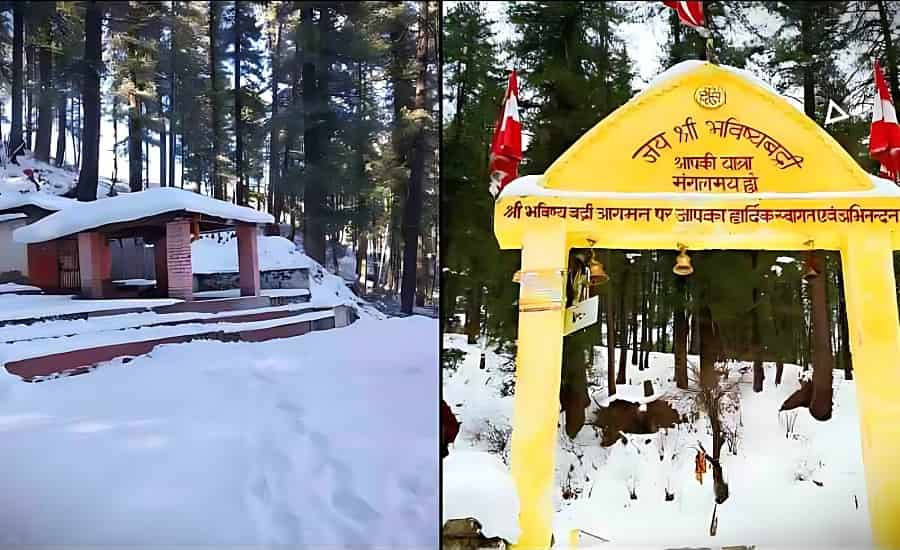
Bhavishya Badri Temple is one of the five sacred temples of Panch Badri, dedicated to Lord Vishnu, and is located in the Garhwal Himalayas of Uttarakhand. Situated near Subhain village, about 17 km from Joshimath, at an altitude of approximately 2,744 meters, Bhavishya Badri holds a unique prophetic importance in Hindu tradition.
According to ancient scriptures and regional belief systems preserved through Badri-Kedar religious traditions, Bhavishya Badri is believed to be the future seat of Lord Badrinath—the place where Lord Vishnu will be worshipped when access to present-day Badrinath becomes impossible in the advanced stage of Kali Yuga.
Key Facts About Bhavishya Badri
- Deity: Lord Vishnu (Narasimha form associated)
- Temple Group: Panch Badri
- Altitude: ~2,744 meters
- Location: Subhain Village, near Joshimath
- Distance from Joshimath: ~17 km
- Associated With: Adi Shankaracharya tradition
- Temple Timings: 05:00 AM – 09:00 PM
- Entry Fee: No entry fee
- Time Required: 45 minutes – 1 hour

Deity of Bhavishya Badri – Lord Vishnu
Bhavishya Badri is dedicated to Lord Vishnu, the preserver of the universe in Hindu theology. The temple enshrines a naturally manifested (swayambhu) idol of Vishnu emerging from a rock formation. This form is traditionally associated with Narasimha, one of Vishnu’s ten avatars.
Pilgrims believe that the idol is gradually growing in size, symbolizing the future manifestation of Vishnu at this site. While this belief is devotional in nature, it is consistently documented in regional religious literature and oral traditions of the Garhwal region.
Location & Natural Setting
Joshimath serves as the base for visiting Bhavishya Badri. From Joshimath, the route passes through Tapovan and Subhain Village, followed by a short trek of around 3 km.
The temple is set amidst:
-
Dense Cedar (Deodar) forests
-
A natural freshwater spring
-
Panoramic Himalayan terrain
The secluded location contributes to its reputation as a meditative and spiritually charged site, distinct from the busier Badrinath Temple.
Historical Background of Bhavishya Badri
The history of Bhavishya Badri is deeply rooted in Hindu eschatological beliefs and Adi Shankaracharya’s spiritual legacy.
According to traditional accounts:
-
Adi Shankaracharya, while reviving the worship of Badri Vishal (Badrinath), is believed to have received a divine revelation
-
The prophecy states that when the mountains of Nara and Narasimha close the route to present-day Badrinath, Lord Vishnu will manifest at Bhavishya Badri
-
This belief is closely linked to the Kali Yuga cycle described in Hindu cosmology
Another regional legend suggests that Lord Vishnu once left Tibet due to disorder and declared Bhavishya Badri as his future earthly abode.
These narratives are consistently referenced in Badri-Kedar Mahatmya texts and Uttarakhand’s religious heritage documentation.
Religious & Spiritual Significance
Bhavishya Badri occupies a unique position among the Panch Badri temples:
-
It represents the future phase of Vishnu worship
-
Closely connected with Narasimha Temple, Joshimath, where the deity’s form is believed to be gradually changing
-
The temple lies within the ancient Badri Van region, traditionally extending along the Alaknanda River valley
Devotees consider a visit to Bhavishya Badri as:
Best Time to Visit Bhavishya Badri
The most suitable time to visit Bhavishya Badri is:
✔ March to May
✔ September to November
✖ Avoid:
-
Monsoon (July–August): Landslides, slippery trails
-
Winter (December–February): Heavy snowfall, access issues
Things to Do at Bhavishya Badri
1. Spiritual Contemplation
The tranquil setting allows for prayer, meditation, and introspection.
2. Trek to Tapovan Route
The route offers stunning Himalayan landscapes and a peaceful trekking experience.
3. Observe the Swayambhu Idol
Devotees visit repeatedly to witness the natural rock-formed idol, believed to be evolving over time.
Dress Code & Temple Etiquette
-
Wear modest, respectful clothing
-
Traditional Indian attire is preferred
-
Footwear must be removed before entering the temple
-
Maintain silence and decorum
Festivals Celebrated at Bhavishya Badri
Krishna Janmashtami
Celebrates the birth of Lord Krishna, an incarnation of Vishnu. Special prayers and bhajans are performed.
Makar Sankranti
Marks the sun’s transition into Capricorn. The temple witnesses devotional gatherings and traditional rituals.
Nearby Attractions
Narsingh Temple
Closely linked to the prophecy associated with Bhavishya Badri.
Tapovan
Known for scenic beauty and spiritual retreats.
Places to Visit Near Bhavishya Badri
Food & Dining Options
How to Plan Your Trip
-
Check weather forecasts
-
Book accommodation in Joshimath
-
Carry medicines and trekking essentials
-
Maintain physical fitness for short treks
Hotels & Accommodation
How to Reach Bhavishya Badri
By Road
Travel to Joshimath via Rishikesh or Haridwar. Hire a taxi to Subhain Village, followed by a short trek.
By Rail
Nearest railheads:
By Air
Nearest airport:
FAQs
Q1. What is Bhavishya Badri Temple famous for?
Bhavishya Badri is famous as the prophesied future seat of Lord Badrinath, where Vishnu worship is believed to shift in the advanced stage of Kali Yuga.
Q2. Is Bhavishya Badri part of Panch Badri?
Yes, Bhavishya Badri is one of the five temples of Panch Badri in Uttarakhand.
Q3. How far is Bhavishya Badri from Joshimath?
Bhavishya Badri is located approximately 17 km from Joshimath, near Subhain Village.
Q4. Which deity is worshipped at Bhavishya Badri?
Lord Vishnu is worshipped at Bhavishya Badri, with symbolic association to the Narasimha avatar.
Q5. What is the best time to visit Bhavishya Badri?
The best time to visit is March to May and September to November, when weather conditions are favorable.
Q6. Is there any entry fee for Bhavishya Badri Temple?
No, there is no entry fee to visit Bhavishya Badri Temple.
Q7. Is trekking required to reach Bhavishya Badri?
Yes, a short trek of about 3 km from Subhain Village is required to reach the temple.
Q8. Can Bhavishya Badri be visited along with Badrinath?
Yes, Bhavishya Badri can be visited while staying in Joshimath, often as part of a Panch Badri or Badrinath itinerary.



 Call
Call Enquiry